Alaska National Park Machine Rules
Planning an ATV or UTV ride near an Alaska national park can get confusing fast: a state permit, a registration decal, or a route shown on a map does not automatically authorize travel on National Park Service land. The key is to identify the exact land and route, then confirm which motorized uses are allowed there before unloading your machine.
The basic rule: permission depends on the land and route
Alaska’s national parks are not one continuous riding area with one set of rules. Each park unit has its own boundaries, designations, management plan, and access rules. A route that crosses state land, federal land managed by another agency, private property, or a national park may be subject to different requirements within a short distance.
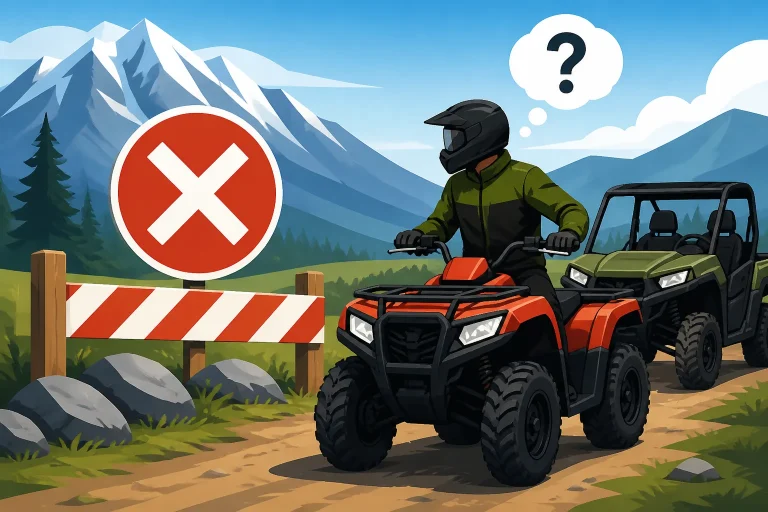
As a practical starting point, do not assume that an ATV or UTV can be ridden off road in a national park. On National Park Service land, off-road vehicle use is generally limited to routes or areas specifically open to that use. An existing track, old road, trailhead, or line on a phone map is not proof that public motorized travel is permitted there.
The National Park Service may also distinguish among different kinds of machines and uses. A wheeled ATV or UTV, a snowmachine, a vehicle used for subsistence, a machine accessing private property, and a vehicle used under an agency permit may not be treated the same way. An allowance for one kind of access does not necessarily authorize another.
| Situation | What to assume before riding |
|---|---|
| Wheeled ATV or UTV on NPS land | Use only a route or area confirmed as open to that machine and purpose |
| Snowmachine travel | Check the unit-specific rules, season, conditions, and any closure |
| Statewide Alaska land permit | It does not grant access to NPS land |
| Trail or road shown on a map | Verify land ownership and current motorized-use status |
| Private property inside or beside a park | Confirm access rights and any NPS rules that apply to the route |
| Commercial or organized riding | Check whether an agency authorization is required |
The distinction between a national park and a national preserve can matter, especially for hunting and associated access. It does not mean that every preserve is open to unrestricted ATV riding. Federal rules, unit-specific decisions, closures, land status, and the purpose of travel still matter.
A state registration or permit addresses only part of the picture. It may establish that the machine meets a state requirement, but it does not grant permission to cross federal land or ride a route the land manager has closed. For the boundary between state permits and federal land, see Does Alaska’s State Permit Cover Federal Land?. For a broader look at which agency may manage a parcel, see Alaska Land Managed by Other Agencies.
Rules differ for ATVs, UTVs, snowmachines, and special access
Wheeled ATVs and UTVs
For a wheeled ATV or UTV, the safest assumption is that riding is not allowed unless the National Park Service confirms the route or area is open to that type of vehicle. A route used by park staff, contractors, or local residents under a specific authorization may not be open to general recreational riding.
Do not treat a hiking trail, historic route, utility corridor, or service road as an ATV trail just because it is wide enough for a machine. Access can depend on the route’s official designation, the vehicle, the season, and the reason for travel. Conditions may also lead to temporary restrictions, even where some motorized use is normally allowed.
Snowmachines
Alaska has federal provisions that can allow snowmachine use for traditional activities and travel to and from villages or homes in certain circumstances. That is not a blanket recreational snowmachine permit. The applicable rules can depend on the park unit, the purpose of travel, snow and ground conditions, and whether the area has been closed or restricted.
A winter route does not automatically become a legal route for a wheeled ATV when the ground is frozen. Nor does a snowmachine allowance establish that a UTV or other wheeled vehicle can travel over the same land. Ask about the exact machine and route rather than relying on a general statement that “motorized use” is allowed.
Subsistence and hunting access
Subsistence access may be treated differently from recreational riding. Federal law and unit rules can provide for certain traditional uses or access, but that does not create a general right to ride anywhere in a park. Requirements can depend on the land, the activity, the person’s eligibility, and the mode of transportation.
Hunting rules also vary between park units and preserves. Where hunting is allowed, the rules governing vehicle access, retrieval of game, seasons, and closed areas still apply. A hunting license or a legal hunt does not, by itself, make an otherwise closed route open to an ATV. See Alaska Hunting Access by Machine for the separate questions involved in traveling by machine for hunting.
Private inholdings and authorized work
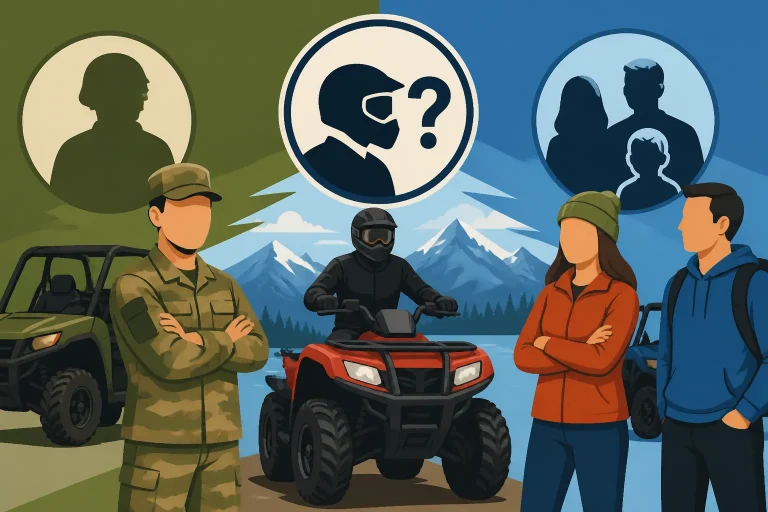
Some private property or other non-NPS land may lie within or near a park boundary. An owner’s access rights can be different from general public recreational access. If a route crosses NPS land to reach a private parcel, confirm what access is authorized and whether the route has limits. Do not assume that permission from a property owner also covers the federal portion of the trip.
Likewise, maintenance, research, commercial operations, and agency work may take place under permits or other authorization. Seeing a machine on a route does not show that the public can ride there. Ask the park office about the specific access authority and whether it applies to your planned trip.
How to verify a route before you unload
A reliable check starts with the exact route, not just the name of a nearby park. “Near the park” could mean state land outside the boundary, a federal parcel managed by a different agency, a preserve, or land inside a national park. Each can have a different answer.
Use this process before planning around a route:
- Mark the full route. Include the trailhead, crossings, turnarounds, and intended destination. A route that begins on open land may enter a restricted area farther along.
- Check who manages each section. Use land-status information as a starting point, then confirm uncertain boundaries with the relevant agency. The landowner or agency can change along a route.
- Ask about your exact machine. Say whether it is a wheeled ATV, side-by-side UTV, or snowmachine. Include any trailer or support vehicle if it will travel on park roads.
- Explain the purpose and timing. Recreational travel, subsistence use, access to an inholding, and authorized work may be governed differently. State the intended season and dates.
- Confirm current closures and conditions. A route’s normal status may not reflect a temporary closure, seasonal restriction, or condition-based limit.
- Ask what documentation or authorization to carry. If access depends on a permit, landowner permission, or a specific use authorization, confirm what proof is expected in the field.
When contacting a park office, ask direct questions: “Is this exact route open to a wheeled ATV?” “Does the answer change for a UTV?” “Is access allowed for recreation, or only for a specified purpose?” “Are there seasonal or temporary restrictions?” If the answer is unclear, request the route’s official name or a map reference and confirm it before departure.
Land-status maps can help you locate boundaries, but a map does not always show whether motorized use is permitted. Likewise, a route on a commercial app may be outdated, user-submitted, or intended for a different kind of travel. Use maps to form your question, not as final permission. Alaska Land Status Maps and Checking a Land Status Map explain how to use that information without treating it as an access authorization.
A general Alaska permit for state land does not extend across a boundary onto federal land. The same principle applies to trailhead passes: paying a parking or recreation fee does not necessarily authorize riding beyond the area covered by that fee. If a route crosses land managed by another agency, confirm its rules separately. Alaska’s General Permit Covers State Land explains the state-land scope, while Alaska BLM Land Riding Rules and Alaska Forest Service Land Riding Rules cover other federal land managers.
Common mistakes and a safer pre-ride plan
Mistakes that can turn a trip around
Assuming a park road is open to ATVs. A road may be limited to highway vehicles, official use, or a specific class of access. Ask whether your machine is allowed on that particular route.
Treating a snowmachine rule as an ATV rule. Alaska’s special provisions for snowmachine access do not automatically authorize wheeled machines. The machine type matters.
Relying on a state permit or registration decal. These documents do not replace federal land authorization. A machine can be properly registered and still be on a route where it is not allowed.
Following another rider’s tracks. Tracks show that someone traveled there, not that the travel was legal or that the route remains open. The rider may have had a permit, been working for an agency, or simply been somewhere they should not have been.
Assuming all land inside a boundary has the same manager. Private parcels, state land, and other agency holdings can occur in or around federal units. Check each segment rather than relying on the park’s name.
Planning around a vague verbal answer. If a response does not clearly identify the route, machine, and purpose, ask again. A precise question is more useful than “Can I ride near the park?”
A useful pre-ride checklist
Before heading out, make sure you can answer these questions:
- What agency manages every part of the route?
- Is the route open to this exact type of machine?
- Is the planned use recreational, subsistence-related, access to private property, or authorized work?
- Are there seasonal restrictions or current closures?
- Does a permit or written permission apply, and what does it cover?
- Does the route cross a stream, private parcel, or restricted area?
- What documents should be carried in case an officer or land manager asks about access?
Keep any relevant permit or written authorization accessible, but do not assume that carrying a document makes travel legal beyond the area or purpose it covers. For wider land-access questions, Alaska Land Ownership and Who to Ask is a useful place to start. If your trip also involves private or Native corporation land, verify those permissions separately; a national park office cannot grant access on land it does not manage.
When a planned route cannot be confirmed as open, choose a clearly authorized riding area rather than testing the boundary in the field. The cost of turning back at a trailhead is usually far less than dealing with a trespass complaint, a citation, or a machine stranded beyond an access point.
Disclaimer
This article is for general informational purposes only and does not constitute professional advice. Laws, prices and regulations vary by location and change over time. Consult a qualified professional for guidance on your specific situation.