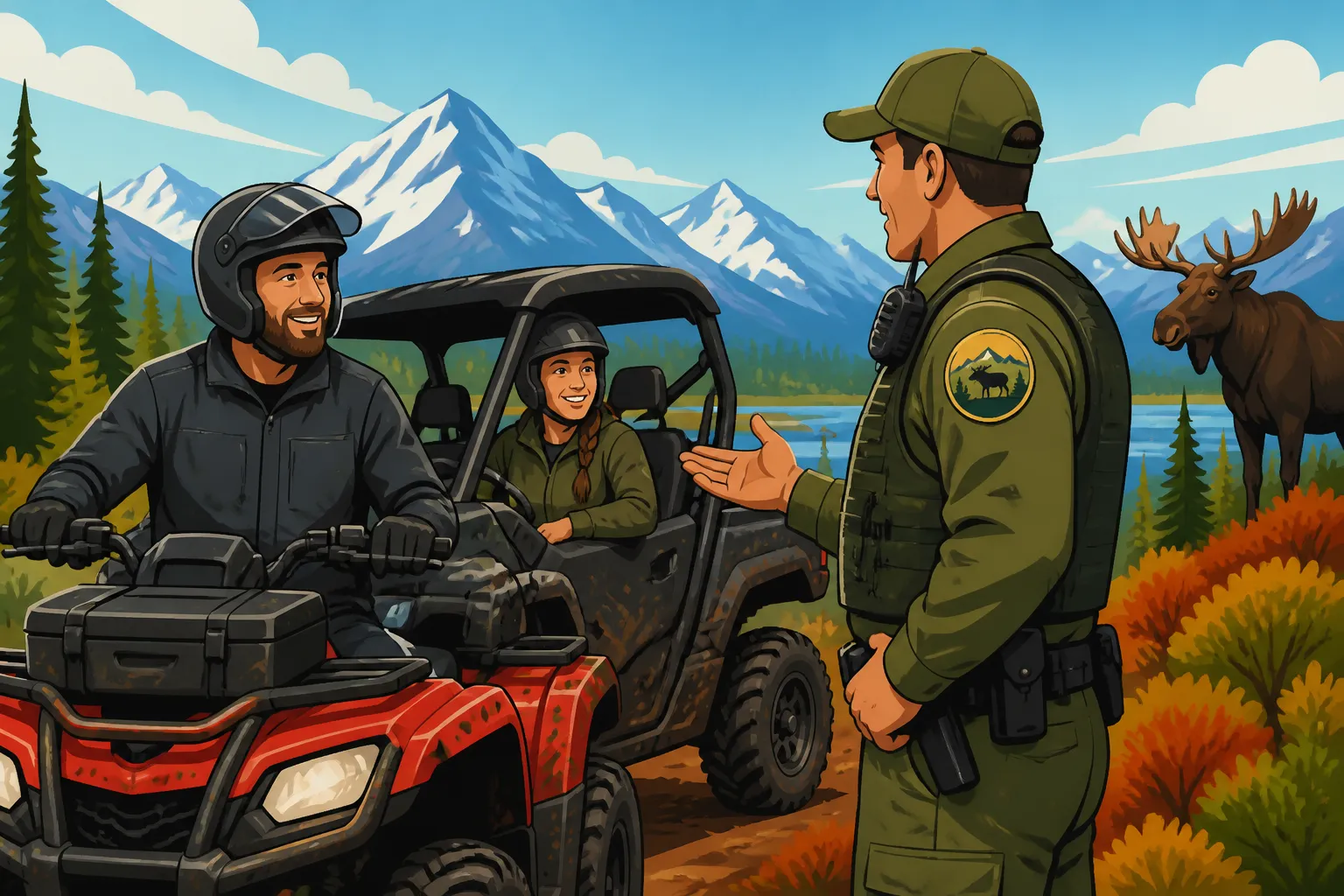
Meeting a Wildlife Trooper Miles From the Road
A wildlife trooper can meet you far from a road, town, or cell signal while you’re riding an ATV or UTV in Alaska. The encounter may involve land access, hunting activity, equipment, or an incident—not just your registration. Knowing what to carry, how to respond, and which permissions apply helps you answer questions clearly and avoid assuming one document covers everything.
Why a wildlife trooper may stop to talk
A wildlife trooper’s work can involve wildlife and hunting rules, as well as public-safety and law-enforcement duties. On a remote trail, an officer may be checking on an activity, investigating a report, responding to a crash, or speaking with riders in an area where wildlife or land-use rules matter. A stop does not necessarily mean you have done something wrong.
The location can make the conversation more complicated. A route that looks like one continuous trail may cross state land, federal land, private property, or land managed by a Native corporation. The rules and permissions may differ from one parcel to the next. A state land-use permit, for example, does not automatically provide permission to cross every type of land. Before riding, check the route and the land manager’s requirements through Alaska Land Ownership and Who to Ask and Checking a Land Status Map.
A trooper may ask where you came from, where you’re headed, who owns or manages the ground, or whether you are hunting. Answer honestly and briefly. If you’re unsure about a boundary or rule, say so rather than guessing. You can explain your route and show the information you used to plan it, but a map or permit is not proof that every part of a route is open.
A useful distinction is that registration, land-use permission, and hunting authorization address different issues:
| Item | What it may help establish | What it does not establish by itself |
|---|---|---|
| ATV or UTV registration | That the machine has the required registration for the situation | Permission to travel across land you do not have access to |
| State land-use permit | Authorization for covered use of eligible state land, subject to its conditions | Permission to ride in a state park, on private land, or on land managed by another owner or agency |
| Landowner or land-manager permission | Permission to use a particular parcel or route, if required | Compliance with vehicle registration, equipment, or hunting rules |
| Hunting license or other hunting authorization | Eligibility to hunt under the applicable rules | Permission to ride anywhere or use a machine in every hunting area |
For an overview of the state permit’s scope, see Alaska’s Statewide General Permit for ATV Use. The details matter: the permit has limits and exclusions, and other agencies or landowners may set separate conditions. A Trailhead Pass Is Not a Land Permit is another useful distinction when a riding area has both parking fees and land-use rules.
What to carry and how to make it accessible
When an officer is standing beside your machine, rummaging through a wet pack or asking another rider to search a vehicle miles away is frustrating. Keep the records you may need together, protected from rain, and easy to reach without unloading your gear.
The right documents depend on your trip. A practical starting point is:
- Identification and any required driving credential. If the route or road use makes a driver’s license necessary, carry it rather than relying on a photo or a companion’s copy.
- Registration information. Carry the paperwork or other evidence that applies to your machine and where you’re riding. An Alaska registration decal and its registration record are not the same thing as permission to enter land.
- Ownership or permission records. If the machine is borrowed, rented, or registered to someone else, keep a way to explain that arrangement. For an overview of what may count as trail documentation, see Alaska Proof of Ownership on the Trail.
- Land-use permission. Carry the state permit or other permission that applies to your route, if required. Keep any instructions or conditions that came with it.
- Hunting documents, when relevant. If you are hunting, carry the licenses, tags, or other records that apply to your activity and make sure your plan follows the current rules.
- Route and emergency information. A paper map, route notes, and a written trip plan can help explain where you are going when there is no signal or your phone battery is dead.
A compact, sealed document sleeve or dry bag can keep paper records legible in rain and mud. Outdoor retailers such as Amazon carry options, but the important feature is that the documents stay dry and can be retrieved quickly. Don’t store every record in a place that requires taking apart a loaded machine to reach it. If you use a phone, save key documents for offline access and consider carrying paper backups for the information that would be difficult to replace.
The machine itself may be part of the conversation. Keep its registration decal visible and legible, and make sure the identification number is not obscured by mud or accessories. A trooper may also notice equipment or ask about it. For a general overview of possible checks, see Alaska Equipment Checks by Troopers. The rules can depend on where and how you are riding, so do not treat that list as a substitute for checking the requirements that apply to your specific route.
For more detail on protecting paperwork during a wet ride, see Carrying Documents in the Rain. A simple system works well: keep the original records in one protected place, and store backup copies separately. Avoid handing over your only copy of a document if a copy will answer the question; if the officer needs to inspect an original or asks for specific information, follow lawful instructions and ask politely if you are uncertain.
Permits, out-of-state machines, and hunting trips
Visiting riders sometimes assume that a registration from another state or province settles every Alaska requirement. It may help identify the machine, but it does not automatically grant access to land or satisfy every local requirement. Likewise, an Alaska land-use permit does not replace machine registration, permission from a landowner, or hunting authorization.
Before setting out, check three separate questions:
- Is the machine properly documented for this use? Confirm registration requirements for the machine and the places where you plan to ride. The rules may differ between public and private property. Alaska Registration Before Riding Public Land explains why this question should be settled before the trip.
- Who manages each part of the route? A route can cross boundaries that are not obvious on the ground. Confirm whether the state permit applies and whether you need separate permission for a park, private parcel, Native corporation land, or land managed by another agency. See Alaska Rules for Riding Native Corporation Land for one example of why a statewide permit is not a universal pass.
- Does the trip include hunting or transporting game? If so, check the current hunting rules for the area and activity before relying on a machine for access or transport. Alaska Hunting Regulations and Machines covers the connection between hunting rules and machine use.
For riders coming from outside Alaska, do not rely on a friend’s recollection or a decal from home as the full answer. Requirements can depend on the machine, the route, the land manager, and the activity. Verify current rules with the relevant official agency or land manager before departure. If a permit or access permission is unclear, ask the agency or owner responsible for that ground; an officer encountered in the backcountry is not a practical substitute for route planning.
Bring the route information you used, but be prepared to explain its limits. A map may show a trail without clearly establishing who owns the land beneath it, whether a seasonal closure is in effect, or whether motorized travel is allowed. A good plan identifies likely boundaries, the authority responsible for the area, and a turnaround option if permission or conditions are uncertain.
How to handle the encounter calmly
Stop in a safe place, switch off the machine if asked or if it is safe to do so, and keep your hands visible. If you are traveling in a group, avoid having everyone crowd around the officer. One person can answer questions while the others stay with their machines and follow directions.
Listen to the question before reaching for paperwork. Tell the officer if you need to move slowly or remove a glove to retrieve a document. If you do not understand what is being asked, request clarification in a calm, respectful way. Do not argue about a boundary or rule based only on what another rider told you. You can explain your understanding and ask which requirement the officer is concerned about.
Be accurate about your activity. If you are hunting, say so; if you are simply traveling through an area, explain your route. Don’t hide, discard, or alter documents, and don’t make a confident claim about a permit’s coverage unless you have checked it. If you are carrying hunting equipment or game, follow the applicable instructions and avoid handling a firearm or other equipment unless it is necessary and safe.
If you are asked to move, leave an area, or change your route, make sure you understand the direction before departing. A disagreement about whether a rule applies is usually better handled through the appropriate process later, not by escalating the roadside conversation. If you receive a citation or notice, keep it, note the location and circumstances when you can do so safely, and follow the instructions for responding or contesting it. For a crash or injury, prioritize immediate safety and follow the relevant reporting requirements; Alaska Accident Reporting for an ATV Crash can help with the separate question of what to do after a collision.
A short pre-ride check reduces the chance of confusion: confirm who manages the route, carry the documents that apply, keep them protected and reachable, and make sure your group knows the plan. That preparation is useful whether you meet a trooper or simply need to explain your route to a land manager, another rider, or a responder.
Disclaimer
This article is for general informational purposes only and does not constitute professional advice. Laws, prices and regulations vary by location and change over time. Consult a qualified professional for guidance on your specific situation.