Alaska Has No Online OHV Registration
You've just moved to Alaska, or perhaps you've finally saved up for that dream side-by-side to explore the vast backcountry, and you're ready to get it registered. It's completely natural to expect a quick trip to a state website, a few clicks, and done. But then you hit a wall: Alaska doesn't offer online registration for Off-Highway Vehicles (OHVs). This guide is here to walk you through the real-world process, explaining why it's different and exactly what you need to do to get your ATV or UTV legally registered in the Last Frontier.
The Reality of Alaska's OHV Registration Process
It's a common modern convenience to handle most official tasks online, from renewing your driver's license to paying taxes. So, when you discover that Alaska operates a bit differently for OHV registrations, it can feel like a step back in time or an unnecessary hurdle. Many new residents, especially, come from states where online vehicle registration is the norm, leading to understandable confusion and frustration when they can't find a similar option here for their quad or side-by-side.
Why No Online Option?
The truth is, Alaska's Department of Administration, Division of Motor Vehicles (DMV), which handles OHV registration, simply hasn't developed an online portal for this specific type of vehicle. While you can often renew standard vehicle registrations or change an address online, the initial registration, and even renewals in many cases for OHVs, requires a more traditional, hands-on approach. This isn't unique to Alaska for certain vehicle types, but it can certainly catch riders off guard. Part of the reason likely stems from the specific requirements for proving ownership, which often involve physical documents like a Manufacturer's Certificate of Origin (MCO) or a notarized bill of sale, which are easier to process in person or via mail. It ensures a direct review of critical documents to prevent fraud and maintain accurate records for these specialized vehicles.
What "No Online Registration" Truly Means for You
For you, the OHV owner, the lack of an online registration means a few things: patience, preparation, and either a trip to a physical office or a visit to the post office. You won't be able to log in, fill out a form, upload documents, and pay with a credit card from the comfort of your couch. Instead, you'll be interacting directly with DMV staff or a partner agent. This might mean waiting in line, ensuring you have all your original documents ready, and possibly even making a second trip if something is missing. It's a process that requires a bit more planning than you might initially anticipate, especially if you're used to digital convenience. Understanding this upfront can save you a lot of grief and wasted time.
The Expectation vs. Alaska's System
It's natural to expect consistency across various vehicle types within a state's DMV system, or even consistency with how other states handle similar registrations. Many people arrive in Alaska thinking, "Well, if I can register my car online, surely I can register my ATV!" The reality is that OHVs often fall into a different category with unique requirements, and state systems aren't always uniformly digital. This discrepancy can be a source of genuine irritation, especially for those living in more remote areas of Alaska where a trip to a DMV office might involve significant travel. The key is to shift your mindset from a quick digital interaction to a more deliberate, document-centric, in-person or mail-based process.
Your Options for Registering an OHV in Alaska
Since online registration isn't on the table, you're left with two primary methods for getting your OHV registered in Alaska: in-person or by mail. Both have their pros and cons, and choosing the right one depends on your location, timeline, and how comfortable you are entrusting important documents to the postal service.
Registering In Person at a DMV or Partner Office
This is often the quickest and most straightforward way to register your OHV. You can visit any Alaska DMV office or one of their authorized [Alaska Partner Offices That Register OHVs]. These partner offices are typically private businesses, like vehicle service stations or title agencies, that are contracted by the state to handle certain DMV transactions, including OHV registrations. The benefit of an in-person visit is that a clerk can immediately review your paperwork, flag any issues, and usually issue your registration decal on the spot. This means you walk out with proof of registration, ready to hit the trails. However, it does require you to physically go to an office during business hours, which might involve travel time and potentially waiting in line, especially in busier urban areas like Anchorage or Fairbanks. Remember to bring all your original documents, as photocopies might not always be accepted for critical ownership proofs.
Registering by Mail
If an in-person visit isn't feasible due to distance or schedule, mailing in your registration application is your other option. This requires you to carefully gather all necessary documents, make copies for your records (because you'll be sending originals or certified copies), fill out the [The Vehicle Transaction Application Every OHV Owner Files], and include a check or money order for the correct fee. While convenient from a location standpoint, this method comes with a significant drawback: processing time. Mail-in registrations can take several weeks to process, and during peak seasons, it could be even longer. There's also the risk of documents getting lost in transit or returned if something is incorrect, prolonging the wait. If you choose this route, consider sending your package with tracking and confirmation to ensure it reaches the DMV.
What to Bring for an In-Person Registration
To make your in-person visit as smooth as possible, arriving prepared is paramount. You'll need proof of ownership, identification, and payment. Here's a quick checklist:
- Proof of Ownership: This is the most crucial piece. For a new machine, this is typically the Manufacturer's Certificate of Origin (MCO) or a warranty card. For a used machine, it will be a properly executed [Alaska Bills of Sale for a Used Machine] or a prior title.
- Completed Application Form: The Alaska Vehicle Transaction Application (Form V1). You can often get this form at the DMV, but filling it out in advance can save time.
- Identification: A valid driver's license or state ID.
- Payment: Cash, check, money order, or credit/debit card (though card acceptance can vary by location or involve a service fee, so always check ahead).
- Lien Holder Information (if applicable): If you financed your machine, you'll need the name and address of your lender. [Alaska Registration and Financing] touches on this.
Having these items organized and ready will prevent delays and ensure you get your registration decal promptly.
Essential Paperwork and Proof of Ownership
Getting your OHV registered in Alaska hinges almost entirely on proving you actually own the machine. This isn't just a formality; it's a legal requirement designed to prevent theft and ensure clear ownership records. The type of proof you need depends largely on whether your machine is new or used, and what documents are available.
Proving Ownership for a New Machine
When you purchase a brand-new ATV or UTV from a dealership in Alaska, the process for proving ownership is relatively straightforward. The primary document you'll receive from the dealer is the Manufacturer's Certificate of Origin (MCO), also sometimes called a Manufacturer's Statement of Origin (MSO). This document is essentially the "birth certificate" of your machine, certifying that it's new and has never been titled or registered. The dealer should endorse the MCO over to you, indicating you are the new owner. Some manufacturers might also issue a warranty card that can serve as supplementary proof of purchase. Always double-check that the VIN (Vehicle Identification Number) on the MCO matches your machine exactly. This MCO is what the DMV will primarily use to establish your ownership and initiate the first registration. Dealers in Alaska are typically well-versed in this process and should provide you with all the necessary paperwork at the time of sale. You might also want to review [Alaska Dealer Paperwork at Delivery] to understand what to expect.
Proving Ownership for a Used Machine
Purchasing a used OHV from a private seller introduces a few more variables regarding proof of ownership. Ideally, the previous owner will have a title or a bill of sale from when they acquired the machine.
- Existing Title: If the machine was previously titled in Alaska (which became required for APVs in 2022) or another state, the seller should sign over the existing title to you. This is the cleanest form of ownership transfer.
- Bill of Sale: For machines without a title, especially older ones, a detailed bill of sale is crucial. This document should include the VIN, make, model, year, purchase price, date of sale, and the full names, addresses, and signatures of both the buyer and seller. It's wise to have this document notarized to prevent future disputes. You can find reliable templates for a bill of sale through services like LawDepot, which offers customizable legal documents for various transactions, ensuring all the necessary fields are included for Alaska's requirements. A well-drafted bill of sale, especially if notarized, is strong evidence of your purchase. [Buying From a Private Seller in Alaska] has more details on this.
- Affidavit Naming the Seller: In situations where a traditional title or a robust bill of sale isn't available, the DMV may accept an affidavit naming the seller and detailing the transaction. This is often a last resort and requires careful construction. Again, resources like LawDepot can provide affidavit templates that can be adapted to your specific situation, ensuring all pertinent details are recorded and notarized.
Addressing Lost or Missing Ownership Documents
This is a common headache for OHV owners. What if you bought a machine years ago and lost the bill of sale? Or inherited one without any paperwork? Alaska does have provisions for registering machines with missing or lost paperwork, though it often involves an extra step and a waiting period.
- No Title Issued (NTI) Registration: If you genuinely cannot produce a valid MCO, title, or sufficient bill of sale, Alaska offers a "No Title Issued" (NTI) registration path. This process typically requires you to register the machine for a two-year period without a title being issued. During this period, the state checks for any liens or claims against the vehicle. If, after two uncontested years, no one claims ownership or a lien, you can then apply for a title for the machine. This is a deliberate process designed to protect all parties and prevent the registration of stolen property. For more detailed information on this, you can look up [Alaska No Title Issued Registrations] and [Two Uncontested Years]. This emphasizes why diligent record-keeping from the start is so important.
Understanding Alaska's OHV Registration Specifics
Beyond the "how-to" of submitting your paperwork, it's vital to grasp the specific nature of Alaska's OHV registration. It's not quite like registering your car, and understanding these nuances will help you ensure your machine is always compliant.
Decals, Not Plates: What to Expect
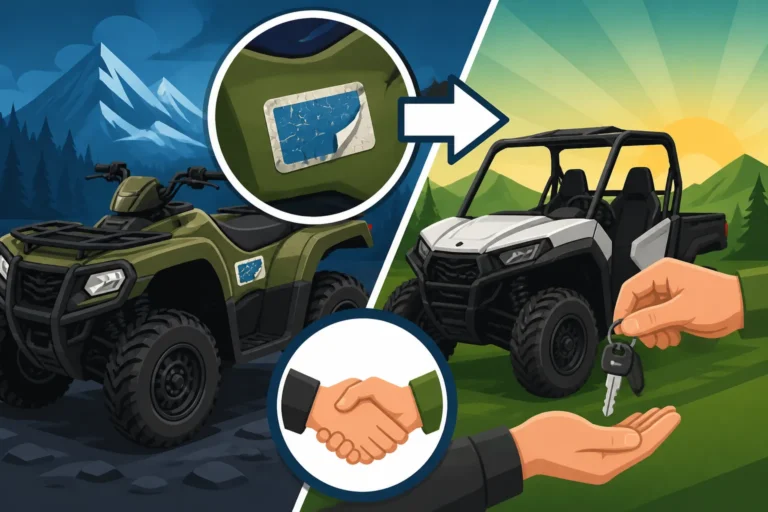
Unlike cars and trucks that receive license plates, registered OHVs in Alaska are issued a decal. This decal is a sticky label that clearly displays your registration number and the expiration date. It's your visible proof that your machine is legally registered. The DMV will provide instructions on where to place this decal on your machine. For quads and side-by-sides, it generally goes on a prominent, visible part of the vehicle, like the tunnel side or fender, to ensure it can be easily seen by law enforcement. It's a small but mighty piece of paper that signifies compliance. Make sure to place it correctly so it adheres well and remains visible even in adverse weather conditions. [What You Get Instead of a License Plate] gives you a deeper dive into this.
Registration Terms and Expiration
Alaska offers flexible registration terms for OHVs, allowing you to choose between two, four, or six years. This flexibility can be a real convenience, letting you align your registration with your long-term ownership plans.
- Two-Year Term: This is the shortest option and often chosen if you're uncertain about how long you'll keep the machine or if you prefer more frequent renewals. [Alaska Charges $10 for Two Years].
- Four-Year Term: A popular choice for many, balancing convenience with a reasonable commitment. [Alaska Charges $20 for Four Years].
- Six-Year Term: The longest available term, perfect for those who plan to keep their OHV for an extended period and want to minimize renewal frequency. [Alaska Charges $30 for Six Years].
Regardless of the term you choose, there's a crucial detail to remember: every OHV registration term in Alaska expires on September 30th. This means if you register for two years in, say, March, your decal won't expire two years from March; it will expire on September 30th of the second year. This fixed expiration date ensures a common renewal period for all OHVs, simplifying the state's administrative process but requiring riders to be mindful of their specific expiry date relative to their registration purchase. [Every OHV Registration Term Expires on September 30] provides more context.
Costs Associated with Registration
The cost of registering your OHV in Alaska is quite reasonable and depends directly on the term you select. As mentioned, a two-year registration currently costs a specific amount, four years another specific amount, and six years another specific amount. These fees are generally stable but are always subject to change by the state legislature, so it's always a good idea to confirm the current figures on the official Alaska DMV website or by calling a DMV office before you go in. These fees contribute to the administration of the OHV program and are distinct from any borough or city sales taxes that might apply when you initially purchase your machine. [Alaska OHV Registration Cost] is a good resource for the latest figures.
Tips for a Smooth Registration Experience
Navigating any government process can be a bit daunting, but with the right preparation and knowledge, registering your OHV in Alaska can be a relatively smooth experience. Avoiding common pitfalls and understanding what to expect will save you time and frustration.
Preparing for Your Visit or Mail Submission
The mantra here is "prepare, prepare, prepare." For an in-person visit, gather all your documents well in advance. Make copies of everything important for your records, even if you're bringing originals. If you're mailing your application, definitely keep copies of all submitted documents, especially your bill of sale or MCO. Double-check the filled-out [Alaska Registration Paperwork Checklist] to ensure every blank is accounted for and all required signatures are present. If using a service like LawDepot for a bill of sale or affidavit, print it out clearly and ensure all parties sign where required. Don't forget your form of payment, and if paying by check, make sure it's correctly filled out and funds are available. Consider calling your local DMV or partner office ahead of time to confirm their specific hours, accepted payment methods, and any recent changes to requirements.
Common Mistakes to Avoid
Many new OHV owners, and even some seasoned ones, can inadvertently make mistakes that delay their registration. One of the most common is not having adequate proof of ownership. A handwritten note on a napkin isn't going to cut it; you need a proper bill of sale or MCO. Another frequent issue is an incomplete application form – missing signatures, incorrect VINs, or blank fields will get your application sent back. For mail-in applications, insufficient postage or sending without tracking can lead to lost documents and a lot of headaches. Finally, misunderstanding the September 30th expiration date can lead to an unexpected early renewal. Always assume that if a document or piece of information is missing, your registration will be delayed or denied. Don't rush the process, and verify every detail before submission.
Beyond Registration: What Comes Next?
Once your OHV is registered and you have that shiny new decal, you might think you're all set. But remember, registration is just one piece of the puzzle. You'll also need to consider:
- Titling: For new machines or those going through the NTI process, ensuring your machine eventually gets a title is crucial for clear ownership and future resale. [Alaska APV Titling Required Since 2022] explains why this is important.
- Riding Rules: Alaska has specific rules about where and how you can ride your OHV, including age limits, helmet laws, and restrictions on public lands. Don't just assume you can ride anywhere. Always check local ordinances and land management rules. [Alaska APV Road Rules Explained] is a great starting point.
- Insurance: While not always mandatory for off-road use, liability insurance is often required if you plan to operate your OHV on any public roads or highways, even for short crossings. It's also a smart idea for protecting your investment. [Alaska Insurance Requirements for an APV] is something you should definitely look into.
Getting your OHV registered in Alaska might not be as simple as a few clicks online, but by understanding the process, preparing your documents, and knowing what to expect, you'll be well on your way to enjoying the incredible riding opportunities Alaska has to offer.
Disclaimer
This article is for general informational purposes only and does not constitute professional advice. Laws, prices and regulations vary by location and change over time. Consult a qualified professional for guidance on your specific situation.