Registering in Person at a Counter
Trying to figure out how to register your ATV or UTV in Alaska can feel like navigating a maze blindfolded, especially when you're just looking for straightforward answers. The good news is that for many Alaskans, the simplest and most reassuring way to get your machine legal is by walking right up to a counter. This guide will walk you through everything you need to know about registering your off-highway vehicle (OHV) in person, making the process less daunting and more direct.
Why Registering In Person Can Be Your Best Bet
Let's be honest, sometimes dealing with official paperwork online can be a nightmare. You click through menus, upload documents, and then wonder if it actually went through or if you missed a critical step. For many Alaskans, especially those who prefer direct answers or have unique situations, registering your ATV or UTV in person offers a level of clarity and immediate feedback that online portals simply can't match.
The Human Touch and Direct Answers
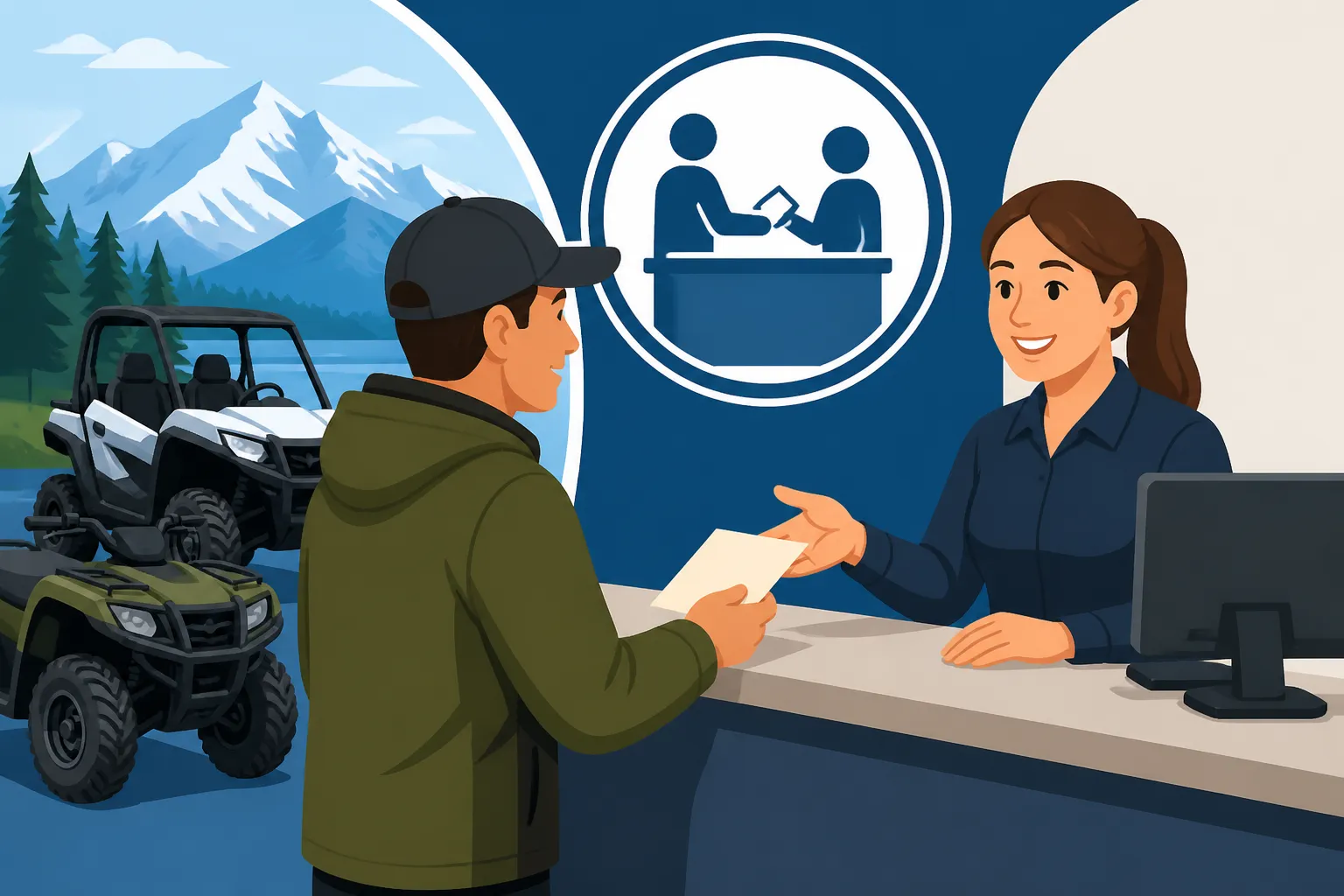
When you walk into an Alaska Division of Motor Vehicles (DMV) office or one of its authorized partner offices, you get to interact with a real person. This isn't just about friendliness; it's about having an expert right there to answer your specific questions. Maybe you're unsure if your [Alaska No Title Issued Registrations] scenario applies to your decades-old machine, or perhaps you've got questions about how [Alaska Charges $10 for Two Years] versus a four or six-year registration would work for your plans. A clerk can look at your documents, tell you exactly what's needed, and even help you fill out forms correctly on the spot. This can save you countless hours of stress and potential errors that might lead to your registration being rejected if you tried to mail it in.
Think about it: have you ever tried calling a government office only to be put on hold indefinitely or bounced between departments? Registering in person eliminates that frustration. You join the line, wait your turn, and then get dedicated attention. For a new resident trying to navigate Alaska's specific rules, or someone with a complicated ownership history for their machine, this direct interaction is invaluable. You can clarify confusing points about your [Alaska APV Titling Required Since 2022] or ensure you understand [Alaska's APV Class Explained] for your specific vehicle. It's about peace of mind, knowing that when you leave, your paperwork is in order.
Immediate Feedback and Problem Solving
One of the biggest advantages of registering in person is the instant feedback loop. If you've forgotten a document, or if there's a discrepancy in your paperwork, the clerk will tell you right away. Imagine mailing in your application, only to receive it back weeks later with a note saying you missed a signature. That's precious riding time lost! In person, you might just need to step aside for a moment, make a quick phone call, or find a notary in a nearby office.
For instance, if you show up with a bill of sale that's missing crucial information, the clerk can point it out, giving you the chance to contact the seller immediately. Or, if you're trying to register a machine with [Alaska Machines With No Paperwork], they can guide you through the process of getting an affidavit, like those available through services like LawDepot, to establish ownership. This immediate problem-solving capability drastically reduces delays and ensures you walk out with your registration decal in hand, ready for your next adventure. It's a proactive approach to what can sometimes be a complex administrative task, turning potential headaches into quick fixes.
What You Absolutely Need to Bring to the Counter
Showing up prepared is half the battle when it comes to any official transaction. For Alaska ATV and UTV registration, having all your ducks in a row before you even get to the counter can save you a world of frustration and a second trip. Think of it as packing for a journey: you don't want to leave anything essential behind.
Proof of Ownership Documents
This is probably the most critical piece of the puzzle. The DMV needs to know that you are the rightful owner of the machine you're trying to register. What exactly constitutes "proof" can vary depending on whether your ATV or UTV is brand new or a beloved, well-used machine.
For a new machine straight from the dealer, you'll typically need the Manufacturer's Certificate of Origin (MCO), sometimes called a Manufacturer's Statement of Origin (MSO). This document is like a birth certificate for your machine and should have been provided by the dealership. Sometimes, a copy of the [Alaska Transferred MCO Copies] will suffice, but it's always best to have the original if possible. If you just bought it, the dealer should have provided you with all the necessary [Alaska Dealer Paperwork at Delivery].
If you bought a used machine from a private seller, you'll need a [Alaska Bills of Sale for a Used Machine]. This document is your proof of purchase and should clearly state the buyer, seller, sale price, and most importantly, the Vehicle Identification Number (VIN) of the machine. If the seller didn't provide one, or if it's incomplete, you can use online services like LawDepot to generate a legally sound bill of sale template, ensuring all necessary fields are covered. In cases where the original bill of sale is lost or was never properly created, an affidavit naming the seller can sometimes be used. This is common if you are [Registering a Quad When the Paperwork Is Lost] and need to establish ownership. LawDepot can also provide templates for affidavits, which need to be notarized to carry legal weight. Remember, the goal is to clearly establish the chain of ownership.
Your Identification and Payment
Beyond the machine-specific documents, you'll need to prove who you are. A valid driver's license or state-issued ID is standard. This helps the DMV clerk verify your identity and ensure the registration is tied to the correct individual. If there are two owners, both may need to be present with their IDs, or at least one present with specific authorization for the other.
Payment is another key element. While the exact fees for [Alaska OHV Registration Cost] can change, the general structure involves a fee for a two, four, or six-year term. For instance, you might be looking at [Alaska Charges $20 for Four Years] for your chosen term. Most DMV offices and partner locations accept various forms of payment, including cash, checks, and credit/debit cards. It's always a good idea to call ahead or check the Alaska DMV website for current payment methods accepted at your specific location, just to be sure. Having your payment ready will ensure a smooth transaction and prevent any last-minute scrambling.
Table: Alaska ATV/UTV Registration Document Checklist
| Document Type | Description | For New Machines | For Used Machines | Notes |
|---|---|---|---|---|
| Proof of Ownership | Manufacturer's Certificate of Origin (MCO/MSO) or Bill of Sale/Affidavit | Required (MCO/MSO) | Required (Bill of Sale) | MCO for new, Bill of Sale for used. LawDepot can help with Bill of Sale/Affidavit templates. |
| Identity Verification | Valid Driver's License or State-Issued ID | Required | Required | Ensures registration is linked to the correct individual. |
| Completed Application | Vehicle Transaction Application (Form V1) | Required | Required | Crucial for capturing all necessary vehicle and owner details. |
| Proof of Residency | Utility Bill, Lease Agreement, etc. (if ID doesn't show current Alaska addr.) | Recommended | Recommended | May be required if your ID doesn't reflect your current Alaska address. |
| Lienholder Information | If machine is financed | Required | Required | Details of any loan or security interest on the machine. |
| Payment | Cash, Check, Credit/Debit Card for fees | Required | Required | Check current fees, e.g., for [Alaska Charges $30 for Six Years]. |
| Odometer Reading | Current mileage/hours on the machine | Required | Required | Required on the application form. |
Remember, while this table covers the most common requirements, specific situations might call for additional documents, especially if there's a complex ownership history or if the machine is coming from out of state. It never hurts to call your local DMV or partner office if you have any doubts.
The Step-by-Step Process at the DMV or Partner Office
So, you've gathered all your documents, taken a deep breath, and you're ready to head to the counter. What actually happens once you get there? The process itself is usually quite straightforward, but knowing what to expect can ease any lingering anxieties. Whether you visit a full-service DMV office or one of the convenient [Alaska Partner Offices That Register OHVs], the core steps are generally the same.
Filling Out the Necessary Forms
The main form you'll encounter is the Vehicle Transaction Application, often referred to as Form V1. This is the all-encompassing document where you provide details about your machine and yourself. While you can often download and fill this out ahead of time, a clerk can also provide you with one. This form asks for information like the VIN, make, model, year, and current odometer reading of your ATV or UTV. It also requires your personal information, including your name, address, and driver's license number. Pay close attention to detail when [Filling Out Alaska's Form V1 Line by Line]. Any omissions or errors could cause delays.
If you are dealing with a situation where traditional ownership documents aren't available, such as registering an old machine with no prior title, you might also need to fill out an affidavit of ownership. As mentioned, resources like LawDepot offer templates for these kinds of documents, which you can prepare beforehand. The clerk will guide you through confirming that all fields are complete and signatures are present where required. This is where having a human at the counter is incredibly helpful – they can spot a missing piece of information you might have overlooked.
Review, Payment, and Your New Decal
Once all your forms are filled out and your supporting documents are presented, the clerk will carefully review everything. They'll check the VIN, verify your identity, and ensure all required signatures are in place. This is their chance to catch any potential issues before the registration is processed. Don't be shy if they ask you to clarify something or point out a section you might have missed – they're just doing their job to ensure accuracy.
After the review is complete and everything is deemed correct, you'll proceed to payment. You'll pay the applicable fee for your chosen registration term – remember, you can pick two, four, or [Alaska Registration Terms of Two, Four or Six Years]. Once payment is processed, congratulations! You'll typically receive your new registration decal on the spot. This decal is your official proof of registration and will need to be affixed to your machine in a visible location, like the tunnel side for a snowmachine or a prominent place on your quad. The clerk might even give you instructions on [Alaska Decal Placement on the Tunnel Side] or [Alaska Decal Placement on a Side-by-Side]. You'll also usually receive a temporary paper registration to keep with you until your official card arrives in the mail, if applicable. This immediate gratification is a huge perk of registering in person, allowing you to hit the trails without further delay.
Common Questions and Troubleshooting at the Counter
Even with all your preparation, sometimes unexpected questions or minor hiccups can arise when you're at the registration counter. It's helpful to anticipate these and know how to address them, ensuring a smooth and successful registration process for your ATV or UTV.
What if I'm Missing a Document or Have a Unique Situation?
This is where the benefit of registering in person truly shines. If you've forgotten your original MCO but have a clear photocopy, the clerk might be able to guide you on whether [When a Photocopy of the Title Is Enough] or if further steps are needed. Or perhaps you're in a situation where you're [Registering a New Quad on a Purchase Order] because you haven't received the MCO yet. A clerk can advise if a purchase order is acceptable as temporary proof, or if you need to return once the MCO is in hand.
For machines with very little paperwork, such as those bought from an estate or that have changed hands many times without proper documentation, the clerk can explain options like the [Alaska No Title Issued Registrations] process. This often involves filing an affidavit (again, a template from LawDepot can be invaluable here) and potentially a waiting period before a title can be issued. They can also clarify specific exclusions, for example, why [Alaska Excludes Snowmobiles From APV] class registration, or if your unique vehicle falls under [Machines Alaska Will Not Register as an APV]. Don't be afraid to ask [Alaska Registration Questions Clerks Hear]; they've likely seen it all before. The key is to be honest and open about your situation, allowing them to guide you to the correct solution.
Understanding Registration Expiration and Renewal
One common point of confusion for new registrants is the expiration date. Regardless of whether you choose a two, four, or six-year term, all Alaska OHV registrations expire on September 30th of the final year. So, if you register on October 1st, 2024, for a two-year term, it will expire on September 30th, 2026. If you register in July 2024 for a two-year term, it still expires on September 30th, 2026. This means that a decal issued mid-term won't give you the full two years if registered in July, but it's set to synchronize the expiration cycles. The clerk can clearly explain [Every OHV Registration Term Expires on September 30] and how to plan for [Alaska ATV Registration Renewal].
Another question often arises regarding [What You Get Instead of a License Plate]. For ATVs and UTVs in Alaska, you receive a decal, not a traditional license plate. The clerk will emphasize the importance of proper [Alaska Decal Placement on a Side-by-Side] or other machines to ensure it's visible. If you're planning ahead, the clerk can also discuss the pros and cons of [Picking a Four-Year Term Over a Two-Year One] based on your anticipated ownership period. While you cannot [You Cannot Register an Alaska OHV Online], the in-person visit sets you up for easy renewals in the future. Armed with the correct information from the counter, you'll feel much more confident about keeping your machine legally registered for years to come.
Disclaimer
This article is for general informational purposes only and does not constitute professional advice. Laws, prices and regulations vary by location and change over time. Consult a qualified professional for guidance on your specific situation.