Public Property as the Trigger
It's a common question I hear from fellow Alaskans who are new to the world of ATVs and UTVs, or even those just moving to our beautiful state: "Do I really need to register my quad if I'm only riding it around my property?" This is where understanding Alaska's unique "public property as the trigger" rule for All-Purpose Vehicle (APV) registration becomes absolutely essential, and this guide is here to break it all down for you, making sure you know exactly when and why that decal is required.
Understanding Alaska's APV Classification and the "Public Property" Rule
Navigating the rules for off-highway vehicles (OHVs) in Alaska can feel like trying to find a clear trail in a dense spruce forest – it's not always straightforward! But at its heart, the registration requirement for your ATV or UTV boils down to one critical factor: where you plan to ride it.
What "All-Purpose Vehicle" APV Actually Means in Alaska
First things first, let's clarify what Alaska even considers an "All-Purpose Vehicle," or APV for short. When the state talks about APVs, they're generally referring to those amazing machines we use for work, hunting, fishing, or just plain fun: your typical four-wheel ATVs (quads), side-by-sides (UTVs), six-wheelers, and even dirt bikes. If it's designed for off-road travel and has an engine, chances are it falls under this umbrella.
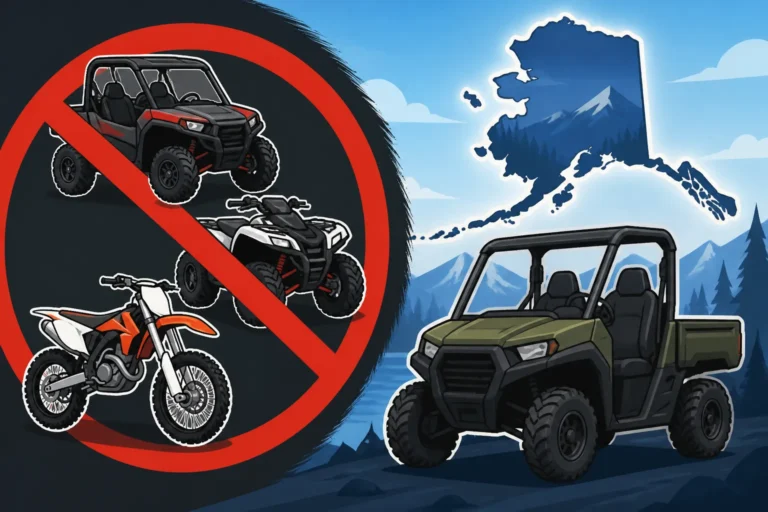
However, it's really important to know what isn't included, because these exclusions often surprise people. Snowmobiles, for example, have their own distinct registration system and rules; they are expressly not APVs. Similarly, three-wheelers, which you might still see around, are generally excluded, as are highly specialized tracked vehicles that aren't built on a typical ATV/UTV chassis. And if you've been tinkering in the garage building your own custom machine from scratch, you might find that [Machines Alaska Will Not Register as an APV] because they don't fit the standard safety and identification criteria. Knowing what category your machine falls into is the first step in understanding your registration obligations.
This classification is crucial because it sets the stage for everything else. If your machine is an APV, then the next question becomes: where are you going to operate it? Without the APV designation, the "public property as the trigger" rule doesn't even come into play for your specific vehicle type. For instance, [Alaska Excludes Snowmobiles From APV] and [Alaska Excludes Tracked Vehicles] because they are handled differently, so don't assume one rule covers all off-road vehicles.
The Core Concept: Public Property as the Trigger for Registration
Here's the golden rule, the one that governs whether your machine needs a decal: If you plan to operate your All-Purpose Vehicle on any "public property" in Alaska, it must be registered. It's that simple, and yet, it's often misunderstood. This isn't just about collecting fees; it's about public safety, land management, and ensuring accountability.
Think about it this way: when you're out on public trails or land, there's a shared responsibility to maintain those areas, adhere to safety standards, and have a system in place for identification in case of an accident, a lost rider, or even a theft. Registration helps with all of that. Without it, tracking machines and ensuring responsible use on our shared lands would be nearly impossible. This means whether you're heading to a popular trail system or just using a public right-of-way to access your hunting grounds, your APV needs that decal.
The contrast with private land is stark. If your APV lives its entire life on your own private property – your homestead, your mining claim, your private cabin parcel – and never, ever touches public ground, then Alaska does not require you to register it. The state's interest is in managing public resources and ensuring safety on shared spaces, not in dictating what you do on your own land. But the moment even one wheel rolls onto public access roads, state game lands, or borough trails, the trigger is pulled, and registration becomes a must.
What Constitutes "Public Property" in Alaska for APV Use?
This is where many Alaskans get tripped up. "Public property" isn't just the obvious state parks or designated trail systems. It encompasses a much broader range of lands and access points that you might encounter during your adventures. Understanding the full scope is key to staying legal and avoiding unexpected fines.
State Lands, Trails, and Rights-of-Way
Alaska is a vast state, and a huge amount of that land is publicly owned, managed by the state itself. This includes designated public use areas, state forests, game management units, and countless miles of unpaved roads and trails that crisscross the landscape. If you're riding in places like the [Knik River Public Use Area in Alaska] or exploring the vast network of trails around [Jim Creek Riding in Alaska], you are absolutely on public land, and your APV must be registered.
Even seemingly informal trails that have developed over time, if they are on state land or within a public right-of-way, fall under this rule. This also extends to easements – strips of land, often near utility lines or old survey markers, that are legally designated for public passage. While they might feel remote and untamed, they are still considered public access. The state's intent is clear: if the public has a right to be there, and you're operating an APV there, it needs to be registered.
Federal Lands and Public Access Roads
Beyond state-managed lands, Alaska also has immense tracts of federal property, including Bureau of Land Management (BLM) land, National Forests, and National Wildlife Refuges. While these lands often have their own specific regulations regarding vehicle use and access, the underlying principle holds: if you're riding an APV on them, it needs to be registered with the state of Alaska first. So, if you're heading out to explore a vast expanse of BLM land, knowing [Alaska BLM Land Riding Rules] is important, but first, make sure your machine is registered. The same applies when venturing into areas managed by the U.S. Forest Service; you'll want to check [Alaska Forest Service Land Riding Rules] in addition to confirming your state registration.
Public access roads are another critical category. These aren't necessarily paved highways. Many unpaved, gravel, or dirt roads across Alaska, even those that seem like mere tracks, are maintained by the state, a borough, or the federal government, and are therefore public property. Using your APV on these roads to travel between points, or even just for a short stretch, means you need that registration decal. It's not just about the epic backcountry trails; it's also about the less glamorous connector routes.
Municipal and Borough-Owned Property
Local governments – cities and boroughs – also own and manage public lands within their jurisdictions. This could be anything from a small municipal park with an ATV trail to a vast borough-maintained recreational area. While many towns like Anchorage or Fairbanks have specific [Alaska Municipal ATV Ordinances] that might restrict APV use on certain public roads or within city limits, if they do allow APV use on designated trails or roads, state registration is still required.
For instance, a borough might maintain a local trail network or an unpaved road that connects subdivisions, even if it's primarily used by residents. If these are publicly funded and maintained, they fall under the "public property" definition. It's always a good practice to check with your local borough or city office to understand their specific ordinances, but remember, state registration is the baseline requirement for operating on any public land they oversee.
Exemptions and Nuances: When You Might Not Need a Decal
Understanding the "public property" trigger is paramount, but just like any rule, there are specific scenarios and important nuances that create exceptions. Knowing these can save you time, money, and potential headaches.
Riding Exclusively on Private Land
This is the big one, the clearest exemption to Alaska's APV registration rule. If your ATV or UTV is used exclusively on land that is privately owned and never, ever crosses onto public property, then you do not need to register it with the state. This means if you have a massive tract of land, a private mining claim accessible only by private easement, or a remote cabin where your quad is used solely within the boundaries of your parcel, you're off the hook for state registration.
Picture this: you own a homestead property out in the Mat-Su Valley, and your quad is your workhorse, hauling firewood, moving tools, and getting you to the back forty. As long as your tires never touch a public road, a state trail, or any other government-owned land, you're good. This also applies if you store a machine on your property and it's not being operated at all – maybe it's a project machine, or one you only use for a very specific private purpose. The key here is operation on public land. For a deeper dive into this, check out [Riding Only on Your Own Ground] and [When a Quad on Private Land Needs No Alaska Decal].
It's a huge relief for many property owners to know they aren't obligated to register a machine that stays strictly on their private ground. Just be absolutely certain that "exclusively" means just that – no shortcuts across the corner of a state-owned parcel, no quick dashes down a borough road to get to the mailbox. If there's any public use, the registration requirement kicks in.
Crossing Public Roads vs. Riding On Them
This is a common gray area that often sparks confusion. Let's say your private property is bisected by a public road, or you need to get from one private parcel to another, and the only way is to briefly cross a public roadway. Alaska law differentiates between merely crossing a public road and operating an APV on it as a means of travel.
Generally, a quick, direct crossing of a public highway or road to access another piece of private property might not trigger the full APV registration requirement solely for that act. However, even during a crossing, you are still subject to all other rules of the road that apply to APVs, such as stopping, yielding, and potentially having lights on. And here's the critical caveat: using that road as a travel route, even for a short distance, does trigger registration. If you're riding along the shoulder, or using the road to reach a different destination, you are operating on public property, and registration is required. You can find more details on this specific scenario in [Crossing a Highway on a Quad in Alaska]. Always err on the side of caution; if in doubt, register it. The penalties for being caught unregistered on public property can quickly outweigh the cost of a decal.
Machines Held Solely for Maintenance or Storage
Consider a scenario where you've inherited an old ATV, or perhaps you're restoring a vintage side-by-side. If this machine is strictly a garage project, stored on private property, or otherwise not in operation on public lands, it does not need to be registered. The act of owning an APV is not what triggers registration; it's the act of using it on property that is open to the public.
This means your collection of non-running project machines, or even a perfectly operational spare that you keep at your remote cabin but only use within the private boundaries, does not need a current decal. The moment that machine is repaired, fueled up, and taken for a spin on a state-maintained trail, however, you'll need to make sure its registration is current. It's a pragmatic approach by the state, recognizing that not every owned machine is actively used on public land.
The Registration Process: Getting Your APV Legal for Public Use
So, you've decided your APV will indeed be touching public land, meaning registration is a must. Don't worry, the process itself isn't nearly as daunting as trying to cross a braided glacial river! It's pretty straightforward once you know what to gather and where to go.
Required Documentation and Where to Go
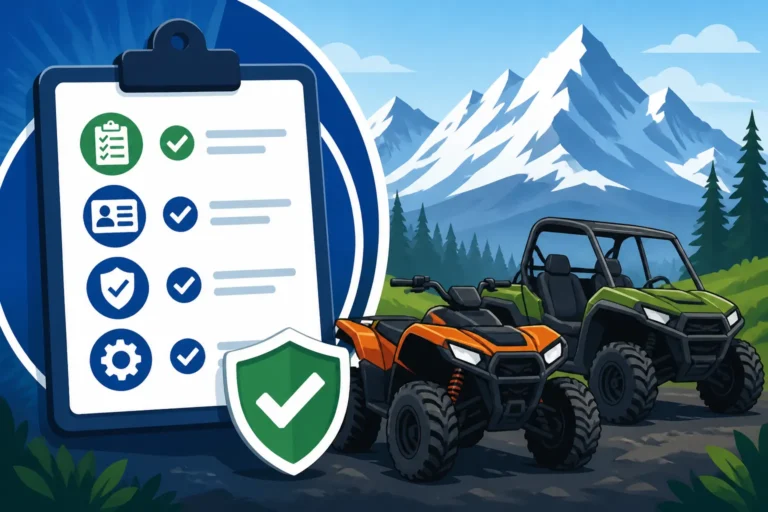
The primary place to register your APV is the Alaska Division of Motor Vehicles (DMV) or one of their authorized partner offices. These partner offices are often local auto dealerships or service centers that are set up to handle vehicle registrations, which can be a real convenience, especially in more rural areas. You can find a list of these helpful locations by looking for [Alaska Partner Offices That Register OHVs]. To get your shiny new decal, you'll need a few key pieces of paperwork to prove ownership and your identity:
- Proof of Ownership: For a brand-new machine, this is usually your Manufacturer's Certificate of Origin (MCO) or a warranty card. If you're buying a used machine from a private seller, you'll need a bill of sale. A detailed bill of sale is crucial for a smooth transfer, and if you're ever in a pinch and need to create one, services like LawDepot can provide customizable templates to ensure all necessary information is included. You might want to refer to [Alaska Bills of Sale for a Used Machine] or [Alaska Warranty Cards for a New Machine] for more specific details on what's acceptable.
- Identification: A valid photo ID, like your Alaska driver's license, is required.
- Application Form: You'll fill out a Vehicle Transaction Application (Form V1), which the DMV provides.
- Fees: Be prepared to pay the registration fees.
If you bought a used machine and the previous owner has lost the original title, or perhaps it's an older machine where a title was never issued, the process can become a bit more involved. Sometimes an affidavit naming the seller can suffice, particularly if you're trying to establish a chain of ownership. Again, a resource like LawDepot could be useful for drafting such an affidavit to ensure it meets legal requirements. Check out [Alaska Affidavits Naming a Seller] for more information on that option. The best advice here is always to gather as much original documentation as possible when you purchase a machine.
Decals, Fees, and Renewal Cycles
Unlike cars, Alaska APVs don't get traditional license plates. Instead, you'll receive a registration decal that includes a unique number. This decal needs to be prominently displayed on your machine, usually on the tunnel side or a flat surface where it's easily visible when seated. [Alaska Issues a Decal, Not a Plate] and [Alaska Decal Placement on the Tunnel Side] provide more details on this.
You have the flexibility to choose a registration term of two, four, or even six years. This is great for those who want to set it and forget it for a while!
| Term Length | Cost (Check Current DMV Site for Exact Figures) | Expiry Date |
|---|---|---|
| Two Years | ~$10 | September 30th |
| Four Years | ~$20 | September 30th |
| Six Years | ~$30 | September 30th |
It's important to note that all APV registrations, regardless of when you initially register or what term length you choose, expire on September 30th. This means if you register in August for a two-year term, your decal will still expire on September 30th of the second year, not August. This universal expiry date simplifies renewals for everyone. [Alaska Registration Ends September 30] is a crucial detail to remember. While the fees mentioned in the table reflect historical rates, always check the Alaska DMV's official website or call them directly for the most current costs, as these can change. For example, you can get a good idea of typical costs by looking at [Alaska Charges $10 for Two Years].
When it's time to renew, you'll typically receive a renewal notice, but it's ultimately your responsibility to ensure your registration is current. Unfortunately, [Alaska Has No Online OHV Registration], so you'll need to visit a DMV office or one of its partners in person or mail in your renewal.
Implications of Not Registering When Required
Ignoring the registration requirement when you're operating on public land can lead to some unwelcome consequences. If a state trooper, park ranger, or other law enforcement officer stops you while you're riding an unregistered APV on public property, you could face fines and penalties. It's not just a slap on the wrist; these can add up, especially if you're cited multiple times.
Beyond the monetary penalties, there's the inconvenience and potential for your riding day to be cut short. Being found in violation means your vehicle might be impounded, or you could be told to cease operation immediately. It's simply not worth the risk. The cost of registration is minimal compared to the potential fines and hassle. For a detailed breakdown of the repercussions, you can refer to [Alaska Penalties for Riding Unregistered]. Always make sure your decal is current and properly displayed before you head out onto any public trail or road.
Summary: Public vs. Private APV Use in Alaska
Here's a quick overview to help you remember the key differences when it comes to registering your APV in Alaska.
| Feature | APV Used Exclusively on Private Land | APV Used on Public Land (Any Amount) |
|---|---|---|
| Alaska Registration Required? | No | Yes |
| Decal Issued? | No | Yes |
| Common Use Cases | Homestead work, private recreation, mining claims, storage | Trail riding, hunting access, fishing access, crossing public roads, village travel |
| Examples of "Public Land" | N/A | State game lands, borough trails, federal forests, public access easements |
| Documents Needed for Registration | N/A | Proof of ownership (MCO, bill of sale), ID, application |
| Penalties for Non-Compliance | None, if strictly private use | Fines, potential impoundment |
At the end of the day, Alaska wants its residents and visitors to enjoy its incredible landscapes safely and responsibly. The "public property as the trigger" rule for APV registration is a foundational element of that. By understanding where you can and cannot ride, and ensuring your machine is properly registered when required, you're doing your part to keep our trails open and accessible for everyone. So, check your decals, know your land, and ride on!
Disclaimer
This article is for general informational purposes only and does not constitute professional advice. Laws, prices and regulations vary by location and change over time. Consult a qualified professional for guidance on your specific situation.