Why Two- and Three-Wheelers Cannot Be Registered
It’s a scenario many Alaskans have faced: you’ve got a perfectly good dirt bike or a classic three-wheeled ATV, and you want to use it on our incredible public lands. You head down to the DMV, ready to get your decals, only to be met with a firm "no." It can be incredibly frustrating to discover your beloved machine doesn't fit into the state's registration categories. This guide is here to unravel why Alaska's All-Purpose Vehicle (APV) classification excludes two- and three-wheeled off-road machines, helping you understand the regulations and what your options are.
Understanding Alaska's All-Purpose Vehicle Definition
Before we dive into the specifics of why certain machines are excluded, it's crucial to understand what Alaska does consider an All-Purpose Vehicle (APV) for registration purposes. The state has a very particular definition, and if your machine doesn't tick all the boxes, it simply won't qualify, no matter how much it feels like an "off-road vehicle" to you. This can be a source of real head-scratching for folks who are new to Alaska or who have machines that used to be street legal elsewhere.
What Qualifies as an Alaska APV?
Alaska's statutes define an APV in a way that, while seemingly broad, has very specific limitations on the number of wheels. Essentially, an APV is a motor vehicle that is designed to travel over unimproved terrain and that has a width of 65 inches or less. Crucially, and this is where many two- and three-wheeled machines fall short, it must have four or more pneumatic tires or two or more tracks. This foundational requirement is the primary hurdle. Think about your typical four-wheeler or side-by-side; they easily meet this "four or more wheels" standard. They are built for stability and carry the weight and design features the state expects for off-road registration and use on public lands.
The reason for these specific requirements often boils down to a combination of safety considerations and historical precedent. Four-wheeled ATVs and side-by-sides are generally seen as having a different stability profile compared to two- or three-wheeled vehicles, especially when navigating varied Alaskan terrain like tundra, gravel bars, or snowy trails. The state legislature carved out this definition to encompass the most common and often deemed "safest" types of off-road machines that people use for recreation, subsistence, and utility across Alaska's vast landscapes. When you read about [Alaska's APV Class Explained], you'll see this wheel count is consistently front and center.
Why Exclusions Exist in the APV Class
The exclusions aren't arbitrary; they stem from a desire to standardize what gets registered and, to some extent, to manage the types of vehicles operating on public lands. The state's goal isn't to prevent people from enjoying the outdoors, but rather to ensure a degree of predictability and safety in how these vehicles are categorized and used. For instance, you might be surprised to learn that even though they are certainly off-road machines, snowmobiles are specifically excluded from the APV class because they have their own distinct registration and rules, as detailed in [Alaska Excludes Snowmobiles From APV]. Similarly, tracked vehicles, while fitting the "two or more tracks" part of the definition, also have nuanced categorizations depending on their design.
This legislative decision means that certain types of recreational vehicles, despite their popularity in specific niches, simply don't have a pathway to APV registration. It's not a judgment on the machines themselves or their operators, but a matter of fitting within the legal framework. For a comprehensive list of what doesn't make the cut, you might want to check out [Machines Alaska Will Not Register as an APV]. Understanding these exclusions upfront can save you a lot of time and frustration at the DMV counter, redirecting your focus to understanding where you can legally operate your specific machine.
Why Two-Wheeled Dirt Bikes Don't Fit the Bill
Dirt bikes are incredibly popular across Alaska, from dedicated motocross tracks to remote trails for hunting and exploration. They are agile, powerful, and in the right hands, incredibly capable off-road. However, despite their undeniable utility and fun factor, they simply don't qualify for Alaska's APV registration. This is one of the most common surprises for new residents or those just getting into the sport here.
The "Four Wheels" Requirement for Dirt Bikes
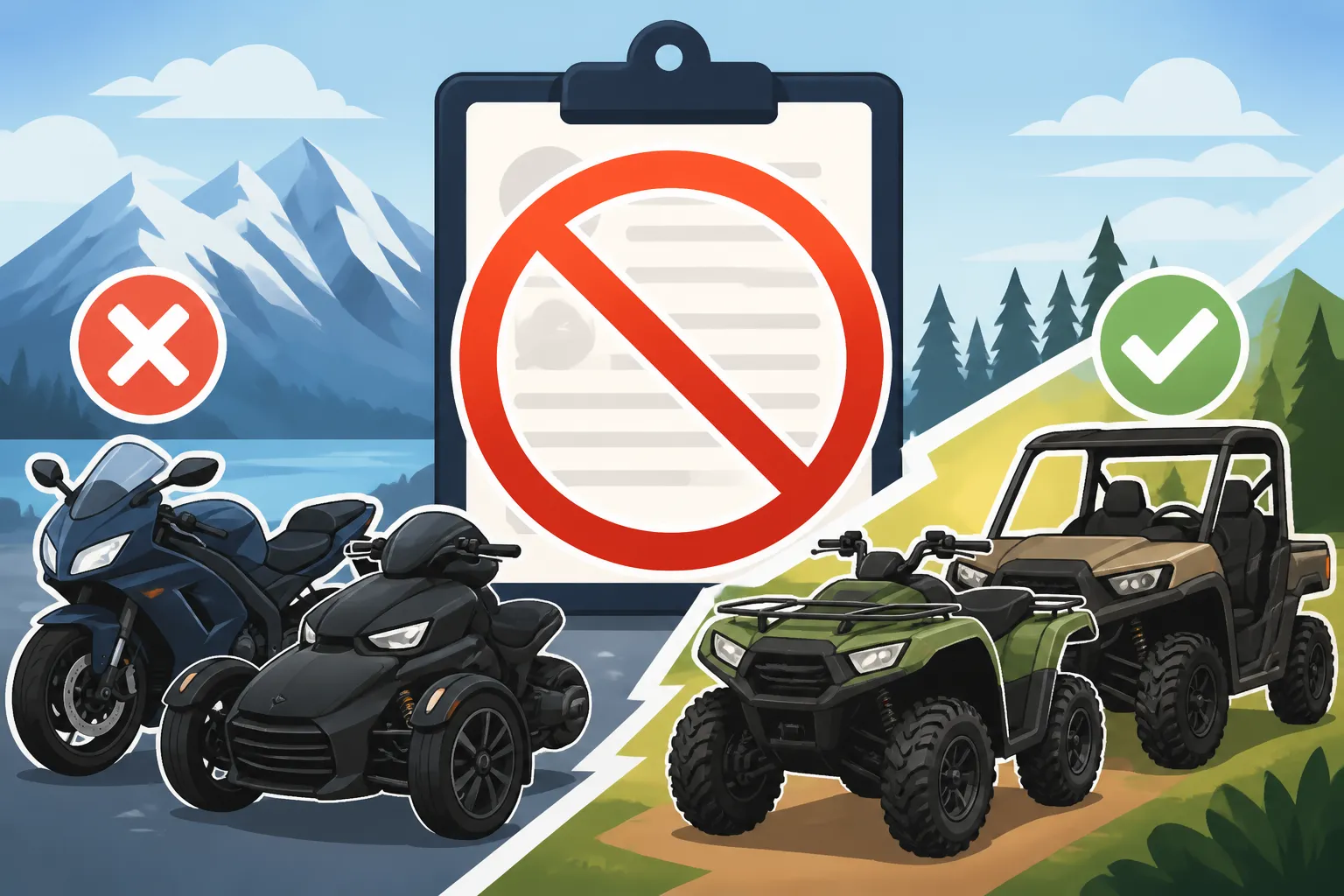
The primary reason dirt bikes cannot be registered as APVs in Alaska is straightforward: they only have two wheels. As we discussed, the state's definition for an APV explicitly requires a minimum of four pneumatic tires or two tracks. This immediately disqualifies all traditional two-wheeled motorcycles, including off-road dirt bikes. It doesn't matter if it's a small 80cc youth bike or a powerful 450cc enduro machine; if it has two wheels and is intended for off-road use, it falls outside the APV registration class.
This distinction can feel unfair, especially when you see other recreational vehicles with motors registered and hitting the trails. But the law, as written, is quite specific. This isn't unique to Alaska; many states have distinct classifications for off-road motorcycles versus ATVs. It speaks to a different regulatory approach for these vehicle types, often influenced by perceived handling characteristics and safety profiles compared to their four-wheeled counterparts. For those pondering [Alaska Registration Before Riding Public Land] with a dirt bike, this is the first and most significant hurdle to be aware of.
Where Can Unregistered Dirt Bikes Be Ridden in Alaska?
So, if you can't register your dirt bike as an APV, does that mean you can't ride it anywhere? Not necessarily, but it does significantly limit your options, particularly on public lands. The key distinction often comes down to land ownership and specific regulations governing those areas. Generally, if you ride on land that requires APV registration (like many state or federal recreation areas), your dirt bike won't be permitted. However, there are still places to ride.
You can almost always ride your dirt bike on private property, provided you have the landowner's explicit permission. This is often the case for folks who own large parcels of land or have agreements with private landowners. This falls under the general principle of [Riding Only on Your Own Ground]. Furthermore, some specifically designated riding parks or private tracks might accommodate dirt bikes without requiring state APV registration, as they operate under their own rules. Always check the rules for any specific area you plan to visit. Understanding land ownership is paramount, as detailed in [Alaska State Land Riding Explained].
The Specific Case of Three-Wheelers in Alaska
Ah, the three-wheeler! These iconic machines, often referred to as ATCs (All-Terrain Cycles), hold a special place in the hearts of many off-road enthusiasts. From the classic Honda ATC to various models from Kawasaki and Yamaha, three-wheelers were once incredibly popular. However, their history is also intertwined with significant safety concerns, which directly impact their registration status in Alaska today.
Historical Safety Concerns and the CPSC Ban
The reason three-wheelers are specifically excluded from APV registration in Alaska—and often face similar restrictions elsewhere—stems largely from their notorious safety record. During the 1980s, three-wheeled ATVs were linked to a disproportionately high number of accidents and injuries. Their design, with a single front wheel and two rear wheels, coupled with an often high center of gravity, made them prone to rollovers, especially for inexperienced riders or when traversing uneven terrain and slopes.
This led to a voluntary ban on the sale of new three-wheeled ATVs by manufacturers in 1988, brokered by the U.S. Consumer Product Safety Commission (CPSC). While used three-wheelers can still be bought and sold today, their history of instability and accident rates profoundly influenced how states like Alaska categorize and regulate them. The state's APV definition, with its strict "four or more pneumatic tires" rule, effectively excludes these machines directly because of these long-standing safety concerns, placing them firmly in the category of [Machines Alaska Will Not Register as an APV].
Why Three-Wheelers Cannot Be Registered as APVs
Because of the definition requiring four or more wheels, a three-wheeler simply doesn't meet the primary criteria for APV registration in Alaska. It's not about the age of the machine, its condition, or even its perceived safety by the individual owner; it's a black-and-white matter of the number of wheels. While some might argue that a modern, well-maintained three-wheeler is as safe as an older four-wheeler, the state's legal framework doesn't make that distinction.
This means that if you own a classic three-wheeler, you'll face the same registration hurdles as someone with a dirt bike. You won't be able to get an Alaska APV decal for it. This can be particularly disheartening for collectors or those who have lovingly restored these vintage machines, eager to ride them legally on the state's expansive trail systems. The regulatory environment simply isn't set up to accommodate them in the same way it does modern quads and side-by-sides.
Navigating Unregistered Off-Road Vehicles in Alaska
So, you have a dirt bike or a three-wheeler, and you know it can't be registered as an APV. What now? It’s not the end of the road for your riding adventures, but it does mean you need to be extra diligent about where and how you operate your machine. The key is understanding land use rules and ensuring you always have proper documentation, even for unregistered vehicles.
Riding Restrictions for Unregistered Machines
The most significant restriction for an unregistered two- or three-wheeler is that it generally cannot be ridden on public lands that require APV registration. This includes many state park lands, state recreation areas, and often federal lands managed by agencies like the Bureau of Land Management (BLM) or the U.S. Forest Service. These areas typically have signs indicating that only registered APVs are allowed, or they refer to state statutes that define what an APV is. Ignoring these rules can lead to fines, citations, or even confiscation of your machine.
The distinction between private and public land is absolutely critical here. While the state cannot dictate what you do on your own private property, as soon as you step onto public ground, you become subject to state and sometimes federal regulations. This means that even if you live right next to a great trail, if that trail crosses state land and requires APV registration, your dirt bike or three-wheeler is not permitted. Always know your land status; for more on this, consider [Public Property as the Trigger].
Proof of Ownership and Legal Documents
Even though your two- or three-wheeled machine can't be registered as an APV, it's still a valuable piece of property, and you need to treat its ownership seriously. Whether you're buying one, selling one, or just storing it, having robust proof of ownership is essential. This protects you from disputes, theft, and makes any future sale much smoother. Imagine trying to prove you own a machine without any paperwork if it’s stolen or if there's a disagreement about who the rightful owner is.
A clear bill of sale is your best friend in these situations. It should detail the buyer, seller, date of sale, purchase price, and a complete description of the machine, including its Vehicle Identification Number (VIN) or serial number. For situations where a formal bill of sale might be missing, an affidavit from a previous owner can serve as valuable proof. Services like LawDepot can be incredibly helpful for drafting these types of legal documents, ensuring they contain all the necessary information and are legally sound, even for machines that don't qualify for state registration. This ensures clarity and reduces headaches down the line. For more on this, you might explore [Alaska Bills of Sale for a Used Machine].
The Role of Private Land and Designated Areas
The most straightforward solution for riding unregistered two- or three-wheelers in Alaska is to stick to private land where you have explicit permission. This could be your own property, a friend's land, or a privately owned and operated riding park or track. When considering [When a Quad on Private Land Needs No Alaska Decal], remember this principle extends to any off-road vehicle not just quads. On private ground, the state registration requirements don't apply, giving you much more freedom.
Additionally, some communities or boroughs might have specific ordinances that create designated riding areas or allow limited use of these types of machines on certain local roads or trails. However, these are often exceptions to the rule, and it's imperative to check local laws and ordinances meticulously before assuming your machine is permitted. Always research the specific area you plan to ride in. While it might be disappointing that your beloved dirt bike or three-wheeler doesn't fit Alaska's APV registration, understanding the rules empowers you to make informed decisions about where and how you can still enjoy your passion safely and legally.
Disclaimer
This article is for general informational purposes only and does not constitute professional advice. Laws, prices and regulations vary by location and change over time. Consult a qualified professional for guidance on your specific situation.