Crossing a Highway on a Quad in Alaska
The allure of Alaska's vast wilderness often means needing to get from one incredible trail system to another, and sometimes, that means crossing a highway. For many riders, the thought of taking their quad or side-by-side onto a paved road, even for a moment, feels like navigating a minefield of rules and potential fines. You're probably wondering if it's even allowed, what equipment you need, and how to avoid an unwanted conversation with a trooper. This comprehensive guide is here to clear up the confusion, explaining exactly what Alaska's laws say about crossing a highway on your all-purpose vehicle (APV), the essential steps to stay legal, and how to ensure your safety and the safety of others.
Understanding Alaska's All-Purpose Vehicle APV Classification for Road Use
Before we dive into the nitty-gritty of crossing a highway, it’s absolutely crucial to understand what Alaska defines as an "All-Purpose Vehicle," or APV, and how that classification impacts its use on public roads. This isn't just bureaucratic jargon; it's the foundation for understanding what you can and can't do with your machine when pavement is involved. The state of Alaska recognizes that these machines are vital tools for many residents, whether for hunting, subsistence, or simply exploring the incredible backcountry, but that doesn't mean they're treated like cars.
What Constitutes an APV in Alaska?
In Alaska, an APV is broadly defined as a motor vehicle, other than a snowmobile, that is designed to travel on land and is operated on land for recreational or other purposes. This category encompasses a wide range of machines, from your typical four-wheel ATV (all-terrain vehicle) to the increasingly popular side-by-sides, sometimes called UTVs (utility task vehicles), and even dirt bikes. The key here is "other than a snowmobile," because snow machines have their own distinct set of rules, particularly when it comes to road interaction. [Alaska Excludes Snowmobiles From APV]. The state's APV definition is intentionally broad to cover the diverse array of off-highway vehicles Alaskans rely on. If your machine has four or more wheels, is designed for off-road use, and isn't a purpose-built snow vehicle, it likely falls under the APV umbrella for registration and use purposes.
When we talk about APVs, we're thinking about those machines built to tackle rugged terrain – the mud, rocks, and snow of Alaska's wild landscapes. These are not designed with typical highway driving in mind, which is why their interaction with paved roads is so strictly regulated. They often lack the standard safety features, such as turn signals, rearview mirrors, or even enclosed cabs, that are common on passenger vehicles. This fundamental design difference is at the heart of why special rules exist for their limited road use.
The Fundamental Distinction: Trail vs. Road Legality
This is where many riders stumble. Just because your machine is registered and legal for trail riding doesn't automatically make it legal for road use. Trail legality is about meeting requirements for off-road operation – things like spark arresters and proper mufflers – to protect the environment and other trail users. Road legality, on the other hand, involves a whole different set of considerations focused on sharing the road safely with cars, trucks, and motorcycles. The distinction is critical. Your ATV or UTV is, by its very nature, an off-road machine. Its primary domain is the trail, the gravel track, the frozen river. [Alaska APV Class Explained].
Alaska law generally presumes that APVs are not for highway use. Any permission to operate them on public roadways, even for crossing, is an exception to this general rule and comes with very specific conditions. This isn't meant to be punitive; it's about public safety. An APV, with its often narrower wheelbase, higher center of gravity, and different handling characteristics, behaves very differently on pavement compared to a traditional vehicle. Throw in a powerful engine and knobby tires designed for grip in mud, not asphalt, and you can see why the state takes a cautious approach. So, while you might feel perfectly comfortable ripping down a dirt track, that confidence needs to be tempered with extreme caution and adherence to regulations when you encounter a paved highway.
Limited Road Use: A Privilege, Not a Right
Operating an APV on any public roadway in Alaska, including just to cross it, is a privilege granted under very specific circumstances, not an inherent right. This distinction is important because it means that lawmakers can, and do, impose strict conditions on that privilege. These conditions are designed to minimize risk to the APV operator, passengers, and other motorists on the highway. Think of it like this: your APV is built for the backcountry, and when it momentarily steps onto the highway, it's entering a different world with different rules.
The limited nature of this privilege means you can't just cruise down the highway to the next trailhead, even if it's only a mile away, unless specifically permitted by local ordinance. The law is very precise about what kind of road use is allowed. Generally, it boils down to crossing, or in some very specific, often village-specific, cases, operating on shoulders or low-speed roads. But even then, there are stipulations. This is why understanding the specific act of "crossing a highway" is so vital – it's one of the most common and legally nuanced interactions an APV will have with the paved road system. Don't assume that because you see someone else doing it, it's automatically legal or that your situation is identical. Always verify the rules for your specific location and intended use.
The Specifics of Highway Crossing: Legal Framework in Alaska
Okay, let's get down to the most common reason you might find your APV touching pavement: crossing a highway. Alaska's laws are quite specific about how this must be done. It's not a free-for-all, and simply pointing your machine at the asphalt and gunning it is a recipe for trouble. There are precise requirements designed to ensure you get across safely and legally, minimizing disruption to highway traffic.
Designated Crossing Points and Visibility
Alaska law permits APVs to cross highways at designated crossing points where it is safe to do so. What constitutes a "designated crossing point"? Often, these are established at natural breaks in a median, at intersections, or where a clearly marked trail intersects the highway. The key, however, is not just where you cross, but how visible you are to oncoming traffic. You must cross at a location where both the APV operator and oncoming traffic have an unobstructed view for a safe distance in both directions. This means no crossing over blind hills, around sharp curves, or where dense vegetation blocks the line of sight for you or other drivers.
Imagine you're out near the Knik River Public Use Area and need to get from one section of trails to another that requires crossing the Old Glenn Highway. You wouldn't just pick a random spot in the middle of a straightaway. Instead, you'd look for a natural break, maybe where a gravel road or another trail clearly meets the highway. Before even approaching the pavement, you'd scan for traffic, ensuring you can see far down the road and that any approaching vehicles can see you well in advance. This isn't just a suggestion; it's a legal requirement. If a trooper observes you crossing at a spot deemed unsafe due to lack of visibility, you could face a citation.
The Straightest Path Rule
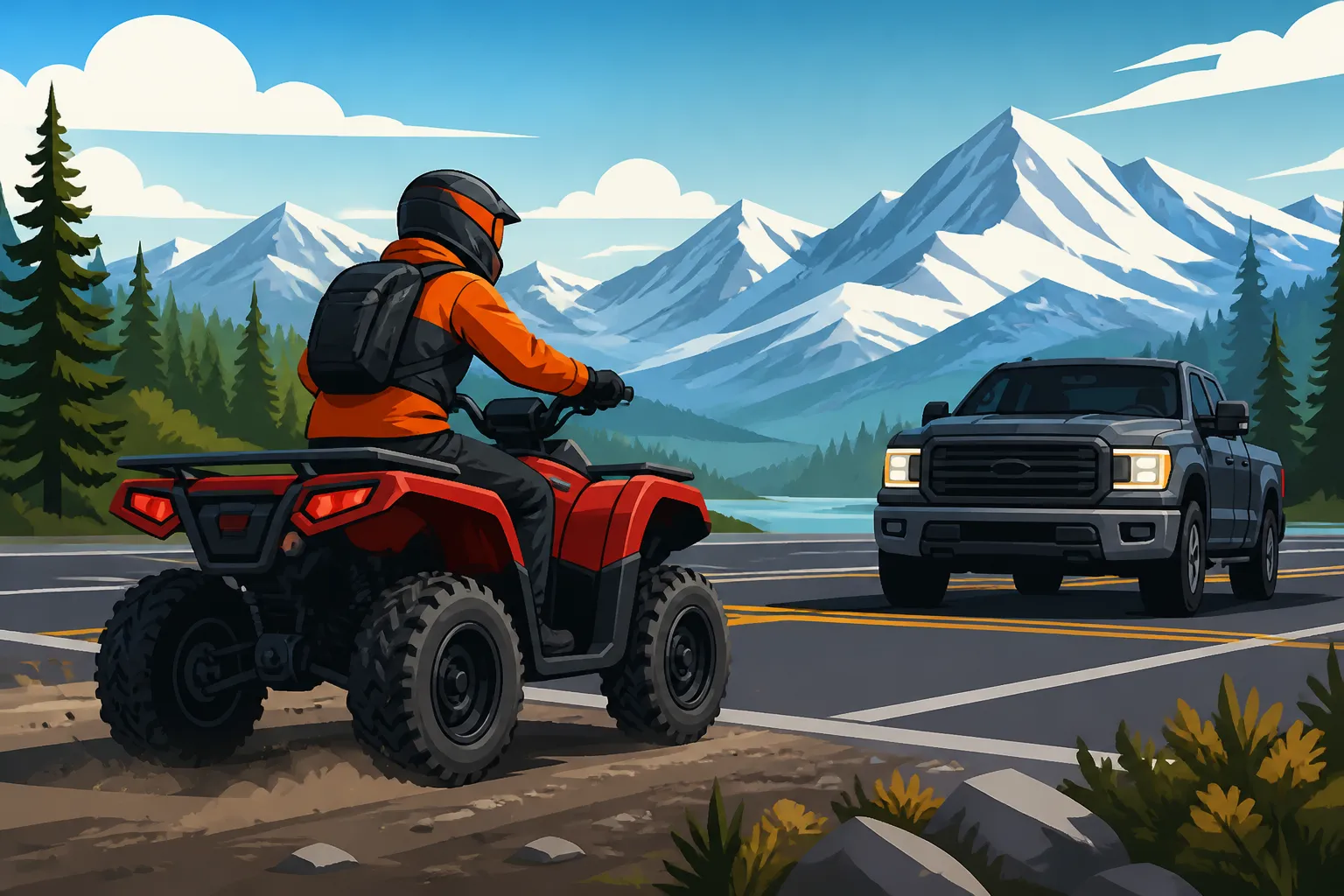
When crossing a highway, Alaska law dictates that you must proceed directly across the highway at approximately a right angle to the roadway. This means you can't weave, drive diagonally, or travel down the highway for any distance before turning to cross. The intent is to minimize the time your APV spends on the paved surface and to make your movement predictable for other drivers. Think of it as the most efficient, shortest possible route from one shoulder to the other.
This rule is often misunderstood. Some riders interpret it as "get across as fast as possible." While speed is a factor in minimizing time on the road, the "straightest path" is about the trajectory. You should aim for a path that looks like the letter "I" or a perpendicular line intersecting the road. This also means you can't use the highway to adjust your angle, line up, or gain momentum. You must approach the highway, stop, assess traffic, and then proceed straight across. This prevents situations where an APV might appear to be merging or turning, causing confusion for highway drivers. For instance, if you're riding a powerful side-by-side from SuperATV with a robust suspension, you might be tempted to just power through, but precision in your crossing path is key to adhering to the law.
Crossing Under Power and Without Delay
Once you've assessed the situation and determined it's safe to cross, the law requires you to cross "under power and without delay." This means you shouldn't dawdle, stop in the middle of the highway, or try to coast across. Your APV should be fully operational, and you should use its engine to propel yourself across the road in one continuous, swift motion. The goal is to be off the highway as quickly and safely as possible.
This regulation reinforces the idea that an APV's presence on the highway is strictly momentary and for the sole purpose of bridging two off-road sections. It's not a place to check your phone, adjust your gear, or have a conversation with a buddy. You need to be ready to execute the crossing with confidence and efficiency. If your machine is known to be finicky or struggles with acceleration, you might need to adjust your crossing strategy or consider if that particular machine is suitable for highway crossings at all. A stalled APV in the middle of a highway is a serious hazard, and the law aims to prevent such situations by requiring a decisive crossing.
Conditions and Restrictions on Highway Crossings
While the law allows for highway crossings in Alaska, it's not a blanket permission. There are significant conditions and outright prohibitions that dictate where and when you can perform these crossings. Understanding these restrictions is just as important as knowing how to execute a legal crossing. Ignoring them can lead to serious legal trouble and, more importantly, dangerous situations.
Speed Limits and Posted Highways
One of the most critical restrictions on APV road use in Alaska, including crossings, involves the posted speed limit of the highway. Generally, APVs are restricted from operating on highways where the posted speed limit is greater than 45 miles per hour. [Alaska's 45 mph Road Limit for APVs]. This rule effectively bans APVs from most major highways and interstates, which typically have speed limits of 55 mph or higher. Even if you're only crossing, if the highway you're traversing has a speed limit above 45 mph, you generally cannot legally cross it.
This restriction is in place for safety reasons. APVs are not designed for high-speed operation on pavement, and they can be difficult for drivers of faster-moving vehicles to spot, especially if the APV is only on the road for a brief moment. Imagine trying to cross a 65 mph highway on a quad – the closing speed of an oncoming car is immense, leaving very little margin for error. This rule limits APV crossings to lower-speed roads, often found in more rural or less-trafficked areas, where the speed differential between the APV and other vehicles is less extreme. Always check the posted speed limit signs before you even consider approaching a highway for crossing.
Crossing Multiple Lanes or Divided Highways
While not always explicitly stated as an outright ban, crossing multi-lane highways or divided highways (those with a median separating opposing directions of traffic) presents unique challenges and often falls outside the spirit of legal APV crossings. The "straightest path" and "without delay" rules become much harder, if not impossible, to safely and legally execute on such roads. Successfully crossing multiple lanes of traffic, potentially from both directions, requires a much longer time on the pavement and a greater level of risk.
Consider a highway like the Parks Highway, which in many sections is a divided four-lane road. Attempting to cross such a highway on an APV means navigating multiple lanes of fast-moving traffic, potentially waiting in the median, and re-entering traffic flow. This is fundamentally different from a single-lane, undivided road. While Alaska law doesn't necessarily prohibit waiting in a median if it's wide enough and safe, the sheer complexity and danger involved usually means these types of crossings are not advisable and often lead to violations. Troopers are highly unlikely to view such a maneuver as a "direct crossing without delay." It's generally best to assume that major, multi-lane, or divided highways are off-limits for APV crossings.
Prohibited Crossing Areas and Communities
Beyond the general restrictions, many specific communities and areas in Alaska have outright banned APV road use, including crossings, within their municipal boundaries. [Alaska Communities That Ban APV Road Use]. This is a critical point that many riders overlook, assuming state law is the only law. Cities like Anchorage, Fairbanks, and Juneau, for example, have ordinances that prohibit APV operation on most, if not all, public roads within their city limits. Wasilla and Palmer also have very specific regulations that riders need to be aware of.
Even if state law would allow a crossing based on speed limits, a local ordinance can supersede or further restrict that. For example, a highway with a 35 mph limit might be permissible for crossing under state law, but if it runs through a town that has banned all APV road use, then crossing there would be illegal. It is the rider's responsibility to know the local laws for any area they plan to ride in or through. Before embarking on any ride that involves highway interaction, especially near or within populated areas, always [Checking a City Code Before You Ride] is an absolute must. Ignorance of local ordinances is not a valid defense, and you could find yourself with a hefty fine or even a towed machine.
Essential Equipment for a Legal Highway Crossing
Successfully and legally crossing a highway in Alaska involves more than just knowing the rules of the road; your machine itself needs to be properly equipped. Because APVs are primarily off-road vehicles, they don't always come from the factory with the necessary safety features for limited road use. To be compliant with state law for even momentary highway interaction, you'll likely need to make some additions or ensure existing components meet specific standards.
Lighting, Reflectors, and Visibility Enhancements
When you're crossing a highway, you need to be seen. This is paramount for safety, and Alaska law reflects this with specific requirements for lighting and reflectors on your APV. Your machine must be equipped with at least one headlight that emits a white light visible from a distance of 100 feet. This headlight must be on during any road crossing, regardless of the time of day, as it significantly enhances your visibility. You also need at least one taillight, emitting a red light, visible from a distance of 1,000 feet to the rear.
In addition to lights, your APV must have at least one red reflector on the rear, visible from all distances from 100 feet to 600 feet when directly in front of lawful upper beams of headlights. This redundancy is important for situations where your taillight might fail or be obscured. Furthermore, many riders consider adding turn signals, even if not explicitly required for a quick crossing, because they drastically improve communication with other drivers. Brightly colored flags or flashing amber lights (often mounted on a tall whip antenna, particularly popular with companies like SuperATV) can also be excellent visibility enhancements, though they may not be explicitly mandated for all road crossings. The more visible you are, the safer you and others will be.
Braking Systems and Self-Closing Throttles
Reliable braking is non-negotiable when you're interacting with highway traffic. Alaska law requires APVs to have a braking system that is capable of stopping the vehicle effectively. This means your brakes must be in good working order, properly adjusted, and able to bring your machine to a controlled stop. Before any ride that might involve a highway crossing, always perform a quick check of your front and rear brakes. Ensure they engage smoothly and stop the machine without excessive pull or fade.
Equally important, and often overlooked, is the requirement for a self-closing throttle. This means that when you release the throttle control, it must automatically return to the idle position. This is a crucial safety feature that prevents runaway vehicles, especially if you were to lose your grip or become incapacitated. Most modern APVs come equipped with self-closing throttles from the factory, but it's always wise to verify its functionality. If your machine's throttle sticks or requires manual return, it is not compliant with the law for road use and should be repaired before you attempt any highway crossing. These seem like small details, but they are critical for preventing accidents.
Mufflers, Spark Arresters, and Mud Flaps
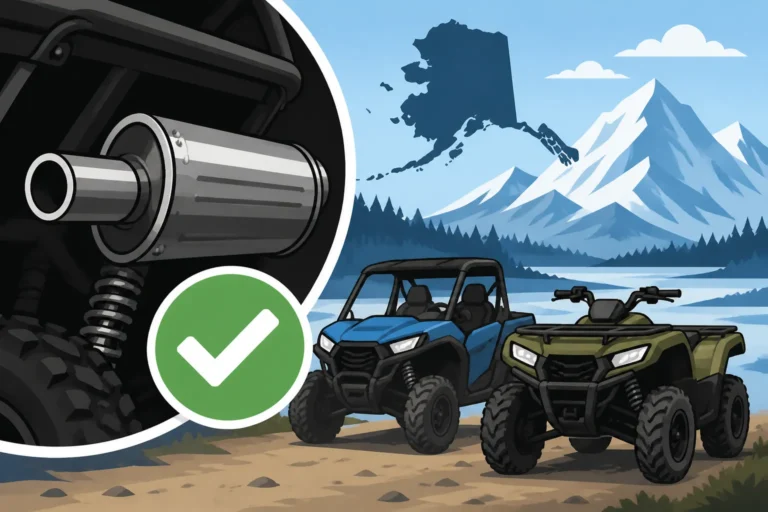
Beyond lights and brakes, there are environmental and functional equipment requirements. Your APV must have an effective muffler system in good working order to prevent excessive noise. This isn't just about being a good neighbor on the trail; it's a legal requirement designed to control noise pollution, which is particularly relevant in more populated areas near highways. Loud, unmuffled machines can also startle drivers and reduce the ability to hear approaching traffic. [What Counts as a Legal Muffler in Alaska].
Furthermore, all APVs operating on public land or roads (where permitted) must be equipped with a U.S. Forest Service approved spark arrester. This device prevents hot carbon particles from exiting the exhaust system and potentially starting wildfires, a very real threat in Alaska's dry summers. Finally, your APV may need mud flaps. If your tires extend beyond the body of the vehicle, particularly on side-by-sides, mud flaps or fenders may be required to prevent rocks, mud, or water from being thrown onto other vehicles. This is more of a concern for vehicles operating on a highway for an extended period, but it's good practice to have them if your setup demands it, even for a brief crossing. [Alaska OHV Equipment Requirements].
Here's a quick reference table for essential equipment:
| Equipment Item | Requirement | Purpose |
|---|---|---|
| Headlight | White, visible 100 ft, on during crossing | Ensure rider visibility to oncoming traffic |
| Taillight | Red, visible 1,000 ft to rear | Ensure visibility from behind |
| Rear Reflector | Red, visible 100-600 ft from lawful upper beams | Backup visibility, especially in low light or fog |
| Braking System | Effective, capable of stopping vehicle | Safe stopping and control |
| Self-Closing Throttle | Automatically returns to idle upon release | Prevents runaway vehicle, critical safety feature |
| Muffler | Effective, good working order | Noise reduction, compliance with environmental regulations |
| Spark Arrester | USFS approved | Prevents wildfires from exhaust sparks |
| Mud Flaps/Fenders | May be required if tires extend beyond body (check local rules) | Prevents debris from being thrown onto other vehicles |
| Horn | Some localities may require | Alerting pedestrians or other vehicles |
Driver Qualifications and Responsibilities for APV Road Use
It's not just about the machine; the operator also has responsibilities and specific qualifications they must meet to legally cross an Alaskan highway. These requirements are in place to ensure that anyone operating an APV in proximity to public roads has a basic understanding of traffic laws and is capable of safely controlling their vehicle.
The Alaska Driver's License an APV Rider Needs
This is a common point of confusion: do you need a driver's license to operate an APV on a public road in Alaska? The answer is generally yes. If you are operating an APV on a public highway or road where APVs are permitted, even for a brief crossing, you must possess a valid Alaska driver's license, at minimum a Class D. [Alaska Requires a Class D License]. This means that simply having a permit or being of age to ride off-road is not enough if you're going to touch pavement.
This requirement ensures that you have passed a basic driving test and are familiar with standard traffic laws, hand signals, and road etiquette. Without a valid driver's license, you are not authorized to operate any motor vehicle on a public roadway, regardless of whether it's an APV, a car, or a truck. This regulation applies to all operators, regardless of age, provided they are old enough to obtain a Class D license in Alaska. If you're caught crossing a highway without one, you'll likely face a citation for operating a vehicle without a license, which is a serious offense.
Insurance Requirements for Road-Legal APVs
Another critical requirement for operating an APV on public roads in Alaska, even for crossing, is having adequate liability insurance. Just like a car or truck, if your APV is going to be on the pavement, it must be insured. [Alaska Requires Liability Insurance for an APV]. This insurance coverage protects you and others in the event of an accident. Imagine a worst-case scenario where, despite all precautions, a collision occurs during your highway crossing. Without insurance, you could be personally liable for significant damages, medical bills, and legal fees.
Proof of insurance must be carried with you whenever you are operating the APV on a public road. A trooper conducting a stop, even for something minor, can and will ask to see your registration, driver's license, and proof of insurance. Just like with your driver's license, failure to provide proof of insurance can result in a significant citation and potential impoundment of your machine. It's a small but vital piece of paperwork that can save you immense trouble and financial burden. Ensure your policy specifically covers limited road use for your APV, as some off-road policies might have exclusions for street operation.
Helmet Laws and Passenger Safety
While Alaska does not have a universal helmet law for all adult APV riders, there are specific regulations concerning helmets, particularly for younger riders and passengers, which are especially relevant when considering highway crossings. For anyone operating or riding as a passenger on an APV who is under 16 years of age, a helmet that meets federal safety standards (like those from the Consumer Product Safety Commission, or CPSC) is mandatory. [Alaska Helmet Law for Riders Under 16]. This law is rigorously enforced, and the fines for non-compliance can increase with repeat offenses.
Beyond the legal requirement, wearing a helmet is simply smart practice for all riders and passengers, regardless of age, whenever operating an APV. While the duration of a highway crossing is brief, the risks involved are heightened due to the presence of fast-moving traffic. The consequences of an accident, even a low-speed one, can be severe. Additionally, if you plan to carry a passenger, ensure your APV is designed to safely accommodate two riders (a "two-up" model or a side-by-side with appropriate seating) and that they also meet any age-related helmet requirements. Never carry more passengers than your machine is designed for, and always ensure they are properly seated and holding on.
Safety Protocols and Best Practices for Crossing Alaskan Highways
Even when you know the laws and your machine is perfectly equipped, the act of crossing a highway still demands extreme caution and a clear strategy. Safety should always be your top priority. While the law tells you what you can do, best practices guide you on how to do it responsibly.
Situational Awareness and Traffic Assessment
Before you even approach the edge of the pavement, you need to be fully aware of your surroundings. This starts well before you're at the immediate crossing point. Begin by slowing down as you approach the highway. Listen for approaching traffic. Look for signs of other vehicles, not just directly in front of you, but also behind you and in the distance. When you get to the shoulder, come to a complete stop. Do not roll onto the highway without stopping.
Once stopped, it's time for a thorough traffic assessment. Look both ways, repeatedly. Look far down the highway in each direction. Are there any blind spots? Are there any curves or hills that might hide an approaching vehicle? Assess the speed of oncoming traffic. If vehicles are traveling at or near the speed limit, you'll need a much larger gap in traffic to safely cross. Don't underestimate the speed of highway vehicles. Their approach might seem slow in the distance, but they cover ground quickly. Never assume a driver sees you. Make eye contact if possible, but still proceed with caution. If there's any doubt, wait. It's always better to wait five extra minutes than to attempt a risky crossing.
Signaling Intent and Communicating with Other Drivers
While your APV may not have traditional turn signals (unless you've added them, which is a great idea!), you still need to clearly communicate your intent to other drivers. The most effective way to do this is through clear and deliberate body language and, if necessary, hand signals. Before you commit to crossing, ensure your body position indicates you are preparing to cross. Look directly at oncoming traffic, making yourself as visible as possible.
If you have passengers, brief them beforehand on the crossing procedure so they know to remain still and not distract you. Once you begin to cross, maintain your line directly across the highway. Avoid any sudden swerving or hesitation that could confuse other drivers. If you've equipped your machine with a horn, a quick, polite honk can sometimes draw attention, but rely primarily on visual assessment and a clear path. Remember, other drivers may not be expecting to see an APV on the highway, so every effort to be seen and understood is crucial.
Preparing Your Machine for the Moment
A successful highway crossing also depends on your machine being ready at a moment's notice. This means ensuring it's in a low enough gear to provide immediate power for a quick acceleration across the road. You don't want to be fumbling with gear changes in the middle of a busy highway. Have your thumbs on the throttle, ready to engage. If you have a manual transmission, select your gear before you even start the crossing.
Beyond the mechanical readiness, consider your own physical and mental state. Are you fatigued? Distracted? Under the influence of anything that impairs your judgment? Highway crossings demand your full attention and quick reflexes. If you're not feeling 100%, it's best to find an alternative route or wait until you are fully alert. Always carry [What a Trooper Can Ask to See] which includes your registration and proof of insurance in a waterproof bag, easily accessible. You don't want to be fumbling for documents if a trooper stops you immediately after a crossing.
Consequences of Illegal Highway Crossing and APV Road Violations
Riding an APV in Alaska is an incredible experience, but it comes with the responsibility of knowing and obeying the law. Ignorance is not an excuse, especially when it comes to highway safety. Violating the rules for APV road use, including illegal highway crossings, can lead to a range of unpleasant and costly consequences that can quickly sour your Alaskan adventure.
Fines, Citations, and Vehicle Impoundment
The most immediate consequence of an illegal highway crossing or other APV road violation is usually a citation and a fine. These fines can vary depending on the specific offense and the jurisdiction, but they are rarely negligible. For instance, operating an APV without a valid driver's license or insurance on a public road can result in substantial monetary penalties. If your machine isn't properly equipped, you could receive additional citations for equipment violations.
In more serious cases, especially if you're deemed to be operating the APV recklessly, unsafely, or while impaired, your vehicle could be impounded. This means your quad or side-by-side is towed away, and you'll be responsible for towing fees, storage fees, and any fines before you can retrieve it. This can quickly add up to hundreds, if not thousands, of dollars, not to mention the immense inconvenience of being without your machine far from home. A trooper will certainly ask for [Proof of Ownership on the Trail] and verify your machine's status. It's simply not worth the risk.
Insurance Implications and Liability Concerns
Beyond the immediate fines, an illegal highway crossing can have significant long-term implications for your insurance. If you're involved in an accident while illegally operating your APV on a highway, your insurance policy might refuse to cover the damages. Many policies have clauses that void coverage if the vehicle is being operated in violation of state or local laws. This means you could be personally responsible for all damages, including repairs to your machine, repairs to other vehicles, and any medical bills for injured parties.
The financial burden of an un-insured accident can be catastrophic. Imagine hitting another vehicle during an illegal crossing – you could be facing property damage claims, personal injury lawsuits, and legal fees that could quickly reach into the tens or even hundreds of thousands of dollars. Even if you have "off-road" insurance, it might not apply to incidents that occur on public highways. Always check with your insurance provider to ensure you have appropriate coverage for any potential limited road use, even for crossings.
The Importance of Knowing Local Ordinances
As discussed earlier, local ordinances play a huge role in APV road use in Alaska. Failing to know and adhere to these local rules can lead to the same fines, citations, and impoundments as violating state law. Many riders, especially those new to an area or visiting from out of state, mistakenly assume that state law is universal. This is a dangerous assumption. What might be perfectly legal in a remote borough could be strictly prohibited in a city just a few miles down the road.
For example, a number of Alaska cities have opted out of the state's limited APV road use provisions and have their own, often more restrictive, ordinances. [Alaska Bans APVs in Anchorage], for instance. Crossing a highway within these city limits, even a low-speed one, could be a violation of local law, leading to a ticket. It's your responsibility to be informed. Always check the specific municipal codes for the area you plan to ride in. A quick call to the local police department or borough office can save you a lot of headache and expense.
Navigating Local Ordinances and Community-Specific APV Rules
The patchwork of APV rules across Alaska can be one of the most frustrating aspects of riding legally. State laws provide a baseline, but local municipalities have significant authority to implement their own regulations, especially concerning APV use on public roads within their boundaries. This means what's legal in one town might get you a ticket in another.
Alaska Communities That Ban APV Road Use
Several prominent Alaskan communities have decided that APVs, for safety and other reasons, should generally not be allowed on their public roads. These bans often extend to highway crossings within city limits, regardless of the state's general provisions. Major population centers like Anchorage, Fairbanks, and Juneau are prime examples. In these cities, operating an APV on any paved public road, even briefly to cross, is typically prohibited. [Alaska Bans APVs in Fairbanks].
These bans are usually enacted through city ordinances and are often a response to concerns about noise, safety, traffic congestion, and the general integration of off-road vehicles into an urban or semi-urban environment. If your intended riding area requires you to cross a highway that passes through one of these communities, you need to find an alternative. This might mean trailering your machine through the prohibited zone, finding a designated bypass, or choosing a different route entirely. Simply put, if a community has a blanket ban on APV road use, assume that includes highway crossings.
Communities With Restricted or Permitted APV Access
Outside of the outright ban cities, many other communities and boroughs in Alaska have more nuanced rules. Some allow APV road use, including crossings, but with stricter conditions than state law, such as specific hours of operation, designated routes, or additional equipment requirements. Others might permit APVs on certain types of roads (e.g., gravel roads or low-speed residential streets) but not on state highways, even for crossing.
For example, in some Mat-Su Valley communities, APV use on certain public roads might be permitted, but you still have to adhere to speed limits (usually 45 mph or lower) and state equipment requirements. [Alaska Bans APVs in Wasilla and Palmer] on many main thoroughfares, but there might be specific exceptions or designated routes. It's a complex landscape, and the rules can change. A "village machine" or a "cabin machine" might have different permissible uses depending on its exact location and the local council's decisions. The key here is specificity – don't assume broad permissions; look for specific grants of access.
How to Research Local Rules Before You Ride
Given the variability of local ordinances, the most important step before any ride involving road interaction is to do your homework. There are several ways to research local APV rules:
- Check City/Borough Websites: Most municipalities have their ordinances posted online. Look for sections related to "motor vehicles," "off-road vehicles," or "all-purpose vehicles." This is often the most reliable source of information.
- Contact Local Law Enforcement: A quick, polite call to the non-emergency line of the local police department or State Troopers for that area can provide clarity. Ask specific questions about highway crossings and general APV road use.
- Consult Local APV Clubs: Riders in local clubs are often well-versed in the specific rules and regulations of their area. They can offer practical advice and insights.
- Look for Posted Signs: While not comprehensive, many communities will post signs at their entry points or along roads indicating APV restrictions. However, do not rely solely on signage.
- Talk to Locals: If you're in a remote community, ask residents about the local rules. Many bush communities have unique APV cultures and traditional use patterns that may be recognized locally.
Failing to research local rules can lead to significant problems. As mentioned earlier, [Checking a City Code Before You Ride] is non-negotiable. It's far better to spend a few minutes researching online or making a phone call than to face a ticket or have your machine impounded miles from home. Be proactive, be informed, and ride responsibly.
Disclaimer
This article is for general informational purposes only and does not constitute professional advice. Laws, prices and regulations vary by location and change over time. Consult a qualified professional for guidance on your specific situation.