Eight Communities That Opted Out
It can be incredibly frustrating to hear that All-Purpose Vehicles (APVs) like ATVs and UTVs are "street legal" in Alaska, only to discover that the place you actually want to ride them on the road prohibits it. Many riders have been caught off guard, assuming a statewide rule meant uniform access. This guide will shine a light on the specific Alaska communities that have exercised their right to opt out of the state's general APV road use statute, helping you understand where you can and absolutely cannot ride your machine on public roads.
Understanding Alaska's APV Road Rules
Navigating the rules for riding your ATV or UTV on public roads in Alaska can feel like trying to cross a braided river: there are many channels, and what seems clear in one spot might be a dead end in another. While Alaska's state statutes do provide a framework for APV use on certain public roadways, it’s not a blanket permission slip for every street in every town. This dual system, where state law sets a baseline but local jurisdictions can impose stricter rules, is often the source of confusion for new and experienced riders alike.
The Statewide Framework for APVs on Roads
At the state level, Alaska does permit APVs to operate on certain public roads. The intent behind this is often to facilitate travel in areas where traditional vehicles might be impractical, or to allow access to trailheads and essential services in less developed regions. However, this permission comes with very specific strings attached, designed to ensure safety and integrate these machines into existing traffic flows. For instance, the state sets a clear [Alaska's 45 mph Road Limit for APVs] for any APV operating on a public road. This isn't just a suggestion; it's a hard limit, and exceeding it can put you on the wrong side of a trooper.
Beyond speed, there are other crucial requirements that riders must meet. Just like driving a car, you need to possess a valid driver's license – specifically, [Alaska Requires a Class D License] for operating an APV on a public road. This means that if you're a younger rider or someone who doesn't hold a standard driver's license, your options for road riding are severely limited, even in areas where it's otherwise permitted. Furthermore, the state has mandated that [Alaska Requires Liability Insurance for an APV] for road use. This is a critical point that many off-road enthusiasts overlook. While you might not carry insurance for trail riding, if your wheels touch a public roadway where it's allowed, you absolutely need to be covered. These are just some of the fundamental [Alaska APV Road Rules Explained] that form the baseline, before local rules even come into play.
Local Control and the "Opt-Out" Provision
The real twist in Alaska's APV road use comes from the significant power granted to local municipalities and boroughs. The state statute, while outlining what's generally permissible, also explicitly includes a provision that allows local governments to "opt out" or impose their own, more restrictive ordinances. This means that even if a road technically falls within the state's 45 mph limit and you have your license and insurance, a local law can still make it illegal to ride there. This is a common arrangement in Alaska, where distinct communities often have unique needs and concerns.
These [Alaska Municipal ATV Ordinances] are passed by city councils or borough assemblies, often in response to public safety concerns, traffic congestion, or noise complaints. What works in a sparsely populated rural community might be deemed unsafe or disruptive in a bustling urban center. Therefore, it's never enough to just know the state law; you absolutely have to check the local regulations for any community you plan to ride through or within. Ignoring these local laws is a surefire way to get a ticket or, worse, have your machine impounded. These local rules vary wildly, too. Some [Alaska Boroughs With Their Own Rules] might have specific corridors, while others might ban APVs entirely from roads within their incorporated limits. This makes pre-ride research absolutely essential.
The Eight Communities That Have Opted Out
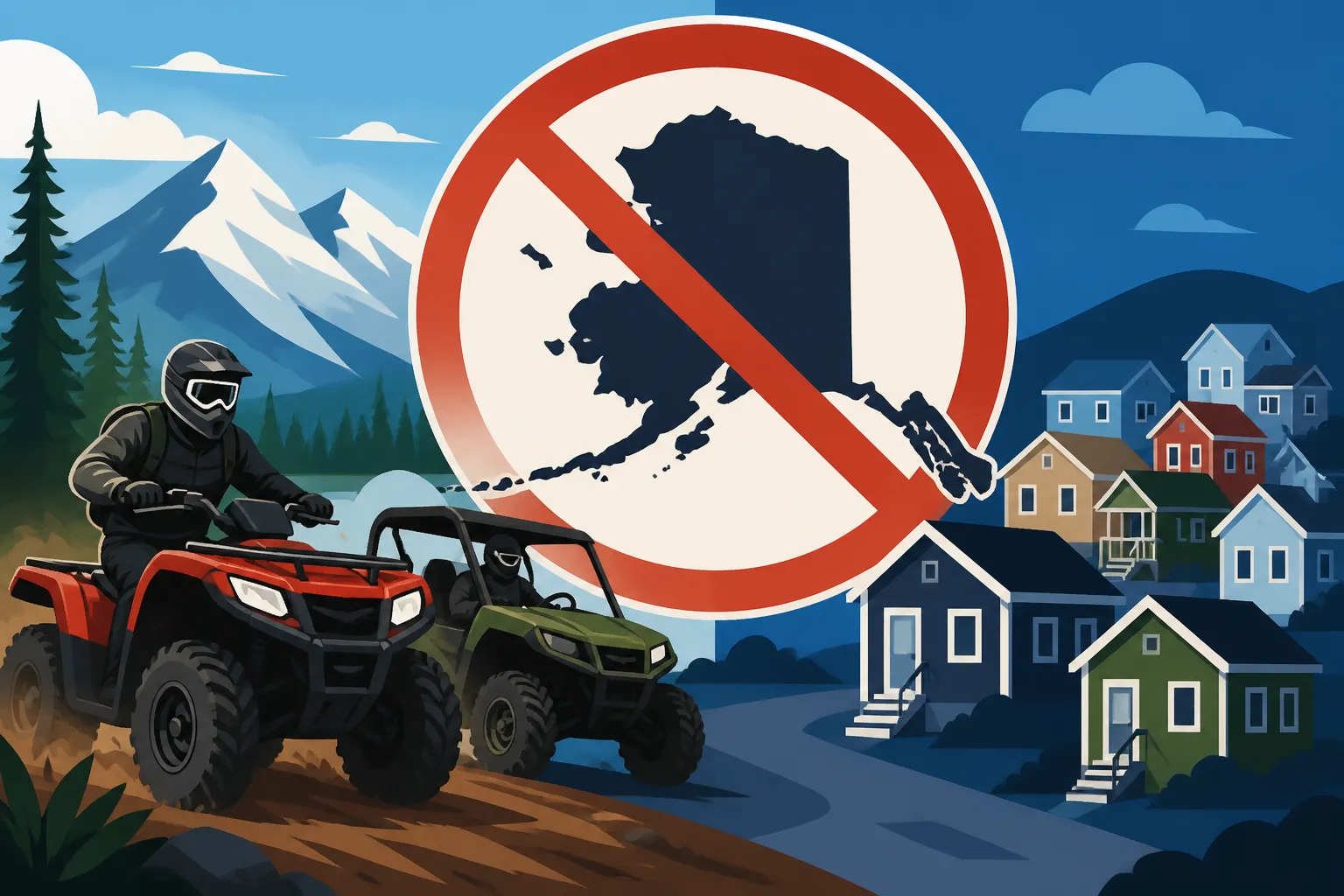
When the state allows communities to make their own decisions about APV road use, it inevitably leads to a patchwork of regulations. For many riders, the dream of cruising from town to trailhead on their quad quickly bumps up against the reality of local bans. Alaska has several communities that have decisively chosen to prohibit APV use on their roads, and knowing which ones these are can save you a lot of hassle and potential legal trouble. This isn't about shaming these places; it's about acknowledging their right to govern their streets and helping riders respect those boundaries.
Anchorage, Fairbanks, and Juneau: Major Hubs Off-Limits
It often comes as a surprise to visitors and even some newer residents that Alaska's three largest cities have all opted out of allowing APV road use. If you're planning on riding your side-by-side on the paved streets of these metropolitan areas, think again. [Alaska Bans APVs in Anchorage], which means you won't be cruising down Dimond Boulevard or along the Old Glenn Highway within city limits. The reasons are pretty straightforward: these are dense urban environments with high traffic volumes, lots of pedestrians, and a focus on traditional vehicle traffic. Integrating ATVs and UTVs into such complex ecosystems is simply deemed too hazardous and disruptive by local lawmakers.
Similarly, [Alaska Bans APVs in Fairbanks]. While Fairbanks is known for its access to vast wilderness areas, the city's core itself is off-limits for APV road travel. You might see machines operating on trails just outside the city, but the moment you hit the paved streets of downtown Fairbanks, you're breaking local ordinance. The same holds true for the state capital, [Alaska Bans APVs in Juneau]. With its unique geography and often narrow, winding roads, adding APV traffic to Juneau's streets would create significant safety and logistical challenges. These bans reflect a clear decision by these major population centers to prioritize other forms of transportation and traffic management on their roadways.
Mat-Su Valley Towns: Wasilla and Palmer
Moving north from Anchorage into the rapidly growing Mat-Su Valley, you'll encounter two more communities that have decided against allowing APV road use: Wasilla and Palmer. These towns have seen significant population booms, transforming them from smaller, more rural centers into bustling communities with increasing traffic and suburban characteristics. This growth has brought with it the challenges of managing diverse modes of transportation and ensuring public safety.
[Alaska Bans APVs in Wasilla], so don't plan on riding your quad down the Parks Highway or through the city's commercial areas. The city council has made a clear stance on this, reflecting the desire to maintain a predictable and safe road system for cars, trucks, and pedestrians. Likewise, [Alaska Bans APVs in Palmer]. While Palmer might retain more of its small-town charm compared to Wasilla, its main streets and residential areas are also off-limits for APV road travel. For riders in the Mat-Su, this means you'll need to trailer your machine to designated trailheads or areas where road use is explicitly permitted, rather than attempting to ride through town to get there. It's a common oversight, especially for those new to the area, but one that can lead to an expensive lesson if ignored.
Kenai Peninsula Communities: Kenai, Soldotna, and Homer
Down on the beautiful Kenai Peninsula, often called "Alaska's Playground," you'll find three more communities that have opted out of the statewide APV road use statute: Kenai, Soldotna, and Homer. These towns are popular destinations for fishing, tourism, and outdoor recreation, but their municipal roads are not open for APV travel. This can be particularly confusing in areas where fishing access points or trailheads might seem just a short hop down a paved road.
[Alaska Bans APVs in Kenai], meaning you can't ride your machine on the main roads in the historic old town or towards the Kenai River beaches. The same applies to its neighbor, [Alaska Bans APVs in Soldotna]. The commercial strip along the Sterling Highway through Soldotna is a busy thoroughfare, and local ordinances prohibit APVs from joining that traffic flow. Farther south, the picturesque town of [Alaska Bans APVs in Homer] also maintains a ban on APV road use. While the Homer Spit might seem like a unique place to cruise on a UTV, local law dictates otherwise. These communities, despite their proximity to vast wildlands, have chosen to keep their urban and semi-urban road systems free of APV traffic to manage safety and community aesthetics, meaning riders need to transport their machines to areas where trail access or permitted road use begins.
Here's a quick look at the communities that have opted out:
| Community | Region | APV Road Use Status | Common Rationale |
|---|---|---|---|
| Anchorage | Southcentral | Banned | High population, traffic density, public safety |
| Fairbanks | Interior | Banned | Urban traffic, pedestrian safety |
| Juneau | Southeast | Banned | Unique geography, narrow roads, traffic flow |
| Wasilla | Mat-Su Valley | Banned | Rapid growth, increased traffic, suburban character |
| Palmer | Mat-Su Valley | Banned | Growing community, main street congestion |
| Kenai | Kenai Peninsula | Banned | Traffic management, tourist safety, residential zones |
| Soldotna | Kenai Peninsula | Banned | Busy commercial corridors, safety on highways |
| Homer | Kenai Peninsula | Banned | Tourism focus, unique geography, traffic flow |
What "Opted Out" Means for Riders
When a community opts out of Alaska's statewide APV road use provisions, it's not a suggestion; it's a rule with legal teeth. This isn't just a minor inconvenience; it fundamentally changes how you can interact with your machine in that area. Understanding the full implications of an opt-out decision is crucial for staying on the right side of the law and ensuring a hassle-free riding experience. It’s the difference between an enjoyable day on the trails and a costly interaction with law enforcement.
Complete Prohibition vs. Partial Restrictions
For the communities that have "opted out," it generally means a full prohibition on APV road use within their incorporated limits. This isn't usually a situation where certain roads are allowed and others aren't, or where there are specific times you can ride. Instead, if a city or borough has opted out, you should assume that virtually all public streets and roads within its jurisdiction are off-limits for your ATV or UTV. This means that even if you're just trying to cross a street to get to a gas station or move from one section of a trail to another, if that street is within an opt-out community, it's a no-go.
While some communities that haven't opted out might have their own partial restrictions – for example, limiting speed or certain road types – an "opt-out" typically implies a much broader ban. It's not a nuanced approach; it's a clear statement that APVs are not considered compatible with their public road infrastructure. This is why a simple online search or a quick phone call to the local police department or city hall is always a smart move before you even load your machine onto a trailer for a trip to a new riding area. Don't assume that just because it's a small town, it's automatically open to APV road use.
Consequences of Riding in Restricted Areas
Ignoring a municipal ban on APV road use can lead to a range of unpleasant and expensive consequences. The most immediate and common outcome is receiving a citation. [Alaska Ticket Costs for Road Riding] can vary, but even a basic traffic ticket for an APV infraction can add up quickly with fines and court costs. This isn't just a slap on the wrist; it can be a significant dent in your wallet that could have been easily avoided with a little research.
Beyond a ticket, there's always the possibility of your machine being impounded. If law enforcement deems your operation of an APV on a prohibited roadway to be particularly egregious, unsafe, or if you're a repeat offender, they may tow and store your vehicle. Retrieving an impounded machine involves towing fees, storage fees, and often requires proof of ownership and payment of all outstanding fines. This entire process can easily cost hundreds, if not thousands, of dollars. It’s a very real deterrent designed to enforce these local ordinances. Nobody wants to be stranded miles from home or have to deal with the logistical nightmare and expense of retrieving their prized UTV from an impound lot. Remember that [Alaska Penalties for Riding Unregistered] machines can be compounded if you're also riding on a prohibited road, making the situation even worse.
Navigating the Legal Landscape Beyond Opt-Out Zones
While it's important to know where you can't ride your APV on the road, it's equally important to understand that many areas in Alaska do permit it, albeit with regulations. Alaska is a vast state, and the rules are far from uniform. The key to enjoying your machine on public ways without incident is thorough research and a commitment to understanding local nuances. It's a bit like learning the local fishing holes; you need to know the specific regulations for each stream, not just the general statewide rules.
Communities That Still Allow Road Use
Thankfully, the list of communities that have not opted out is extensive, especially in more rural and remote parts of the state. These are the places where APVs often play a crucial role in daily transportation, whether it's for subsistence activities, accessing remote cabins, or simply getting around town. For example, [Nome's Citywide OHV Access in Alaska] is a well-known exception, where APVs are very much a part of the everyday streetscape, helping residents navigate the unique landscape and often serving as primary transportation.
Beyond Nome, many smaller villages and unincorporated areas will allow APV road use, often under the state's general provisions. However, even in these areas, it's crucial to remember the statewide rules: the 45 mph speed limit, the need for a driver's license, and liability insurance. Furthermore, some communities that haven't outright banned APVs might still have specific streets or zones that are off-limits, or they might impose curfews or noise restrictions. So, while [Which Alaska Towns Have Not Banned APVs?] is a long list, it's never a blank check to ride anywhere. Always assume there are rules, and seek them out before you ride.
Checking Local Ordinances Before You Ride
This point cannot be stressed enough: always check local ordinances before you ride your APV on any public road. This is your best defense against unexpected fines and legal trouble. A quick online search for the specific city or borough name along with "ATV ordinance" or "OHV rules" will often yield the relevant information on their municipal website. Many communities post their entire code of ordinances online, allowing you to read the specific language that applies to APVs. If online resources are scarce or unclear, don't hesitate to call the local city hall, borough office, or the non-emergency line of the local police department or state troopers. They are the definitive source for current regulations.
Taking the time to [Checking a City Code Before You Ride] can save you a world of trouble. Imagine planning a multi-day trip, only to discover on day one that you can't even ride your machine to the local gas station because of a local ban. This kind of preparation is especially important if you're visiting a new region or a community you're unfamiliar with. What might be perfectly legal in your hometown could be strictly prohibited just a few hundred miles away. Also, remember that rules can change, so even if you rode through a particular town five years ago without issue, it's worth a quick re-check. Lastly, be mindful of specific rules for [Alaska Riding After Dark], which might include additional lighting requirements even in areas where APV road use is otherwise permitted.
Essential Gear and Practices for Responsible Riding
Riding an ATV or UTV in Alaska, whether on a remote trail or a permitted road, requires a certain level of preparedness. It's not just about knowing the rules; it's about having the right equipment and adopting responsible practices to ensure your safety and the longevity of your machine. Even in areas where road use is allowed, your APV needs to meet certain standards to be considered street-legal. Think of it as gearing up for any other serious outdoor activity – you wouldn't go hiking in the Chugach in flip-flops, and you shouldn't ride an unprepared machine on public ways.
Equipment for State-Legal Road Riding Where Allowed
For those fortunate enough to ride their APV on public roads where it's permitted, your machine needs to be equipped similarly to a motorcycle or small car in many respects. This goes beyond just the basics you might use for trail riding. First and foremost, you need proper lighting. This means a working headlight that is visible at a specific distance, a taillight, and often brake lights. Reflectors are also typically required to enhance visibility, especially from the sides. You can find many of these crucial upgrades, like lighting kits, mirrors, and turn signals, from aftermarket specialists like SuperATV, ensuring your machine meets the legal requirements without sacrificing performance.
Beyond lighting, your machine must have functional brakes on all wheels. A horn or other audible warning device is usually a must-have, allowing you to alert other drivers or pedestrians to your presence. [Alaska OHV Equipment Requirements] also often include a muffler and emission controls to minimize noise and air pollution, and a spark arrester is critical for preventing wildfires, especially during dry seasons. In fact, [Alaska Spark Arrester Requirements] are a non-negotiable for riding in many public land areas. Having all these components not only makes your machine legal but also significantly enhances your safety and courtesy to others on the road.
Planning Your Route and Staying Informed
Responsible riding isn't just about what you carry; it's about how you plan. Before you even fire up your machine, you should have a clear understanding of where you're going, what the terrain will be like, and crucially, what the legal status of the land and roads you'll traverse is. This is particularly important in Alaska, where land ownership can be a complex mosaic of state, federal, borough, Native Corporation, and private parcels, each with its own set of rules.
Utilizing resources like [Alaska Land Status Maps] and conducting [Alaska Land Ownership Lookups] are invaluable steps. These tools can help you identify who owns the ground you plan to ride on and, consequently, which rules apply. Don't assume that because one section of a route is legal, the entire route is. You might start on state land, cross private property, and then hit a municipal road, each with different regulations. Always plan for the most restrictive rules along your route. Additionally, consider communicating your travel plans to someone reliable, especially if you're venturing into areas with no cell service. A satellite messenger, also available from reputable gear suppliers, can be a lifesaver in an emergency. Being well-informed and well-prepared makes for a safer, more enjoyable, and legally compliant ride.
Other Important Considerations for Alaska ATV/UTV Riders
Beyond the specific rules of road use and the "opt-out" communities, there are broader aspects of ATV/UTV ownership and operation in Alaska that every rider should be aware of. These foundational elements ensure that you’re not only compliant with the law but also contributing to a sustainable and respectful riding culture. Alaska's unique environment and diverse communities demand a thoughtful approach to outdoor recreation, especially when operating powerful machines.
Registration and Insurance Basics
First things first: most APVs operated in Alaska need to be registered with the state, especially if you plan to ride on public land or any road where it's permitted. The question, "[Do You Need to Register an ATV in Alaska?]", is typically met with a resounding yes, though there are specific exemptions for private land use. Registering your machine helps fund trail maintenance and enforcement, and provides a clear record of ownership. Understanding [Alaska APV Registration Requirements] involves knowing what paperwork you need, like a bill of sale or manufacturer's statement of origin, and where to submit it.
Equally important, and often overlooked by purely off-road riders, is insurance. As mentioned earlier, [Alaska ATV Insurance Requirements] are mandatory if you intend to operate your APV on any public roadway where it's permitted. This isn't just about avoiding a ticket; it's about financial protection. In the event of an accident, liability insurance can cover damages to other vehicles, property, or injuries to other people. Even if you only ride on trails, having comprehensive insurance can protect your investment against theft, damage, or other unforeseen events. Don't let a misunderstanding about insurance turn a fun ride into a financial catastrophe.
Respecting Local Customs and Environment
Riding in Alaska isn't just about legal compliance; it's about showing respect for the land, the wildlife, and the people who call this state home. Alaska's environment is incredibly fragile, and careless riding can cause irreversible damage. The tundra, for instance, recovers extremely slowly from damage, and rutting it with your tires can leave scars that last for decades. Understanding [Alaska Tundra Damage and Riding] is crucial for protecting this delicate ecosystem. Similarly, [Alaska Wetland Riding Restrictions] are in place to preserve critical habitats and water quality, and knowing these limitations is part of being a responsible rider.
Beyond the environment, there's a strong culture of outdoor ethics and respect for private property and local communities. This includes being mindful of noise levels, especially when riding near residential areas, and understanding that what might seem like a shortcut to you could be someone's private driveway or traditional subsistence trail. In more remote communities, APVs are often a vital part of life, and showing courtesy and respect to locals goes a long way. Always ask permission before crossing private land, and be mindful of your impact on shared resources. By combining legal knowledge, proper equipment (perhaps including some protective gear from SuperATV), and a deep respect for Alaska's unique character, you can ensure your ATV and UTV adventures are safe, enjoyable, and sustainable for everyone.
Disclaimer
This article is for general informational purposes only and does not constitute professional advice. Laws, prices and regulations vary by location and change over time. Consult a qualified professional for guidance on your specific situation.