Can You Ride an ATV on the Road in Alaska?
One of the most common questions I hear from folks new to Alaska, or even long-time residents looking to explore more with their ATV or UTV, is whether they can actually ride their machine on the road. It's a valid question, full of nuances, and frankly, the rules can feel a bit like navigating a braided river – constantly shifting and sometimes unclear. This guide is here to cut through that confusion, explaining exactly when and where your all-purpose vehicle can legally hit Alaska's roadways.
The Great Alaskan Road Debate: Is Road Riding Even Possible?
Let's get right to it. The short answer to "Can you ride an ATV on the road in Alaska?" is: sometimes, under very specific conditions, and it varies wildly depending on where you are. It's not a blanket "yes" or "no," and that's precisely where the frustration often comes in. Alaska law defines these machines as "All-Purpose Vehicles" or APVs, which covers a broad spectrum including ATVs, UTVs, and even dirt bikes and some six-wheelers. The state's general stance is that APVs are meant for off-road use, but they've carved out exceptions, and more importantly, they've given local communities a lot of power to make their own rules.
Imagine you've just unhooked your trailer at a trailhead near Palmer, excited for a day of riding. You might look at a short stretch of paved road connecting to a dirt trail and wonder if it's okay to just drive your quad that half-mile. Or perhaps you're in a smaller community in rural Alaska, where the main "street" is a gravel track, and everyone seems to be using their ATVs to get to the store or post office. These are the real-world situations that make the rules feel so important, and so complicated. The key takeaway here is that while the state sets some baseline rules, local city and borough governments often have the final say, adding layers of complexity that can trip up even experienced riders. Understanding [Alaska APV Class Explained] is a good starting point for what exactly falls under this umbrella.
The Nuances of Alaska's APV Road Rules
Alaska's approach to APV use on public roads is a patchwork, designed to balance access for residents with safety concerns and the distinct character of different communities. You can't just assume what's okay in one town will be okay in another. This section will break down the state-level conditions that open the door to road use, as well as the critical role local ordinances play in either welcoming or restricting your ride.
State-Level Conditions for Road Access
At the state level, there are some fundamental criteria that, if met, could allow an APV to operate on a public road. The most significant of these is the speed limit of the road itself. Generally, your APV can only be operated on roads where the posted speed limit is 45 mph or lower. This immediately rules out most major highways and many arterial roads, especially those connecting larger population centers. It's not just about how fast your machine can go, but about the legal speed designation of the road you're on. A trooper isn't going to care if you're only doing 30 mph; if the sign says 55, you're in violation.
Beyond the speed limit, there are very specific rules for crossing a highway or riding on the shoulder. While you generally can't cruise down the highway, state law often permits crossing a public road at a right angle to get from one legal riding area to another, provided you do so safely and quickly. Riding on the shoulder of a state-maintained road is also tightly restricted and usually only allowed if there's no other practical way to access a trail or private property, and again, only on roads posted 45 mph or less. These aren't invitations for joyrides; they are narrow allowances for essential access. For a comprehensive overview, checking out [Alaska APV Road Rules Explained] can clarify many of these points.
Local Control: City and Borough Ordinances
Here's where things get really interesting, and often, really frustrating. Alaska empowers its cities and boroughs to enact their own ordinances regarding APV use on local roads, and many have taken them up on it. This means that a road that's perfectly legal to ride on in one community might land you a hefty ticket just a few miles down the road in another. Many of Alaska's larger population centers have outright banned APV use on their roads. For example, [Alaska Bans APVs in Anchorage], and the same goes for Fairbanks, Juneau, Wasilla, Palmer, Kenai, Soldotna, and Homer. If you're planning a trip to any of these areas, assume your machine needs to stay off the pavement, or at least be trailered.
However, other communities have embraced APV use as a vital part of transportation and recreation. In places like Nome or certain bush communities, APVs are a primary mode of transport, and their ordinances reflect that necessity, often allowing broader access on community roads, sometimes even with designated routes or specific hours of operation. It's a stark contrast to the road system towns. The absolute best advice I can give you is this: always check the local city or borough code before you ride. A quick call to the city clerk's office or a search on their website can save you a lot of headache and potential fines. This is truly where the phrase "ignorance of the law is no excuse" hits home for ATV riders. For more specific information on where you can and can't ride, delving into [Alaska Communities That Ban APV Road Use] is highly recommended.
Rider Requirements and Safety Gear
Beyond where you can ride, Alaska also has rules about who can ride and what equipment your machine needs to have, especially if it's going to touch a public road. First and foremost, if you're operating an APV on any public road, you need a valid Class D driver's license. This isn't a suggestion; it's a legal requirement, just like driving a car. Don't leave home without your license, and definitely carry it on your person when you're out riding. [Carrying Your Driver's License on Every APV Ride] is crucial, as a trooper can and will ask for it.
Then there's the question of insurance. While not always required for off-road use on private land, if your APV is going to be operated on a public highway or road where APVs are permitted, you generally need to carry liability insurance. This protects you and others in case of an accident. It's a smart idea anyway, given the cost of repairs and potential medical bills. [Proof of Insurance on a Quad] should be kept with your registration and driver's license.
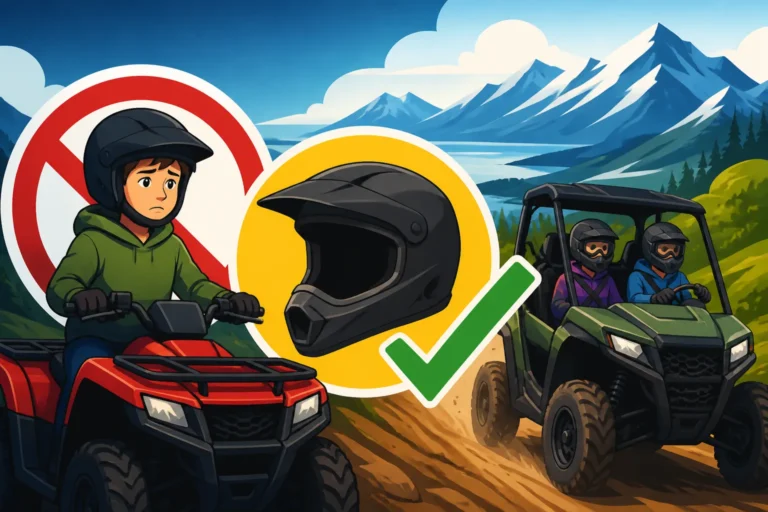
Finally, safety gear is a big one, especially for younger riders. Alaska has a helmet law for riders under 16 years of age. If your child, or any passenger under 16, is on an APV, they absolutely must be wearing a helmet. This applies whether you're on a trail or a permissible road. Even for adult riders, while not always legally mandated, wearing a helmet is just plain common sense. The terrain can be unpredictable, and a helmet can be the difference between a minor tumble and a life-altering injury. [Alaska Helmet Law for Riders Under 16] details these requirements further.
Navigating the Exceptions and Staying Legal
It's clear that riding an APV on Alaska's roads isn't as straightforward as hopping in your truck. But for those specific instances where it is allowed, understanding the nuances of these exceptions is key to avoiding trouble and staying safe. This isn't about finding loopholes; it's about respecting the framework that exists.
Crossing Public Roads and Shoulders
We've touched on this, but let's dive a bit deeper into what "crossing" actually means. It's not a casual drive-across. When you're permitted to cross a public road, the law generally means you should do so at a right angle to the roadway, and you should aim to take the shortest practical route to get from one side to the other. Think of it like crossing a busy street on foot – you wouldn't wander diagonally; you'd go straight across at an intersection. This minimizes your time on the paved surface and reduces the potential for conflict with other vehicles. Always yield to traffic on the road, of course.
Riding on the shoulder of a road is another area where many riders get confused. In Alaska, riding on the shoulder is generally restricted to situations where there is no other reasonable way to access an adjacent trail, property, or another legal riding area. It's not an alternative thoroughfare for long distances. You should be riding as far to the right as safely possible, and again, only on roads with a speed limit of 45 mph or lower. This is often where proper machine equipment comes into play, as visibility becomes paramount.
Specific Use Cases: Village Streets and Access
Many of Alaska's smaller, rural communities and villages have a distinctly different relationship with APVs. In places off the main road system, an ATV or UTV isn't just a recreational toy; it's often the primary mode of transportation. These communities often have local ordinances that reflect this necessity, allowing APVs on "village streets," which might be gravel roads or even packed earth paths. You'll see locals using them to get to the store, the clinic, or the post office, or to access subsistence hunting and fishing grounds.
However, even in these areas, there can be specific rules about speed, noise, or areas where machines are prohibited, such as near schools or residential areas after certain hours. For visitors or new residents, it's absolutely critical to ask the locals or the village council about their specific rules. What might be common practice for a long-time resident could still be a violation if you're unfamiliar with the local nuances. This context is important, as the intent isn't always recreational; it's often about daily life and essential access.
The Importance of Knowing Your Route
Ultimately, staying legal and safe while riding your APV in Alaska comes down to diligent preparation and respect for the rules. Before you ever head out, especially if your route involves any roads, you need to know the land status and local ordinances of every inch of your planned ride. Land status maps can show you if you're on state land, federal land, private property, or Native corporation land, all of which can have different rules. For instance, [Alaska State Park ATV Rules] will be different than rules for Bureau of Land Management (BLM) land.
Ignoring these rules, whether intentionally or out of ignorance, can lead to significant consequences. Troopers and local law enforcement actively patrol areas where APV use is common, and they are well-versed in both state statutes and local ordinances. Penalties can range from hefty fines to impoundment of your machine. It's not worth the risk. Always take the time to understand where you're riding, and remember that even if you think a stretch of road looks clear, there might be a local ban in effect. [Checking a City Code Before You Ride] is truly your best defense against an unexpected citation.
Equipping Your Machine for Alaska Road Use (Where Permitted)
If you're in an area where APV road use is permitted, even for short crossings or shoulder travel, your machine needs to be properly equipped to handle both the demands of the road and the scrutiny of law enforcement. This isn't just about legality; it's about safety for yourself, your passengers, and other drivers.
Essential Safety and Visibility Upgrades
Visibility is paramount when you're sharing any space with cars and trucks, even briefly. State law dictates that your APV must have certain equipment if it's going to be operated on a public road. This includes functioning headlights and taillights that are visible from specific distances, especially when riding after dark. Your headlights, for instance, need to illuminate objects at least 100 feet ahead, and your taillights and reflectors should be visible from 1,000 feet behind. [Lights That Work at Midnight] aren't just for trails; they're vital for road safety. Brake lights are also essential. While turn signals might not always be legally required for APVs, installing them is a smart safety upgrade that makes your intentions much clearer to other drivers. Many aftermarket companies, like SuperATV, offer comprehensive lighting kits that can easily upgrade your machine's visibility.
Beyond lighting, reflectors are a non-negotiable requirement, typically needing to be mounted on the front, rear, and sides of your machine. These are crucial for passive visibility, especially if your lights aren't on or fail. Many riders also add mirrors to their ATVs or UTVs. While not always legally mandated for APVs, mirrors significantly improve your ability to monitor traffic behind you and make safer maneuvers. Again, SuperATV offers robust mirror options that can withstand rough trail conditions while providing excellent rear visibility on the road. Finally, your machine needs to have intact body panels and mud flaps behind the tires to prevent throwing rocks and debris onto other vehicles, which is a common complaint from motorists sharing roads with ATVs.
Compliance and Performance
Beyond visibility, your machine needs to comply with environmental and mechanical regulations. A functioning muffler and spark arrester are absolutely critical. A muffler keeps your machine's noise levels within acceptable limits, preventing noise complaints and potential fines. An intact spark arrester, which is a screen or device in the muffler, is designed to prevent hot carbon particles from escaping the exhaust and potentially starting a wildfire – a massive concern in Alaska's dry summers. [What Counts as a Legal Muffler in Alaska] can give you more details.
Your brakes must be in good working order, capable of stopping your machine effectively. A self-closing throttle is also a requirement, meaning the throttle automatically returns to idle when you release it, which is a crucial safety feature to prevent runaway machines. When considering tires, if you anticipate mixed use (trail and road), you'll want tires that offer good grip on both loose terrain and pavement without excessive wear. While a winch and recovery gear aren't directly road-legal requirements, they are indispensable for serious Alaska riding. If your legal road access leads to remote trails, a high-quality winch from a brand like SuperATV can be a lifesaver when navigating challenging conditions or recovering a stuck machine far from help. Equipping your machine correctly means you're prepared for the varying conditions Alaska throws your way, whether it's a short paved section or a challenging backcountry trail.
Disclaimer
This article is for general informational purposes only and does not constitute professional advice. Laws, prices and regulations vary by location and change over time. Consult a qualified professional for guidance on your specific situation.