Alaska Rules for a Visiting Washington Rider
Arriving in Alaska with your trusty ATV or UTV from Washington state can feel like you're entering a whole new world, and the rules of the trail – and the road – can be just as foreign as the landscape. Many riders from the Lower 48 assume their home state's registration and street-legal status will simply transfer, only to find themselves scratching their heads at Alaska's unique approach. This guide is here to untangle the complexities for Washington riders, helping you understand what's required to legally hit Alaska's trails and, in some rare cases, its roads.
Understanding Alaska's APV Classification for Out-of-State Riders
First things first: Alaska calls your ATV or UTV an "all-purpose vehicle," or APV. This might seem like a minor detail, but it's important because many of the state's laws and regulations specifically refer to this classification. While Washington has its own definitions for ORVs (Off-Road Vehicles) and wheeled ATVs, Alaska lumps a lot of these machines into one broad APV category for registration and use purposes. This classification is key to how Alaska views your machine, whether it's a nimble quad or a sprawling side-by-side.
How Alaska Defines an APV
In Alaska, an APV is generally defined as a motorized vehicle, other than a snowmobile, with an unladen weight of 1,500 pounds or less, 50 inches or less in width, and designed to travel on land other than a highway. Now, that's the classic ATV definition. However, the state also includes utility-type vehicles (UTVs or side-by-sides) in many of its APV regulations, even if they exceed the 50-inch width or 1,500-pound weight. The key is often whether the machine is designed for off-road use. This broad interpretation means that most of what Washington riders call ATVs, UTVs, or side-by-sides will fall under Alaska's APV umbrella. This impacts everything from where you can ride to what kind of registration you might need, even if you’re just visiting. It’s a common frustration for folks who are used to more granular definitions back home, but in Alaska, it’s about simplifying for enforcement.
Key Differences from Washington's ORV Designations
Washington state has a fairly detailed system for ORVs, distinguishing between ATVs, ORV motorcycles, and wheeled ATVs (WATVs). You might have different registration requirements or permits depending on your machine type and where you plan to ride. In contrast, Alaska's APV designation is more encompassing. While Alaska does exclude some specific machines like [Alaska Excludes Snowmobiles From APV] or [Alaska Excludes Tracked Vehicles] from the APV class, for the most part, your typical ATV or UTV from Washington will be considered an APV here. This broad classification means you're generally subject to the same set of APV rules as a local Alaskan, regardless of what Washington calls your machine. The biggest mental shift for many Washington riders is realizing that their machine, which might be street-legal in certain scenarios back home, is almost certainly not considered "street legal" by Alaska's Department of Administration without meeting very specific and rarely practical criteria.
Registration and Decal Requirements for Visiting Washington ATVs
This is where a lot of confusion, and potential tickets, can arise for out-of-state riders. Many assume their Washington registration and plates are sufficient for riding in Alaska. Unfortunately, that's usually not the case. Alaska has specific requirements for APVs operating on public lands, and these often apply to visitors as well. Ignoring these rules can lead to fines and a sour start to your Alaskan adventure.
Does Your Washington ATV Need Alaska Registration?
Generally, yes, if you plan to ride on any public land in Alaska. Even if your machine is fully registered in Washington, Alaska law requires APVs to be registered with the Alaska Department of Administration, Division of Motor Vehicles (DMV) if they are operated on public land, which includes trails, state recreation areas, and public access points. The primary exception is if you are riding exclusively on private land you own or have permission to use, as explained in [Alaska Private Land Registration Exemption]. However, for most visiting riders eager to explore Alaska's vast wilderness, public land access is the goal, and that means getting an Alaska decal. This can be a bit of a shock for riders who are used to reciprocity agreements between states for standard vehicle registration, but Alaska treats APVs somewhat differently. Don't risk getting caught without the proper decal – it's an easy step to take to ensure your trip goes smoothly.
To make things clear, here's a quick comparison:
| Scenario | Washington Registration Status | Alaska Registration Needed? | What You Get in Alaska |
|---|---|---|---|
| Riding on Alaska Public Trails | Any valid ORV registration | Yes | Alaska APV Decal |
| Riding only on private land in AK | Any valid ORV registration | No (with owner permission) | N/A |
| Just transporting through Alaska | Any valid ORV registration | No | N/A |
| Resident of Alaska with AK machine | N/A | Yes | Alaska APV Decal |
How to Get an Alaska Decal for Your Visiting Machine
Getting an Alaska APV decal for your Washington-registered machine involves a trip to an Alaska DMV office or one of its partner offices. Unfortunately, [Alaska Has No Online OHV Registration]. You'll need to fill out [The Vehicle Transaction Application Every OHV Owner Files]. You'll also need proof of ownership, such as your Washington title or registration, and your driver's license. The process is typically straightforward for out-of-state machines with clear ownership documentation. The fee is relatively modest, with options for [Alaska Charges $10 for Two Years], [Alaska Charges $20 for Four Years], or [Alaska Charges $30 for Six Years]. Remember that all Alaska APV registrations, regardless of when you get them, expire on September 30th of the final year of your term, as detailed in [Every OHV Registration Term Expires on September 30]. Once you have your decal, make sure to place it correctly on your machine, typically on the tunnel side where it's [Alaska Decals Visible When Seated]. This ensures that state troopers or park rangers can easily verify your registration status when you're out exploring. It might seem like an extra hoop to jump through, but it's a necessary one for legal riding.
Road Riding Laws: Where Washington Riders Can and Cannot Go
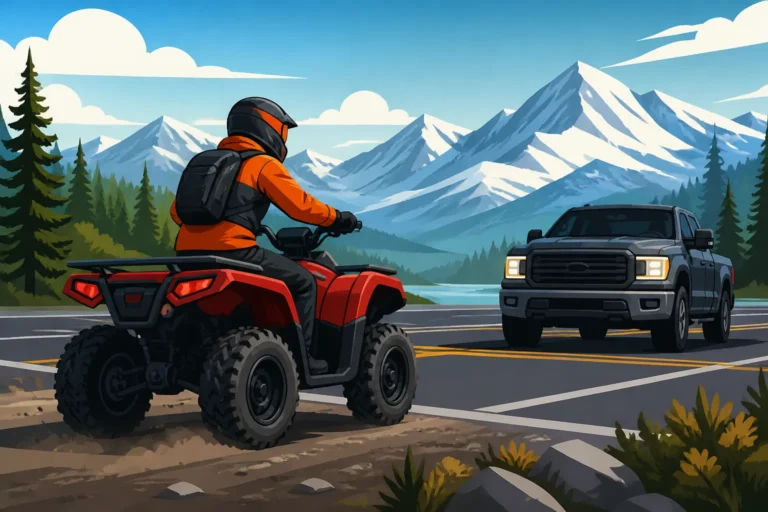
This is perhaps the biggest cultural and legal difference for Washington riders visiting Alaska. Back in Washington, there are specific regulations that allow for ORV use on certain public roads, especially in rural areas, often contingent on equipment and local ordinances. In Alaska, the rules for APVs on public roads are far more restrictive, and generally, an APV is simply not considered a "street legal" vehicle. This often catches visitors off guard and leads to preventable citations.
The General Ban on APVs on Alaska Public Roads
For the most part, [Alaska Bans APVs in Anchorage], [Alaska Bans APVs in Fairbanks], and generally prohibits them on any "highway" or public road in organized boroughs. While there are a few very specific, limited exceptions, such as crossing a highway (see [Crossing a Highway on a Quad in Alaska]) or using a shoulder to access private property, the overwhelming rule is no APVs on public roads. This differs significantly from parts of Washington where you might be able to ride your ATV on designated county roads. Alaskan law sees APVs as off-road vehicles, and that's where they belong. Trying to run into town for groceries or even connect trails via a paved road can quickly land you a ticket.
There are some exceptions, particularly in certain rural and [Alaska Village Corporation Land Rules] communities where APVs are a primary mode of transportation. For example, [Nome's Citywide OHV Access in Alaska] and [Bethel's ATV Ordinance in Alaska] are examples of communities that have their own rules. However, these are localized ordinances and do not apply to the vast majority of the state's road system. A visiting Washington rider should always assume that paved or maintained gravel roads are off-limits unless explicitly posted otherwise by local ordinance, and even then, these exceptions are rare for through-travel.
Specific Exceptions and What They Mean for You
While the general rule is "no roads," there are a few nuances. If you need to cross a highway, you must do so safely and perpendicularly, yielding to all traffic. You can't just drive down the middle of the highway to find your crossing point; it needs to be a direct transit from one side to the other. There's also a limited allowance for APVs on roads posted at 45 mph or less, provided the local municipality hasn't banned it, and you're meeting [Alaska APV Road Rules Explained] such as having a valid Class D driver's license and liability insurance. You also must be equipped with [Alaska OHV Equipment Requirements] like headlights, taillights, and brakes. However, [Alaska Bans APVs in Wasilla and Palmer] and many other populated areas even on these lower-speed roads. The critical takeaway here is to always check local ordinances before you even consider riding on a road. Relying on "it's allowed back home" or "I saw someone else doing it" is a recipe for trouble. Assume you need to trailer your machine to the trailhead.
Essential Equipment and Safety for Alaska Trails and Roads
Whether you're exploring the Knik River Public Use Area or venturing deep into the Interior, being properly equipped and riding safely is paramount in Alaska. The environment here can be unforgiving, and the nearest help might be hours away. While Washington has its own safety standards, Alaska has some specific requirements, particularly concerning helmets, lighting, and general machine integrity.
Required Equipment for Alaska APVs
Alaska has specific equipment requirements for APVs, especially if you ever intend to operate one on a public road (even for a crossing). Your machine needs functional headlights, a taillight, and brakes. You'll also need a muffler and emission controls that comply with state noise standards, and a spark arrester is mandatory, especially during dry seasons, as explained in [Alaska Spark Arrester Requirements]. Beyond the basics, if you're on a road, [Alaska Reflector Requirements] and [Alaska Mud and Snow Flap Rules] may apply.
Even if you're strictly off-road, these features are essential for safety. Imagine being caught out after dark on a remote trail with no functioning lights! Many experienced Alaskan riders also highly recommend a winch, a good toolkit, and extra fuel, as distances can be vast and services non-existent. For a more robust machine ready for Alaska's demanding conditions, many riders look to aftermarket accessories, like those from SuperATV, to enhance protection with skid plates, heavy-duty bumpers, or better lighting for those long, dark Alaskan nights. Ensuring your machine is in top shape before you leave Washington, and even more so before you hit an Alaskan trail, is crucial.
Helmet Laws and Rider Requirements
Alaska's helmet law is straightforward: any APV rider or passenger under the age of 16 must wear a helmet. This is similar to many states, including Washington. However, it's always a good idea for all riders, regardless of age, to wear a helmet, especially given the rugged terrain and potential for hazards. The state also requires that anyone operating an APV on a public highway (even where permitted for crossing or very limited road use) possess a valid Class D driver's license, as discussed in [Alaska Requires a Class D License]. [Alaska's Under-16 Helmet Fine] and subsequent offenses can be costly, so ensure any young riders in your party are properly protected. Beyond the law, consider the extreme conditions you might face. A good quality helmet, eye protection, and appropriate riding gear can make the difference between a minor incident and a serious injury in the Alaskan backcountry. Layering clothing is always a smart move, as weather can change dramatically in a short period.
Insurance and Incident Reporting
While Alaska does not have a statewide mandate for liability insurance for all APVs, it is required if you are operating your APV on a public highway. Given the high costs associated with accidents, and the potential for severe injuries or property damage, carrying liability insurance is strongly recommended regardless of where you ride. Many homeowners' policies exclude off-road vehicle use, so check with your insurance provider before your trip. For serious incidents, especially those involving injury or significant property damage, Alaska has specific [Alaska Accident Reporting for an ATV Crash] requirements. It’s always best to be prepared and understand what steps to take should an unfortunate event occur. While SuperATV might offer great parts to keep your machine running strong, they can't help with the aftermath of an uninsured accident. Stay safe, be prepared, and know the rules before you venture out.
Disclaimer
This article is for general informational purposes only and does not constitute professional advice. Laws, prices and regulations vary by location and change over time. Consult a qualified professional for guidance on your specific situation.