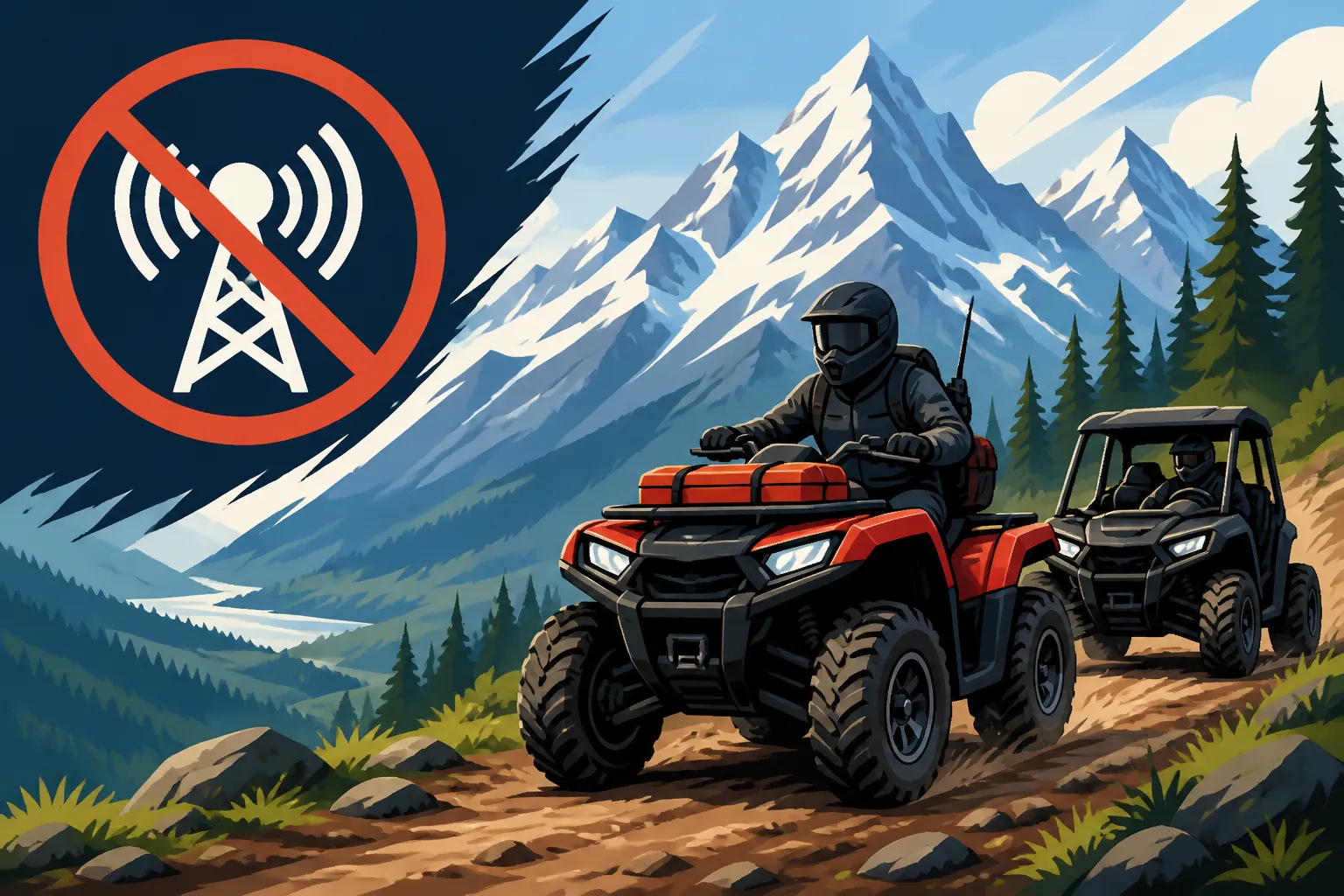
No Cell Coverage Off the Road System
Oh, the sting of that "no service" notification when you're miles into the Alaska backcountry, the sun beginning to dip, and that unexpected rattle starts up in your quad. It's a feeling every Alaskan ATV and UTV rider knows well – that sudden, sinking realization that you're truly on your own. This isn't like breaking down on a highway in the Lower 48 where a quick call to roadside assistance is usually just a few thumb taps away. Out here, the landscape demands a different kind of preparedness, and this guide is all about helping you navigate those vast, beautiful, yet often signal-less expanses safely and confidently.
The Harsh Reality of Alaska's Backcountry Cell Service
Let's be brutally honest: cell service in Alaska, once you leave the relatively populated road system, is largely a myth. It's a frustrating truth for anyone used to constant connectivity, but it's a fundamental aspect of adventuring in the Last Frontier. The sheer scale of our wilderness, combined with rugged topography and sparse population, makes universal cell coverage an economic and logistical impossibility for providers. This isn't just about inconvenience; it's about a critical safety gap that riders absolutely must understand and plan for.
Why "No Bars" is the Norm
Imagine the vastness of the Mat-Su Valley, stretching from the towering Chugach Mountains across braided rivers and dense forests. Now think about the infrastructure needed to provide reliable cell service across even a fraction of that. You'd need towers, power, and fiber optic lines in places that are often only accessible by ATV, plane, or boat for much of the year. Companies have made strides, sure, expanding coverage along major highways and into some more accessible recreational areas like parts of the Knik River Public Use Area. But step a few miles off the beaten path, turn a corner behind a ridge, or drop into a valley, and those precious bars often vanish faster than a summer mosquito. It’s not a flaw in your phone; it’s the reality of the Alaskan landscape.
Many riders, especially those new to Alaska or coming from urban areas, find this incredibly disorienting. They're accustomed to being able to pull up a map, check the weather, or send a quick text to family members. Here, that luxury evaporates, and with it, a layer of perceived security. Understanding why this is the norm helps recalibrate your expectations and reinforces the need for alternative communication methods and self-reliance. It’s not a bug; it’s a feature of our wild places, and it requires a different mindset.
The Illusion of Sporadic Coverage
Sometimes, you might get a bar or two. You might even manage to send a garbled text message that eventually goes through, or load a tiny sliver of a weather forecast. This sporadic, unreliable coverage can actually be more dangerous than no coverage at all, because it creates a false sense of security. You might find yourself thinking, "Oh, I'll probably get service on that next ridge," only to discover you're still in a dead zone when you truly need to make contact.
This is particularly true in areas where major roads pass through remote stretches. You might have fleeting service as you drive the [Denali Highway's 135 Miles in Alaska], for example, but as soon as you turn off onto an ATV trail, that connection is gone. This "now you see it, now you don't" phenomenon means you can never assume you'll have service when you need it most. It’s crucial to treat any area beyond established towns and major corridors as a no-service zone, regardless of what your phone might occasionally flicker on its screen. Don't rely on a fleeting signal to get you out of a bind; instead, prepare as if you'll have zero contact the entire time.
What Happens in an Emergency Without a Signal
This is where the rubber meets the road, or rather, where the mud meets the tire and you realize you're stranded. Without cell service, a flat tire on the outskirts of Anchorage is an inconvenience. A broken axle deep in the Talkeetna Mountains is a serious, potentially life-threatening situation. When you can't call for help, every minor incident can escalate rapidly.
Imagine this scenario: you're exploring a remote trail, maybe pushing a bit further than usual, and your UTV hits a hidden rock, damaging the steering. You or a passenger sustains an injury that makes walking out impossible. If you don't have an alternative communication device, you're now relying entirely on luck – hoping another rider comes by, or that your [Filing a Trip Plan With Someone] pays off and someone realizes you're overdue. In Alaska, search and rescue operations are costly, time-consuming, and often dangerous for the responders. The weather can change in minutes, temperatures can plummet, and wildlife encounters are a real possibility. The absence of a simple cell signal can transform a mechanical problem into a survival situation very quickly. This is why having reliable tools for communication, independent of cellular networks, isn't a luxury; it's a necessity for safe backcountry travel here.
Essential Communication Tools When Off-Grid
Since your phone isn't going to cut it, you need to turn to technology specifically designed for satellite communication. These devices are purpose-built to work where cell towers don't exist, providing a crucial link to the outside world, whether for routine check-ins or genuine emergencies. Don't leave home without one, or better yet, a few.
Satellite Messengers: Your Lifeline
For most Alaska ATV and UTV riders, a satellite messenger is the absolute minimum requirement for off-grid communication. These compact devices utilize satellite networks to send short, pre-programmed text messages, track your location, and most importantly, send an SOS signal to a 24/7 monitoring center. Think of them as your digital flare gun, but with more precision.
Brands like Garmin inReach or Zoleo are popular choices, offering global coverage. You can send custom messages to friends and family, letting them know you're okay or giving them updates on your progress. This is invaluable for peace of mind, both for you and for those waiting for you at home. The tracking feature can also be a comfort, as loved ones can follow your route online. But the real game-changer is the SOS button. In a true emergency – a medical crisis, a serious breakdown, or a lost party – pressing that button instantly alerts rescue services, providing them with your exact coordinates. This significantly reduces search times and can literally be the difference between life and death. Many Alaskans wouldn't dream of heading into the backcountry without one. Seriously, if you're riding [Alaska Riding Off the Road System], you need one of these. [Carrying a Satellite Messenger Off the Alaska Road System] is truly non-negotiable.
Satellite Phones: For When You Need to Talk
While satellite messengers are fantastic for data and SOS, they aren't for long conversations. That's where a satellite phone comes in. These devices allow you to make and receive voice calls from virtually anywhere on the planet, provided you have a clear view of the sky. For extended trips into extremely remote areas, or for those who simply prefer the certainty of a two-way verbal conversation, a sat phone offers unparalleled communication capabilities.
They are generally more expensive to buy and operate than satellite messengers, with per-minute charges and activation fees, but for some, the cost is well worth the ability to speak directly with emergency services, family, or even a mechanic if you have a non-life-threatening but complex issue. While not every ATV rider needs a sat phone for every trip, if you're venturing deep into hunting grounds or exploring truly vast, multi-day routes, considering one, either for purchase or rental, is a very smart move. It provides a level of detail in communication that a messenger can't, allowing you to explain complex situations more fully.
Two-Way Radios: For Group Cohesion
When you're riding with a group, internal communication is just as important as external communication. Cell phones won't work, and shouting over engine noise and wind isn't practical. That's where two-way radios (walkie-talkies) become invaluable. They allow riders in your immediate party to talk to each other, coordinate maneuvers, warn about hazards, or simply check in on everyone's status.
There are various types, from basic FRS/GMRS radios with limited range suitable for smaller groups riding close together, to more powerful VHF/UHF radios with greater range, though these may require a license. For most ATV groups, a good set of GMRS radios is perfect for maintaining contact, especially when riding in varied terrain where riders might get separated by hills or dense trees. Imagine trying to navigate a tricky river crossing or a narrow, overgrown trail without being able to warn the rider behind you about a particularly deep rut or a hidden obstacle. Radios make group riding much safer and more enjoyable, ensuring that [Why Alaska Riders Travel in Pairs] is truly effective. Make sure they are charged and have spare batteries, as relying on them for hours of chatter can drain them quickly.
Here's a quick comparison of these critical communication tools:
| Feature | Satellite Messenger (e.g., Garmin inReach) | Satellite Phone (e.g., Iridium, Globalstar) | Two-Way Radio (e.g., GMRS) |
|---|---|---|---|
| Primary Use | SOS, tracking, limited text messages | Voice calls, global communication | Group communication |
| Coverage | Global (satellite-based) | Global (satellite-based) | Line-of-sight (local) |
| Cost (Device) | Moderate | High | Low to Moderate |
| Cost (Service) | Monthly/Annual subscription | Per-minute, monthly plans | No service cost (after device) |
| Emergency Use | SOS to monitoring center, location data | Direct call to emergency services | Only within group |
| Ease of Use | Relatively simple | Straightforward phone use | Push-to-talk, channel select |
| Battery Life | Excellent for messaging/tracking | Moderate (depends on talk time) | Good (rechargeable) |
Strategies for Staying Safe Beyond Cell Towers
Having the right gear is only half the battle. You also need a robust strategy to maximize your safety when venturing into areas where cell service is non-existent. This involves a combination of careful planning, smart riding habits, and a strong dose of self-reliance.
Filing a Trip Plan and Checking In
This is perhaps one of the most basic, yet most overlooked, safety practices for any backcountry adventure in Alaska. Before you head out, leave a detailed trip plan with a trusted friend or family member who is not going with you. This plan should include:
- Your exact route: List the trails you intend to take, any turn-offs, and your approximate path. Even if it's just general direction, knowing where you're aiming helps.
- Your estimated departure and return times: Be realistic. Build in buffer time for unexpected delays.
- A description of your vehicle(s): Make, model, color, and any distinguishing features.
- Names and contact information of everyone in your party.
- Your emergency contacts.
- What to do if you don't check in by a certain time: This is crucial. Instruct your contact person on when to initiate an alert, and who to call (e.g., Alaska State Troopers, local Search and Rescue, or the monitoring center for your satellite messenger).
When you return, make sure to check in with that person immediately. This prevents unnecessary worry and potentially, a costly and premature search operation. This simple act of communication, even before you lose cell service, can be a lifesaver. It’s like a digital breadcrumb trail that lets someone know where to start looking if you run into trouble. [Filing a Trip Plan With Someone] is not optional.
Riding with a Group: Strength in Numbers
As the old adage goes, there's safety in numbers, and nowhere is that truer than in the Alaska backcountry. Riding alone significantly amplifies the risks associated with breakdowns, injuries, or getting lost. If you're riding solo and something goes wrong, you're entirely dependent on yourself, or the slim chance of another party coming across you.
When you ride with a group, you instantly have:
- More hands for repairs: Fixing a flat tire or hauling a stuck machine out of a mud pit is much easier with help. SuperATV winch lines and recovery gear become much more effective when you have multiple people to operate and secure them.
- Redundant communication: If one person's satellite messenger fails, another's might still work.
- First aid capabilities: More people mean more chances that someone has first aid training and supplies.
- Moral support: Being stranded can be incredibly stressful; having companions makes it easier to keep spirits up.
- Shared knowledge: Different riders bring different experiences and skills, which can be invaluable when navigating challenging terrain or making decisions in difficult situations.
Always ensure everyone in the group knows the route, has essential gear, and understands the communication plan. It's a fundamental principle of [Why Alaska Riders Travel in Pairs].
Self-Sufficiency and Emergency Preparedness
Beyond communication devices, your ability to handle unexpected situations without external help is paramount. This means packing smart and being ready for anything Alaska throws at you.
Your machine:
- Pre-trip inspection: Always perform a thorough check of your ATV/UTV before heading out. Tires, brakes, fluids, battery, and lights.
- Basic repair kit: Include tools for common repairs like fixing a flat, replacing spark plugs, or tightening loose bolts. Spare belt, tire repair kit, zip ties, duct tape are all invaluable.
- Winch and recovery gear: For getting unstuck from mud, snow, or crossing difficult terrain. SuperATV offers a range of robust winches and recovery kits designed for the demands of the Alaskan wilderness, giving you confidence in sticky situations.
Your personal gear:
- Extra layers: Alaska weather is famously unpredictable. Pack for rain, wind, and sudden temperature drops, even in summer. [Packing for a Cold Snap in August] isn't just for August.
- Food and water: Enough for an extra 24-48 hours beyond your planned trip duration. Dehydrated meals, energy bars, and a water filter or purification tablets are smart additions.
- First aid kit: Comprehensive enough for minor injuries and severe trauma. Know how to use everything in it. Remember, you could be [First Aid Hours From a Hospital].
- Fire starting supplies: Waterproof matches, lighter, fire starter.
- Navigation tools: Physical maps and a compass, even if you have a GPS device. [Alaska ATV Trail Map Downloads] can be invaluable offline.
- Headlamp or flashlight: With extra batteries.
- Shelter: A lightweight tarp or emergency blanket can provide crucial protection from the elements if you're forced to spend an unexpected night out.
Planning Your Adventure with No Cell Service in Mind
Effective trip planning is your first line of defense against the challenges of off-grid travel. It's not just about packing gear; it's about anticipating problems and having solutions ready before you ever leave your driveway.
Mapping and Navigation Without GPS Apps
While your phone's GPS can be incredibly useful with downloaded maps, don't rely solely on it. Batteries die, screens break, and sometimes the GPS signal itself can be flaky in deep canyons or under heavy tree cover.
- Physical Maps: Carry detailed topographical maps of your intended riding area. Learn how to read them and use them with a compass. Practice this before you need it in an emergency. The Alaska Department of Natural Resources (DNR) and various federal agencies offer excellent maps.
- Dedicated GPS Devices: Invest in a handheld GPS unit from brands like Garmin. These devices are rugged, waterproof, have long battery life, and are designed specifically for outdoor navigation. Pre-load them with detailed trail maps. They are generally much more reliable than a phone for pure navigation in the backcountry.
- Land Status Maps: Understand [Alaska Land Ownership and Who to Ask] before you go. [Checking a Land Status Map] can prevent accidental trespassing. Knowing who owns the land can also help you anticipate access issues or find emergency contacts if a specific land manager is responsible for the area.
Always let someone know your planned route, even if it's just a general direction for your day trip. If you change your mind mid-ride and decide to explore a different spur, update your party if possible, or at least be aware that rescue efforts would begin on your original plan.
Power Solutions for Your Devices
All your fancy off-grid communication and navigation devices are useless if they run out of power. This is a critical oversight many riders make. Plan for redundancy and extended power.
- Spare Batteries: For radios, headlamps, and any GPS devices that take standard AA or AAA batteries, pack plenty of spares. Keep them in a waterproof container.
- Power Banks: For USB-chargeable devices like satellite messengers or your phone (if you're using it for downloaded maps/photos). Carry a high-capacity power bank, ideally one that can withstand rugged outdoor conditions.
- Solar Chargers: For multi-day trips, a small, portable solar charger can be a lifesaver, allowing you to top off devices during daylight hours. However, remember that Alaskan daylight hours vary wildly by season, and cloudy days can limit their effectiveness.
- Vehicle Charging: Many ATVs and UTVs have 12V outlets or USB charging ports. While great for topping off, relying solely on your vehicle's power isn't ideal if the vehicle itself breaks down. SuperATV offers robust wiring kits and accessory mounts that can help secure charging hubs, but always have backup power that’s independent of your machine.
- Conserve Battery Life: Turn off unnecessary features on your devices. Keep them warm in cold weather, as cold drains batteries faster.
Packing for Unexpected Overnights
Even on a planned day trip, things can go wrong. A breakdown, an injury, getting lost, or even just unexpectedly slow progress can turn a day ride into an unplanned overnight stay. Being prepared for this scenario is a hallmark of an experienced Alaskan rider.
- Emergency Shelter: A lightweight tarp, bivy sack, or even a large contractor bag can provide crucial protection from wind, rain, and snow. Don't rely on your UTV's roof for full shelter.
- Warmth: Beyond extra clothing layers, a compact emergency sleeping bag or a wool blanket can make an enormous difference in comfort and survival if temperatures drop.
- Food and Water: As mentioned before, carry extra. Even a few high-calorie snacks can sustain you and keep your morale up.
- Fire Starting: The ability to build a fire for warmth, cooking, and signaling is a fundamental survival skill.
- Signaling Devices: A whistle, signal mirror, or even a bright piece of fabric can help searchers spot you from a distance.
- Tool Bag: Don't forget your [Alaska Registration Paperwork Checklist] and copies of important documents in a waterproof bag, along with your vehicle's maintenance and repair tools.
Remember, the goal isn't to be paranoid, but to be prepared. Alaska's beauty is immense, but it demands respect and careful planning. Embracing the reality of [No Cell Coverage Off the Road System] and equipping yourself with the right tools and mindset will ensure your ATV and UTV adventures are not only thrilling but also safe.
Disclaimer
This article is for general informational purposes only and does not constitute professional advice. Laws, prices and regulations vary by location and change over time. Consult a qualified professional for guidance on your specific situation.