Insurance After a Backcountry Collision
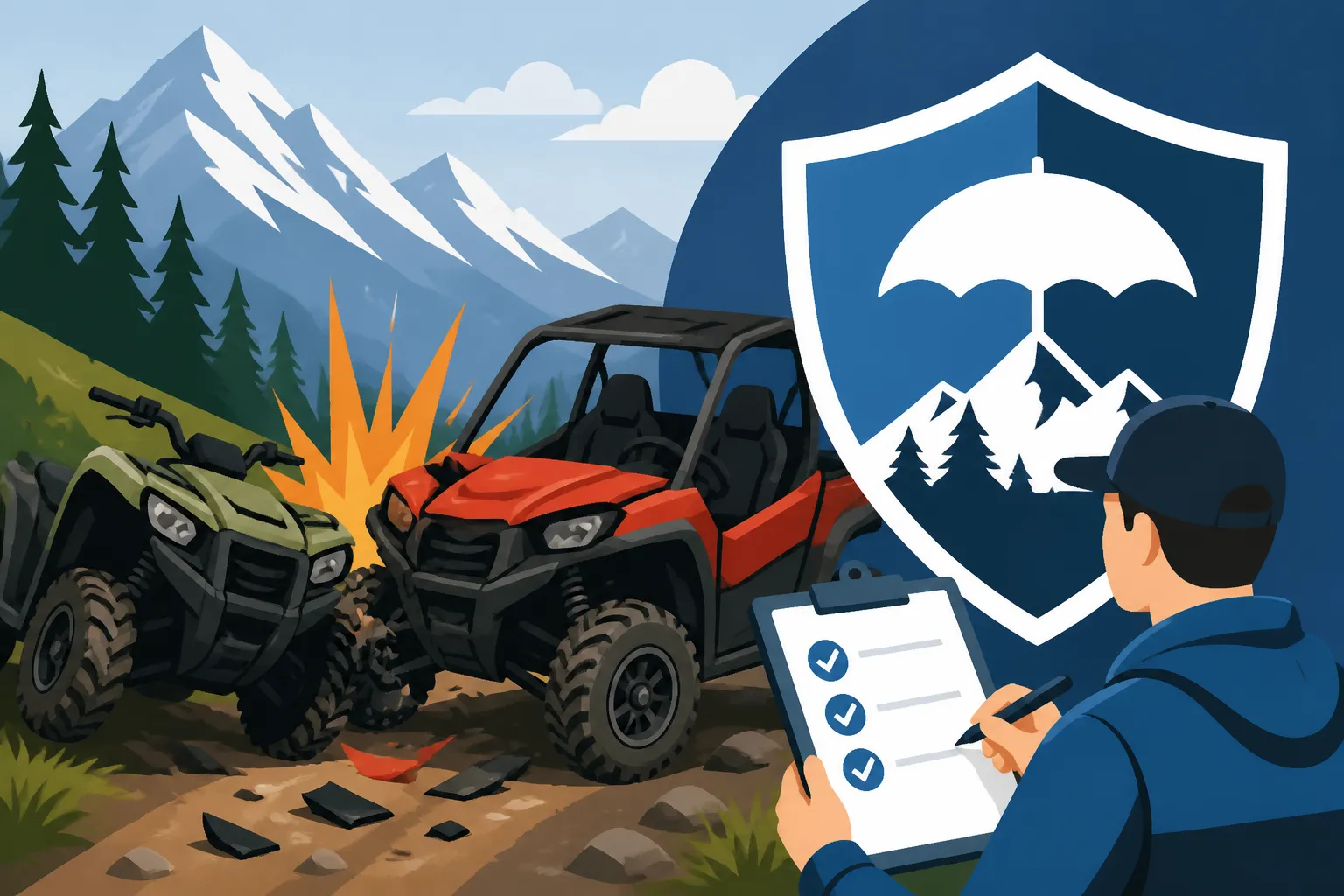
A collision on an Alaska trail can leave you dealing with injuries, a damaged machine, poor cell service, and uncertainty about who pays. The answer depends on the policy, where and how the ATV or UTV was being used, and what happened. This guide explains what to do after a backcountry crash, what insurance may cover, and how to prepare a claim.
Start With Safety and a Clear Record
Deal with people and immediate hazards first
Before thinking about a claim, check for injuries and make the scene as safe as conditions allow. Move away from fire, unstable terrain, moving water, or other immediate hazards if you can do so without putting anyone at greater risk. In remote areas, a collision can quickly become a bigger emergency if someone is cold, trapped, or unable to reach help.
Call 911 when someone has a serious injury, needs urgent medical attention, or faces immediate danger. If you cannot get a phone signal, use the emergency communication device you brought or ask another rider to go for help. If you are riding near a community, a trailhead, or a road-accessible area, do not assume that another person will report the crash for you. Assign someone to seek help while another person stays with the injured rider, if it is safe to do so.
Once the urgent situation is under control, follow instructions from emergency responders and the relevant authorities. Depending on the location and circumstances, that could mean contacting Alaska State Troopers, local police, a land manager, or another responsible authority. Rules and reporting procedures can differ by situation, so don’t rely on a friend’s recollection of what happened in a different town or on a different kind of land. For related information, see [Alaska Accident Reporting for an ATV Crash] and [Alaska Rules for Riding a Gravel Road].
Preserve details before the scene changes
Alaska’s backcountry can make documentation difficult. Weather can shift, daylight can disappear, tracks can be disturbed, and a machine may need to be moved to reach medical care or safer ground. When it is safe, take photos or video of the overall scene, both vehicles, visible damage, tire or track marks, trail conditions, signs, and any relevant obstacles. Photograph the machines from several angles before moving them if you can do so safely.
Write down the basics while they are fresh: the date and approximate time, the location or nearest trailhead, the route you were traveling, the direction each machine was moving, who was driving, and what you remember happening. Include names and contact details for the other rider and any witnesses. If a witness is leaving, ask for their contact information before they head out.
Avoid guessing about fault or trying to settle a complicated claim on the trail. A quick comment such as “I’m sure it was my fault” can be repeated later without the context you intended. Stick to observable facts when speaking with the other party, responders, and your insurer. If you must move a damaged machine, take pictures first and note why it had to be moved.
Understand What Your ATV or UTV Policy May Cover
Separate liability coverage from coverage for your own machine
Insurance policies often treat different losses separately. Liability coverage may apply when you are legally responsible for another person’s injury or property damage. Collision coverage, if included and applicable, may help with damage to your own machine after a collision. Medical payments or other injury-related coverage may address certain medical expenses, subject to the policy’s wording and limits.
These are not interchangeable. A policy that offers liability protection does not necessarily cover repairs to your ATV. Likewise, coverage for your own machine does not automatically pay for every injury or every other person’s losses. Whether a policy applies can depend on the machine, the named insured, the operator, the use, and the exact location of the crash.
Do not assume that coverage for road use settles the question of an off-road crash, or that an off-road policy applies to every type of land or activity. Read the policy language and contact the insurer. The articles [Alaska Insurance Requirements for an APV] and [Alaska ATV Insurance Requirements] can help you distinguish insurance questions from registration and riding-rule questions. Those requirements are not a substitute for checking the coverage in your own policy.
Look for exclusions and details that could change a claim
The policy’s exclusions and conditions matter as much as its coverage summary. Review the sections describing covered machines, authorized operators, recreational use, business or rental use, racing or organized events, and where the machine may be operated. Some policies may have specific requirements for reporting a crash, cooperating with an investigation, or protecting damaged property from further loss.
Modifications can also matter. If you have added accessories or changed the machine’s setup, keep receipts and photographs, and ask your insurer whether those additions need to be listed or separately covered. For example, if your machine has accessories from SuperATV or another supplier, keep a clear record of what was installed and when. Don’t assume an accessory’s purchase receipt alone means its value is insured.
A short call to your insurer before a trip can clarify whether your policy is intended for the kind of riding you plan to do. Ask directly about trail use, passengers, borrowed machines, remote travel, towing, and the areas where you expect to ride. Keep written notes of the answer and the date of the conversation. [Proof of Insurance on a Quad] and [Alaska Insurance Proof at a Trailhead] cover related paperwork questions, but only your policy and insurer can explain your specific coverage.
| Situation after a collision | Coverage that may be relevant | What to check |
|---|---|---|
| Another rider is injured or their property is damaged | Liability coverage | Who was operating the machine, how it was being used, and whether the location is covered |
| Your own ATV or UTV is damaged | Collision or other physical-damage coverage | Whether that coverage is included and whether an exclusion applies |
| Someone needs medical care | Medical payments or other injury-related coverage | Who is eligible, what expenses qualify, and what limits or conditions apply |
| An accessory is damaged | Accessory or equipment coverage, if available | Whether the item was declared, listed, or otherwise included in the policy |
| A machine is borrowed, rented, or used for work | Policy terms for operator and use | Whether the policy covers that person and purpose |
Make the Insurance Claim Carefully
Notify the insurer and provide facts, not guesses
Contact the insurance company using the claim or emergency number shown on your policy documents. If you are injured or unable to call, ask a trusted person to help, but make sure the insurer knows who is speaking on your behalf. Provide the basic facts: where and when the crash happened, which machine was involved, who was operating it, whether anyone was injured, and whether an authority responded.
Ask what the insurer needs next and how to submit photographs, receipts, witness details, and any incident or medical records. Keep a simple log of calls, names, dates, and instructions. Save claim numbers and copies of messages. If you have limited connectivity, take notes offline and send the information once you can get a reliable connection.
Be accurate and distinguish what you saw from what you inferred. For example, “the front of my machine was damaged” is a direct observation; “the other rider was going too fast” is an interpretation unless you have a way to establish it. It is reasonable to say you are unsure about a detail rather than filling in a gap from memory. If the insurer asks for a recorded statement or documents you do not understand, ask what the request is for and consider getting qualified advice before responding.
Keep damaged property and expenses organized
Follow the insurer’s instructions before authorizing repairs or disposing of damaged parts. The machine may need an inspection, and moving or repairing it could make the damage harder to assess. If it must be moved for safety, document the condition and the reason. Keep towing, recovery, transport, storage, and repair records, but don’t assume every cost will be reimbursed; ask the insurer whether a particular expense is covered before committing to it when practical.
Save receipts for medical care, travel connected to treatment, replacement equipment, and any other expenses you believe relate to the crash. Keep those records separate from ordinary trip costs. If someone else’s property was damaged, record what it was and photograph it if possible. Don’t promise to pay for repairs or sign a settlement at the scene simply to end an uncomfortable conversation.
Equipment can help with recovery, but it does not determine how an insurance claim will be handled. If you use recovery gear or protective accessories from SuperATV, keep installation and purchase records with your machine documents; those records may help identify what was present before the crash. Whether the equipment itself is covered remains a policy question.
Prepare Before the Next Backcountry Ride
Confirm land access and riding conditions
A crash can happen on a trail, gravel road, river crossing, or private parcel, and the location may affect who responds and what information you need. Before riding, make a reasonable effort to confirm who manages the land and whether your route is open to the machine you are using. A trailhead pass is not automatically permission to cross every parcel, and a route shown on a map may pass through land with separate access rules. See [Alaska Land Ownership and Who to Ask] for more on checking land status.
Plan around the limits of your communication options. Tell someone where you intend to ride, when you expect to return, and what to do if you do not check in. Bring a charged phone, but don’t treat it as your only emergency plan in areas without service. A satellite messenger or other appropriate communication device can be especially useful when your route takes you away from roads and populated areas.
Carry your registration and insurance information in a protected place, and make sure another rider knows where to find it if you are unable to speak. For guidance on what documentation may be requested, see [What a Trooper Can Ask to See]. Keep a copy of your insurer’s contact information somewhere accessible without relying on cell service.
Keep the machine and policy records current
Before a long ride, confirm that the policy still matches the machine and the people who may operate it. If you sell, replace, lend, or substantially modify an ATV or UTV, ask the insurer whether the policy needs to change. A machine that is newly acquired, used by another household member, or taken on a different kind of trip can raise questions that are easier to resolve before a crash.
Store photos of the machine, its serial or vehicle identification number, accessories, and general condition. Keep purchase documents and receipts in one place. Owners who have installed accessories from SuperATV or other aftermarket suppliers can include those items in the photo record and ask the insurer whether they should be listed. This creates a clearer before-and-after record if damage occurs.
Finally, make a simple post-crash plan with your riding group. Decide who will call for help, who will document the scene, and who will stay with an injured rider, provided it is safe to do so. Agree that no one will move a seriously injured person unless there is immediate danger or emergency personnel direct otherwise. A little planning cannot prevent every accident, but it can reduce confusion when the trail is remote and everyone is shaken.
Disclaimer
This article is for general informational purposes only and does not constitute professional advice. Laws, prices and regulations vary by location and change over time. Consult a qualified professional for guidance on your specific situation.