Alaska Wildlife on the Trail
A moose stepping onto a trail or a bear appearing around a bend can turn a relaxed Alaska ATV or UTV ride into a stressful moment fast. Knowing when to stop, how much space to give wildlife, and what to do next helps protect you, your passengers, and the animals. This guide covers common encounters and practical ways to prepare.
Before You Ride in Alaska Wildlife Country
Expect wildlife and plan for limited visibility
Alaska’s trails pass through varied habitat, from forest and brush to open tundra and river corridors. Wildlife can be hard to spot until it is close, especially where vegetation blocks sightlines or the trail bends sharply. A quiet stretch is not a guarantee that no animals are nearby.
Adjust your speed to the terrain and visibility. Ease off before blind corners, narrow sections, and places where brush reaches the trail edge. If you are riding in a group, leave enough space between machines for each rider to react without causing a pileup. A rider who brakes suddenly should not be followed at a distance of only a few feet.
Pay attention to tracks, fresh scat, disturbed vegetation, and warning calls from birds or other animals, but do not treat any one sign as a reliable prediction of what is ahead. These clues are reasons to become more attentive, not reasons to leave the trail and investigate. For a broader look at animal encounters, see [Alaska Bear Encounters While Riding] and [Alaska Moose Encounters While Riding].
Pack for an encounter, not just the ride
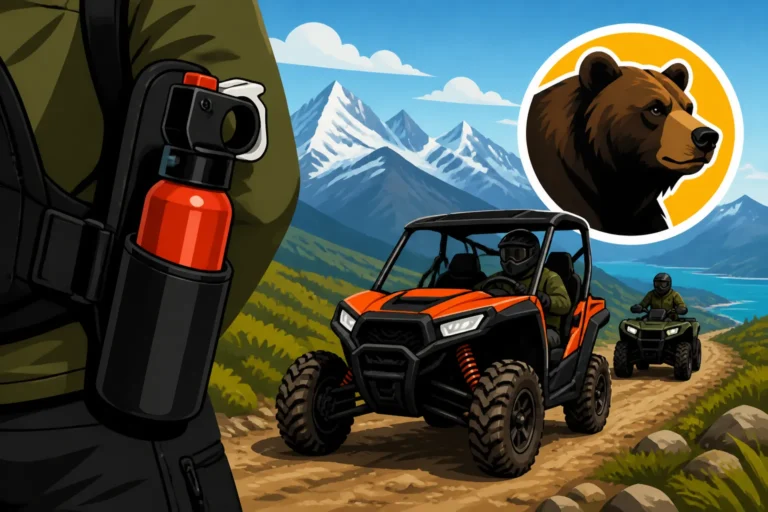
Carry bear spray where you can reach it promptly, rather than buried under spare layers or tied to cargo you cannot access from the seat. Before you go, check that you know how to release it from its holster and operate it. If you are riding with others, make sure everyone knows where it is and can reach their own spray if they carry it.
A phone may be useful near a road or populated area, but much of Alaska’s riding country has limited or no cell service. Tell someone where you plan to ride, when you expect to return, and what to do if you miss that check-in. A satellite messenger can provide another way to communicate when cellular coverage is absent; learn how to use it before leaving the trailhead. [No Cell Coverage Off the Road System] and [Filing a Trip Plan With Someone] offer useful preparation advice.
Pack water, weather-appropriate layers, a first-aid kit, and a way to keep essential supplies secure. If an encounter delays the ride, gets your group separated, or forces you to turn back, those basics make the wait less difficult. Store snacks and other scented items carefully instead of leaving them loose in an open cargo area.
Check the route and land status before setting out
A map can help you follow a route, identify nearby roads, and orient yourself if you need to turn around. Some riders use onX Offroad to review trails and plan their route before heading out. Treat any mapping app as a planning aid, not proof that every line is open or that you have permission to ride there. Check land status and current restrictions with the relevant land manager, and stay on routes you are allowed to use.
That preparation matters for wildlife as well as navigation. A narrow trail may offer few safe places to pull over, while a route through dense brush can limit your view. Knowing where wider openings, junctions, and return options are can help you avoid making a rushed decision in the middle of an encounter. For a closer look at land access, see [Alaska Land Ownership and Who to Ask] and [Alaska ATV Trails: Where to Ride].
What to Do When You Encounter a Moose
Stop, stay back, and give the animal room
Moose are large, powerful animals, and a close encounter can be dangerous even when the animal does not appear aggressive. If you see one on or beside the trail, slow down and stop at a safe distance. Do not ride toward it to get a better look or try to pass closely. Give it an open route away from you, and wait quietly if it needs time to move.
Keep the group together and prevent passengers from hopping off for a photo. A stopped machine is easier to control than one being steered around an animal, and sudden movement can make an already tense situation harder to read. If the moose does not move, do not pressure it by creeping closer. Turn around when there is room to do so safely, or wait at a distance until you can retreat without crowding it.
Moose can be difficult to see in brush and can move quickly. Avoid assuming that an animal standing still is relaxed, or that it will move just because a vehicle is approaching. Use caution around any moose, especially if visibility is limited or the trail leaves you little room to maneuver.
Be especially careful around a cow and calf
A cow moose with a calf needs extra space. The calf may be difficult to see in vegetation, and a mother may react strongly if she believes the calf is threatened. Never ride between a cow and calf, and do not approach a calf that appears alone. The mother may be close by, even if she is not immediately visible.
If you spot a calf, stop and scan the area without driving closer. Let the animals decide where to go. If you are unsure whether a calf is nearby, treat the sighting as a reason to pause and increase your distance. Do not honk, rev the engine, or try to make the animals move.
A common mistake is to focus on getting past the animal and forget that the trail may curve around a patch of brush where another animal is hidden. Give yourself time to assess the scene. If you cannot see a clear, safe way through, back away or turn around rather than squeezing between wildlife and the trail edge.
Recognize when to retreat
Watch the animal’s behavior without trying to interpret every movement as a definite signal. If a moose appears unsettled, turns toward you, or blocks the route, increase the distance rather than testing how close you can get. Put a large object, such as a tree, between you and the animal if one is safely available, and retreat without sudden movements.
Do not chase a moose to clear the trail, and do not follow it after it leaves. An animal that moves away may still be nearby, particularly in wooded terrain. Give it time and space before continuing, and keep the group alert as you ride on.
If a moose charges or knocks someone down, prioritize immediate safety and seek help as soon as it is safe to do so. Riders who have a communication device should know how to send an emergency message before the trip, not learn the controls during a crisis.
How to Respond to a Bear on the Trail
Stop and avoid closing the distance
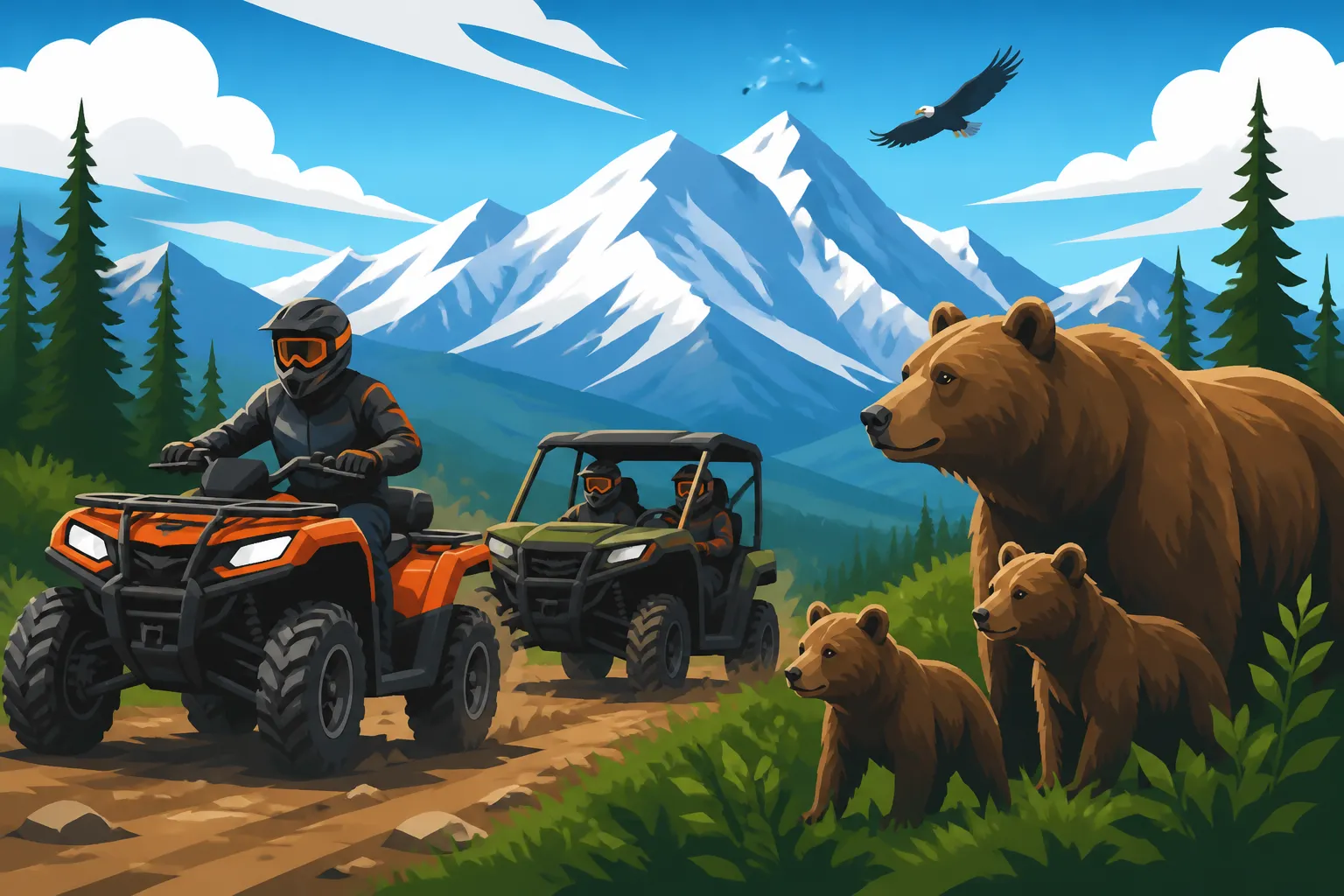
A bear may appear suddenly, cross the trail, or be feeding nearby. If you see one, stop rather than riding closer for a photograph or trying to pass at speed. Keep your group together and give the bear a clear way to move away. Never approach a bear, surround it with machines, or follow it after it leaves the trail.
Do not assume that an engine will scare every bear away. A bear may ignore a machine, move off, or behave in another way that is difficult to predict. Keep your attention on the animal and the terrain around you. If the bear is moving toward you or the route is blocked, prepare to retreat while keeping distance and avoiding sudden, confusing movements.
If you carry bear spray, make sure it is accessible and follow the product’s instructions. It is a last-resort safety tool, not a reason to approach wildlife or take risks. Riders should know how to use it and keep it within reach rather than packed away with gear.
Do not crowd a bear that is feeding or with cubs
A bear focused on food may be less aware of your presence until you are close. If you find one feeding, stop well back and leave the area the way you came when you can do so safely. Do not try to make it abandon a food source, and do not move in for a closer look. Bears with cubs also need generous space; never get between a sow and her cubs.
Avoid stopping to inspect carcasses, fish remains, or other possible food sources. A bear may be nearby even when you do not see it. If the trail passes through an area where you notice a strong animal odor or signs of feeding, proceed cautiously and be ready to turn back rather than pushing deeper into the situation.
Food and garbage should not be left at a trailhead, campsite, or rest stop. Keep scented items secured, and pack out all trash. Careful food handling is one practical way riders can avoid attracting wildlife to places people use.
Make a calm decision about whether to continue
Once the bear has moved away, do not assume it is gone for good. It may have entered brush beside the trail or moved in the same direction your group needs to travel. Give the area time, check that all riders are together, and continue only if you can do so without approaching the bear or blocking its route.
Sometimes the safest choice is to turn around. That can feel frustrating after a long ride or when you are close to a planned destination, but an animal encounter is not a trail obstacle to overcome. A route can be revisited another day; a close approach can put people and wildlife at risk.
For more preparation on route planning and group safety, review [Alaska Wildlife on the Trail]—this guide’s subject—alongside [Alaska Wildlife on the Trail] is not necessary; instead, see [Alaska Group Ride Planning] and [Choosing a Satellite Messenger for a Backcountry Ride]. Use onX Offroad, if it is part of your planning, to help keep track of your route and possible turnarounds, while checking access rules separately with the appropriate land manager.
Build Wildlife-Smart Habits Into Every Ride
Use a simple stop-and-assess routine
When someone spots wildlife, the first priority is to stop safely and alert the rest of the group. Avoid sudden acceleration or a rush to pass. Once stopped, take a moment to identify where the animal is, where the riders are, and whether there is a clear way to retreat. Keep passengers seated unless getting off is necessary for safety and can be done without moving closer.
A useful group routine is to agree on a signal before you ride. For example, riders can use a clear hand signal or radio call to indicate that the group should stop. This prevents the first rider from reacting while everyone behind continues forward. It also helps keep a group from splitting around a blind corner.
| Situation | Safer response | Avoid |
|---|---|---|
| Moose on or beside the trail | Stop well back, give it space, and wait or retreat | Riding close to pass or driving between a cow and calf |
| Bear crossing the route | Stop, keep the group together, and allow it room to leave | Following, surrounding, or approaching for a photo |
| Wildlife hidden in dense brush | Slow down, scan carefully, and be ready to turn around | Accelerating through without knowing what is ahead |
| Animal blocking a narrow trail | Wait at a distance or retreat if safe | Honking, revving, or trying to force it to move |
| Group becomes separated during an encounter | Regroup at a safe distance and confirm everyone is accounted for | Sending one rider toward the animal to find the others |
Match your riding style to the place and conditions
Ride slowly enough to stop within the distance you can see. That advice is especially important on narrow trails, in thick vegetation, and near water or open feeding areas. A fast approach leaves little room to respond if a moose, bear, or other animal appears around a bend.
Stay on the established route. Cutting across vegetation to get around wildlife can damage sensitive ground, create new tracks, and bring riders into closer contact with animals. If a trail is blocked, waiting or turning back is usually the more responsible choice. For seasonal conditions and route closures, see [Alaska Riding Seasons and Breakup] and [Alaska Trails Closed in Breakup].
Respect other trail users, too. A person on foot or on a bicycle may be quieter and less visible than a machine, and may already be watching wildlife. Reduce speed when approaching people, keep the group orderly, and avoid turning a wildlife sighting into a crowd around the animal.
Debrief after an encounter
Once you are safely away, take a moment to check that every rider is accounted for and uninjured. Make sure no one has left a helmet, bag, or other gear behind, and decide whether continuing makes sense. If the encounter changed your route, tell the person expecting your check-in so they are not left wondering why you are late.
Talk through what happened while the details are fresh. Did the group leave enough space between machines? Could the first rider have seen the animal sooner? Was the bear spray accessible? A brief, honest conversation can improve the next ride without turning the encounter into a blame session.
The goal is not to guarantee that you will never meet wildlife. That is impossible to promise in Alaska. The goal is to stay alert, avoid crowding animals, and make choices that leave both riders and wildlife room to move. If you use onX Offroad to plan a route, mark practical turnaround options before departure and still make the final decision based on conditions on the ground.
Disclaimer
This article is for general informational purposes only and does not constitute professional advice. Laws, prices and regulations vary by location and change over time. Consult a qualified professional for guidance on your specific situation.