Carrying Bear Spray on a Chugach Ride
A bear encounter on a Chugach ride can leave you with very little time to dig through a pack, undo a stiff jacket, or ask a passenger where the spray went. This guide explains how to choose a bear spray carry position, make it reachable from your ATV or UTV, and prepare your group to respond calmly without treating spray as a substitute for awareness.
Choose bear spray you can reach quickly
Buy a product labeled for bears
Choose a canister specifically labeled as bear deterrent, and read its instructions before your ride. The label explains how the product is intended to be carried and used, along with its range, spray duration, and any safety warnings. Those details differ among products, so don’t rely on a friend’s canister or assume every model works the same way.
Check the canister before leaving: make sure it is not damaged, the safety mechanism is intact, and the expiration date has not passed. If it has been stored for a long time, inspect it again before the season begins. A can that has been left loose in a cargo box with tools, shifted around on a trailer, or exposed to rough handling may not be in the condition you expect.
Bear spray is a last-resort deterrent for a close encounter, not a scent that keeps bears away from your campsite or machine. Don’t spray it on clothing, food, gear, or the ATV as a preventive measure. Spraying unnecessarily can expose you and your group, and it can leave residue where you don’t want it. Keep it sealed and ready to use according to its label.
Pick a carry position that works with your riding gear
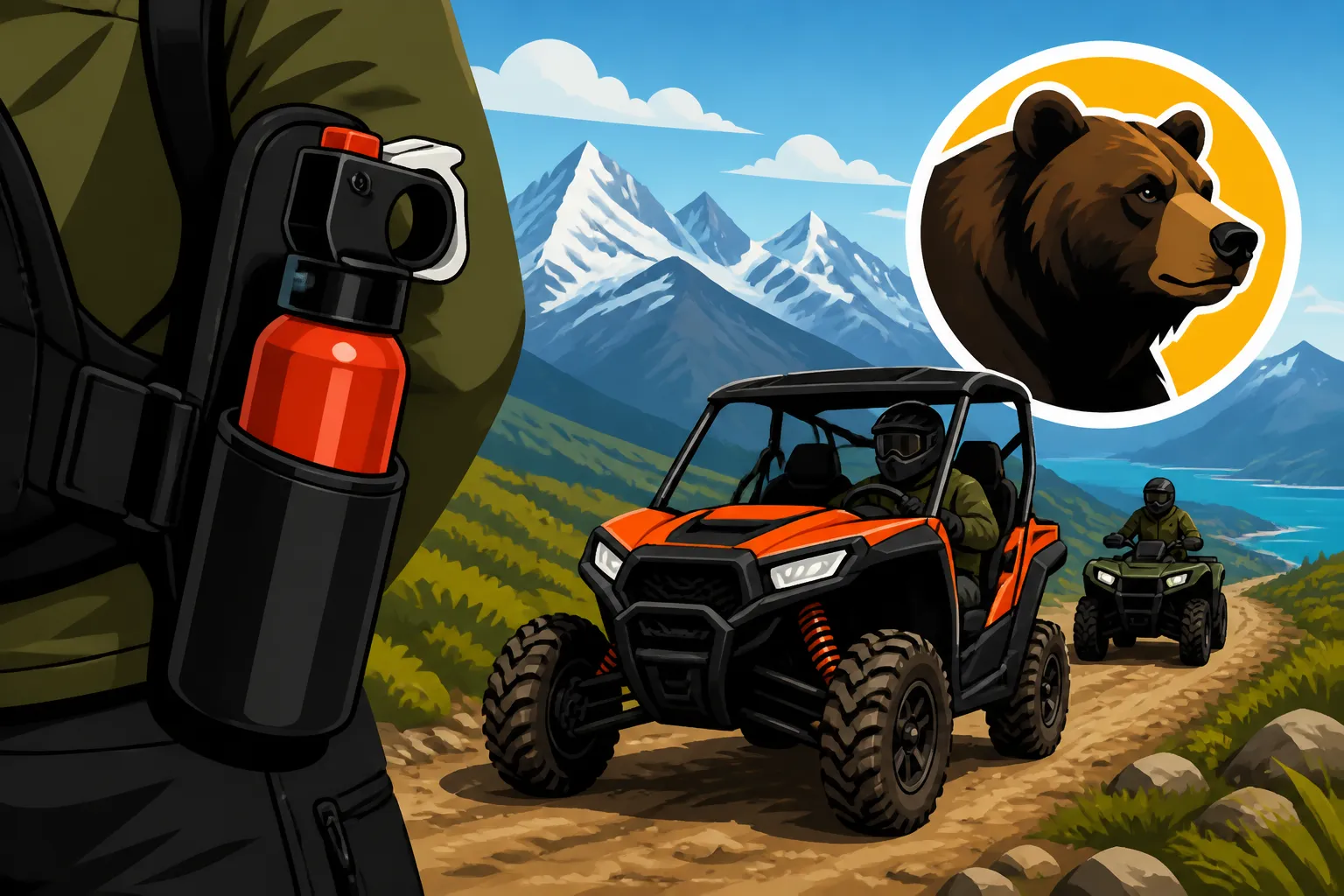
The best carry position is one you can reach while wearing the clothing and protective gear you’ll actually use. A canister buried under rain gear in a dry bag may be easy to pack but difficult to access during a stressful moment. A belt or chest holster may be quicker, but only if it stays secure when you sit, turn, and move around the machine.
| Carry position | Why riders consider it | What to check before leaving |
|---|---|---|
| Belt holster | Keeps the canister close and easy to locate | Make sure the seat, jacket, and belt do not block access |
| Chest holster | Can remain reachable under a pack | Confirm shoulder straps do not cover or trap it |
| Secure external holster on a machine | May suit a rider who cannot comfortably wear a holster | Check that it stays attached, protected, and reachable from your riding position |
| Pack pocket | Keeps the canister with your gear | Use only if the pocket is reliably accessible without removing the pack |
Try your chosen position while seated on the machine, wearing your gloves and helmet. Practice reaching for the canister without taking it out of its holster. You are checking for snags, blocked access, and awkward movement—not rehearsing a dramatic draw. If you have to twist sharply, undo a strap, or ask someone else to hand it to you, choose a different location.
Avoid carrying it where it can be crushed, scraped, or knocked loose. A canister bouncing in a cargo box may be hard to find and could be damaged by other equipment. If you use a machine-mounted holster, make sure the canister is still accessible to the rider and not hidden beneath luggage, a cover, or a passenger’s gear.
Plan for the Chugach route and riding conditions
Prepare for limited time to stop and sort out gear
On a Chugach ride, uneven ground, changing weather, water crossings, and other trail users can all compete for your attention. A rider who has to stop on a narrow or exposed section just to retrieve spray has a harder problem than someone who planned its location in advance. Think through where the canister will sit during the entire ride, including when you add a rain shell or remove a pack.
A route plan should include more than the trail name. Check which land you’ll cross, where you intend to stop, and whether the route is suitable for your group and machine. onX Offroad can help riders review a route and orient themselves before heading out; use it as one planning tool rather than a substitute for checking access rules and local conditions. For more context on choosing an area, see Alaska Riding Near Anchorage.
Before departure, make sure each rider knows where the spray is. If only one person carries it, tell the group who has it and where it is secured. In a side-by-side, a passenger may be the person who can reach the canister most readily—but don’t assume that without checking how seats, belts, and clothing affect access. Decide on a simple plan together, including who keeps track of the group if you need to stop.
Check land access, closures, and changing conditions
Chugach rides may pass through different land jurisdictions, and a route that looks continuous on a screen can cross areas with different access rules. Confirm that your intended route is open to your type of machine and that you have the necessary permissions. Alaska Land Ownership Lookups can help you understand why checking land status matters before riding; verify access with the relevant land manager where needed.
Use a current route plan and be ready to turn around if conditions change. A trail that is muddy, flooded, or damaged can make it difficult to stop safely or move away from a potential hazard. Check for notices and closures before you leave, and don’t treat another rider’s old track as proof that a route is open today. Alaska Trail Closures After a Storm offers related guidance on why conditions can affect access.
If you use onX Offroad to review route lines or map information, look at the map before the ride and save the details you’ll need for your trip. Cell coverage may not be dependable in every riding area, so don’t plan to make your first map check after you’ve lost service. Carry the information you need in a form you can access without relying on a live connection, and have a paper or offline backup if your group depends on navigation.
Make a simple group plan for bear encounters
Talk through roles before the engine starts
A useful group plan is brief, specific, and understood by everyone. Identify who carries the spray, where it is, and who will communicate with the group if a bear is seen. If you’re riding with children or guests who haven’t spent time in bear country, explain that they should alert an adult rather than rush toward the animal or try to take a closer look.
Keep the plan practical. For example, agree that the person who spots a bear will call it out clearly, while the rest of the group pauses and follows the lead rider’s instructions. Don’t have several riders crowd around one person or all reach for the same canister. If you have more than one canister, make sure each person carrying one knows how to access it and has reviewed its label.
Carry the canister in a holster that remains secure while riding, but don’t let the mount become a reason to leave it behind when you get off the machine. If your group stops to walk, check that the spray stays with a person rather than remaining on the ATV or in a parked UTV. Bears and people may meet away from the machine, especially at a trail junction, campsite, or viewpoint.
For broader preparation, Alaska Bear Encounters While Riding and Alaska Wildlife on the Trail are useful related topics to review before heading out.
Know what spray can and cannot do
Bear spray is not a guarantee of safety. Wind, distance, visibility, the animal’s movement, and the rider’s ability to reach the canister all affect what happens in an encounter. Read the label so you understand the product before you need it, and follow official wildlife guidance for the area. Don’t practice by discharging a canister; doing so uses the product and can expose people nearby.
Avoid turning an encounter into a photo opportunity. Keep the group together, give the animal room, and don’t approach or surround it. Riders may be tempted to use the machine’s speed to get closer for a better look, but that can create a more dangerous situation. Alaska Trail Etiquette Locals Expect covers the broader habits that help riders share an area responsibly.
After an encounter, don’t assume the route is automatically safe to continue. Take time to regroup, check that everyone is accounted for, and consider whether the animal or trail conditions make it wiser to leave by another route or turn back. If someone has been injured or exposed to spray, address the immediate health concern and contact appropriate help as needed.
Keep the canister ready from trailhead to return
Check your gear before loading up
Make a quick bear-spray check part of your normal pre-ride routine. Confirm that the canister is present, in usable condition, and secured in its intended position. Then put on your helmet, gloves, jacket, and pack and try reaching it again. A carry setup that works in the driveway may become awkward once a heavy riding jacket or chest strap is in place.
If you’re using a machine-mounted holder, check it after loading the ATV or UTV. Tie-downs, spare fuel, tools, and luggage can block access even if the holder itself is in a good spot. For group rides, this is also the moment to confirm who carries spray and make sure everyone knows where it is. That small conversation is easier at the trailhead than in the middle of a stressful situation.
Keep the canister away from items that could snag the safety mechanism. Don’t let loose straps, tools, or other cargo interfere with the holster. When you unload, take it with you if you’ll be away from the vehicle. A canister left behind in a parked machine doesn’t help a rider who walks ahead on the trail.
Review the route and conditions again before riding
A ride plan can change between the time you map a route and the time you reach the trailhead. Recheck access information and any notices that could affect your trip. If you use onX Offroad, review your route before leaving and make sure the map information you need is available in the field. Keep your expectations flexible: a safer decision may be to shorten the ride, avoid a section, or return to the trailhead.
Be thoughtful about where you stop and how your group spreads out. Don’t leave food or scented items exposed at a rest stop, and don’t crowd around wildlife. Follow local rules for the land you’re using. Alaska ATV Trails: Where to Ride can help you explore riding-area considerations, while Alaska Trail Etiquette Locals Expect is a useful reminder to respect other users and the landscape.
When the ride is over, inspect the canister and holster again. If the safety clip is missing, the canister is damaged, or the holster no longer holds it securely, replace or repair what’s needed before the next trip. Bear spray is most useful when it is the right product, stored according to its label, and reachable without rummaging through gear. A few minutes of preparation at home and at the trailhead can make that setup far more dependable.
Disclaimer
This article is for general informational purposes only and does not constitute professional advice. Laws, prices and regulations vary by location and change over time. Consult a qualified professional for guidance on your specific situation.