Do You Have to Carry Alaska’s General Land Permit?
Alaska’s statewide general land permit can be confusing because “having permission” and “carrying proof” are not necessarily the same thing. The practical answer depends on where you ride and which land rules apply. This guide explains what the permit covers, whether to bring a copy, what it does not replace, and how to check your route before unloading your ATV or UTV.
The short answer: carry proof if you can, but know what the permit authorizes
For ordinary recreational riding on state land covered by Alaska’s statewide general permit, the important requirement is to ride within the permit’s conditions. A printed copy is not a substitute for permission to ride somewhere the permit does not cover, and a decal on your machine does not prove that a particular trail is open.
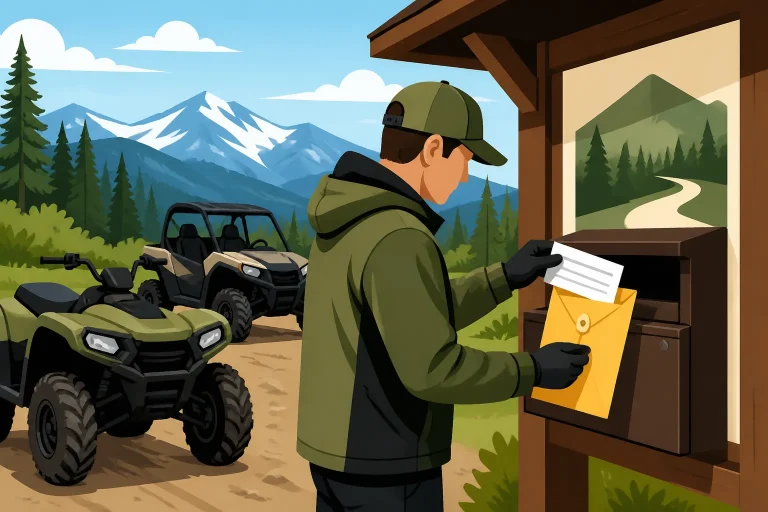
Whether you must physically carry a paper copy is a separate question. Treat the current permit document and its conditions as the authority. If they specifically require you to have a copy with you, follow that requirement. If they do not, having the permit readily available is still sensible: a digital copy saved on your phone or a printed copy in a waterproof pouch can help you explain what authorization you are relying on if a land manager or enforcement officer asks.
The safest, low-hassle approach is:
- Read the current permit and its conditions before your trip.
- Save a copy to your phone for offline access, or bring a paper copy.
- Confirm that the land you plan to ride is within the permit’s scope.
- Check for local closures, landowner restrictions, seasonal limits, and other rules.
- Carry any other documents that apply to you and your machine.
The statewide permit is not a universal ATV pass. It does not make every trail, parcel, park, or road open to riding. It is one piece of the access picture, and the ground’s ownership and management matter just as much as the machine you bring.
For a closer look at what the permit actually allows, see What Alaska’s Statewide General Permit Actually Authorizes. The key idea is simple: know which land rule applies before you rely on the statewide permit.
What Alaska’s statewide general permit is for
Alaska’s statewide general permit provides authorization for certain off-road vehicle use on eligible state land, subject to the permit’s terms and other applicable rules. It is meant to address a broad category of riding, not to give every rider unrestricted access across Alaska.
That distinction matters because “public land” is not one single category. Land can be state-owned, federal, municipal, privately owned, or held by an Alaska Native corporation. Even land that looks open and undeveloped may have a different owner or manager from the parcel beside it. A permit from one land manager does not automatically authorize travel on another manager’s land.
The permit also does not necessarily make all state land available for every type of riding. Boundaries, designated areas, closures, environmental conditions, and the permit’s own restrictions can affect whether an ATV or UTV may be used. Check the current terms rather than relying on a friend’s description or an old screenshot.
The statewide permit is best understood as one layer of authorization:
- It may cover qualifying recreational off-road vehicle use on eligible state land.
- It does not create access rights across land outside its scope.
- It does not override a closure or a restriction imposed by the applicable land manager.
- It does not replace vehicle registration, road-use requirements, insurance requirements, or other rules that apply to your ride.
The precise terms and exclusions matter. Start with Alaska General Permit Requirements and Alaska’s General Permit Covers State Land when you are checking whether the permit fits your plans.
Permit authorization is different from proof of authorization
A rider may be authorized to use a qualifying machine on eligible land while still being unable to demonstrate that authorization clearly during a conversation at a trailhead. That is why carrying a copy is useful even when the question of physically carrying it is not the main legal issue.
A paper copy can be useful if your phone battery dies, you lose service, or a screen is difficult to read in rain or mud. A digital copy is lighter and easier to update, but it should be saved offline. A link that needs cell service is a poor backup in an area with weak or no coverage.
If you bring a digital copy, save the complete permit document and any terms that apply—not just a cropped image of a page or a search result. Make sure you can open it without signing in or connecting to a network. If you travel with a group, tell the other riders where the copy is stored and who has access to it.
The permit is not a trail pass
A general land permit and a trailhead parking pass answer different questions. The land permit concerns whether a particular use is authorized on land under its scope. A trailhead pass or fee may concern parking or use of a specific recreation facility.
Paying for one does not automatically satisfy the other. If a trailhead requires a pass, the statewide permit does not necessarily cover that fee. And a parking pass does not grant permission to ride on every parcel beyond the parking area. See A Trailhead Pass Is Not a Land Permit before assuming one document covers both.
Where the permit does—and does not—apply
The first question before a ride is not “Did I bring the permit?” It is “Who manages the ground I plan to ride on?” A machine can travel a short distance and cross several land boundaries without the rider seeing a fence or a sign. On a map, an established route may appear continuous even though the land ownership or management changes along the way.
The statewide permit applies only within the scope set by its current terms. It does not automatically extend to state parks, private parcels, federal land, municipal land, or Alaska Native corporation land. Those places may have separate rules, permit systems, or access permissions.
| Land or access situation | What to check before riding |
|---|---|
| Eligible state land | Confirm the parcel is within the statewide permit’s scope and that the route is open to your type of use. |
| State park | Check the park’s specific rules. Do not assume the statewide general permit applies. |
| Private land | Get permission from the owner or authorized land manager. The statewide permit does not grant private access. |
| Federal land | Check the managing federal agency’s rules, including any route restrictions or closures. |
| Municipal land | Check the local government’s rules and any trail or area restrictions. |
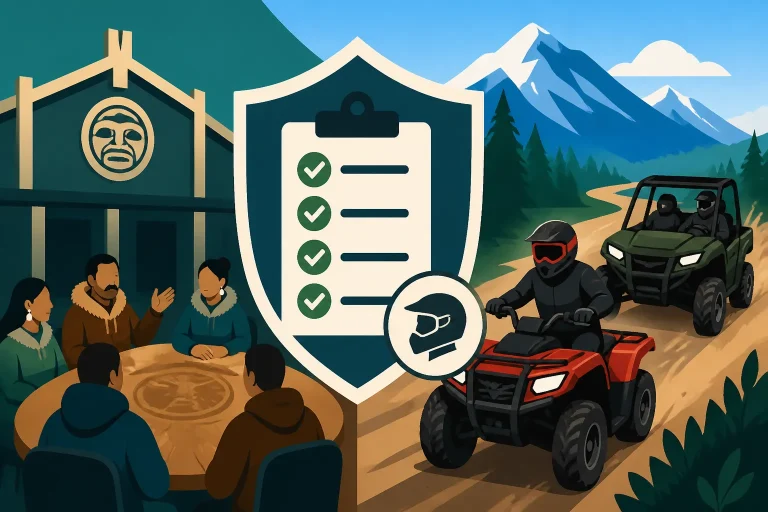
| Alaska Native corporation land | Confirm the corporation’s access rules and obtain any required permission or permit. |
| Trailhead or recreation facility | Check for parking passes, day-use fees, camping rules, and facility-specific restrictions. |
These distinctions are especially important when a route begins on state land but crosses onto another ownership. Permission at the starting point does not necessarily carry through the entire ride.
State parks have their own rules
State parks are a common source of confusion. A rider may see state land nearby and assume the statewide permit applies everywhere in the area. But state parks have their own management and rules, so the general permit should not be treated as a park authorization. Check Alaska’s Permit Excludes State Parks and the rules for the specific park before unloading.
The same principle applies to designated areas or other locations excluded by the permit’s terms. Do not interpret “state land” as meaning “open to all off-road riding.” The permit’s boundary and its exclusions matter.
Private land and Native corporation land require separate attention
A route can pass through land that is not covered by the statewide permit even when it has been used by riders for years. A visible trail is not proof that it is open to the public, and a track on a mapping app is not proof of permission.
On private land, ask the owner or authorized manager. On Alaska Native corporation land, check the corporation’s own access requirements. Some access may be governed by a specific permit or other conditions, and permission to travel through one area should not be assumed to apply to neighboring land. The statewide permit does not replace that separate approval.
If you are unsure how a parcel is classified, use land-status information and then confirm with the manager when the boundary or rule is unclear. Alaska Land Ownership Lookups and Checking a Land Status Map are useful starting points, but a map should not be treated as a guarantee that a route is open today.
Federal and municipal land are not covered just because they are public
“Public land” is a broad everyday phrase, not a single permit category. A federal recreation area or municipal trail system may have its own regulations, closures, and restrictions on vehicle use. The fact that riders can legally use an adjacent state parcel does not answer whether they can continue onto a different agency’s land.
When a route crosses a boundary, check the rules on both sides. If you cannot identify the manager confidently, ask before riding rather than assuming the statewide permit fills the gap. For a wider overview, see Alaska Land Managed by Other Agencies.
How to check your route before the ride
A few minutes of planning can prevent a long ride from ending at a locked gate, a posted closure, or a disputed boundary. You do not need to become a land-records expert. You do need to check the route as a whole rather than only looking at the trailhead.
Use this process:
- Mark your intended route. Include the trailhead, destination, likely crossings, fuel stops, and any alternate route you might use.
- Identify the land manager. Check whether each section is state, federal, municipal, private, or corporation land.
- Compare the route with the permit’s scope. Read the current permit conditions and exclusions rather than relying on a summary.
- Check for local rules and closures. Look for seasonal limits, temporary closures, restricted routes, and rules for the specific riding area.
- Confirm separate permissions. Contact the relevant landowner, agency, or corporation if the route crosses land not covered by the permit.
- Check fees and facility rules. A trailhead pass, day-use payment, campground rule, or parking requirement may apply separately.
- Save the information offline. Keep the permit, route map, and key contact details available without cell service.
- Make a plan to turn around. If a sign, gate, or changed condition shows that your route is closed or outside the authorized area, do not push through.
A land-status map can help you identify boundaries, but maps may be difficult to read at trail scale, and ownership data may not answer every question about current access. If the route is close to a boundary, or the map and posted signs do not seem to agree, contact the land manager. [Questions Worth Asking a Land Manager] can help you make that call productive.
Treat signs and closures as current information
A route that was open last season may have changed. Land managers may close an area because of erosion, wildlife concerns, fire conditions, maintenance, or other local issues. A rider’s saved track is a record of where someone traveled, not a current authorization.
Pay attention to signs at the trailhead and along the route. If a marked boundary or closure conflicts with what you expected, stop and reassess. Do not assume that a broad permit overrides a specific closure. If you are unsure whether a sign applies to your route, ask the manager before riding farther.
Conditions can affect where you should ride
Legal access and responsible riding are related, but they are not identical. A route may be technically open while the ground is too wet or vulnerable for a machine. Alaska’s tundra and wetland conditions can make the impact of a tire track much more serious than it looks in the moment. Stay on established, authorized routes and follow any restrictions for wet ground or seasonal travel. Alaska Tundra and Wetland Conditions explains why a route that seems passable can still be a poor choice.
What the general permit does not replace
The statewide general permit is about land-use authorization within its scope. It should not be treated as a single document that answers every question about an ATV or UTV ride. Several other rules may apply independently.
Registration and vehicle requirements
Land authorization is different from vehicle registration. A permit to use eligible state land does not, by itself, register your machine or satisfy registration requirements that apply to your riding situation. Likewise, having a valid registration does not grant access to private or restricted land.
Check whether your machine needs Alaska registration and what documents you need to carry. Alaska Registration Before Riding Public Land is a useful companion when you are sorting out that separate requirement.
Also verify that your machine fits the relevant vehicle category. A quad, dirt bike, side-by-side, snowmachine, and tracked vehicle may not be treated the same way under every state rule. Do not assume that a permit’s use of a broad term such as “off-road vehicle” automatically answers how a particular machine is classified.
Road-use rules and local restrictions
The statewide land permit does not make public roads open to off-road vehicles. Road access is governed by separate state and local rules, and a community may restrict or prohibit ATV or UTV road use even where land access is otherwise available.
Before connecting a trail to a road, check the rules for the specific road and community. Consider whether your machine is eligible to use that road, whether you have the required license or insurance, and whether local ordinances impose additional restrictions. See Alaska APV Road Rules Explained for the broader road-use picture.
A route that begins on permitted state land can still involve a road crossing or a stretch of road that is not lawful for your machine. Plan those transitions in advance rather than deciding at the intersection.
Insurance and safety rules
Land access permission does not settle whether you need insurance or which safety equipment applies. Those questions can depend on the vehicle and where it is being operated. Check applicable requirements for your machine and route, and carry proof when a rule or practical situation calls for it.
The permit also does not make an unsafe ride safe. Use a helmet and protective gear appropriate to the ride, inspect the machine, and make a plan for weather, distance, and communication. In remote areas, a mechanical problem or injury can become serious because help may be far away. A land permit is not a substitute for preparation.
Hunting and other activities
A general permit for off-road vehicle use does not automatically authorize hunting, game retrieval, travel across someone else’s property, or every activity a rider might combine with a trip. Hunting rules, access rules, wildlife regulations, and land-manager conditions may apply separately.
If your plan includes hunting or transporting game, check the applicable hunting regulations and land-access permissions before leaving. Do not assume that permission to ride gives permission to hunt or retrieve an animal wherever the machine can reach.
Events, commercial use, and group rides
A routine recreational ride may not be treated the same way as a guided trip, commercial operation, organized event, or large group activity. Those uses may call for additional approvals, insurance, or coordination with the land manager.
If you are planning a club ride or taking paying customers onto land, ask the relevant manager what authorization is needed. A statewide general permit for individual use should not be assumed to cover an organized or commercial activity.
What to carry, and how to keep it usable
Even when the permit does not have to be displayed on the machine, it is practical to carry enough information to explain your ride. The goal is not to pack a filing cabinet. It is to make essential documents available if your phone fails, a land manager asks questions, or a group gets separated.
Consider carrying:
- A saved digital copy of the current permit and its conditions.
- A paper copy as a backup, especially on a long or remote trip.
- A map or offline route record showing the area you intend to ride.
- Registration documents and any other required vehicle records.
- Proof of insurance if it applies to your machine or route.
- Contact information for the land manager and your emergency contact.
- Any separate land-use permission or trailhead pass relevant to the ride.
Keep documents protected from water, grit, and fuel. A small waterproof pouch can work for paper documents, while a phone should be secured in a case that can handle the conditions you expect. If you buy a document pouch or phone case through Amazon, check that it fits the actual size of your paperwork or device and can be opened without spilling everything into mud.
Do not rely only on a browser bookmark or an email that requires an internet connection. Save the file locally and test it in airplane mode before leaving. If you ride with a group, make sure at least one other rider knows where the documents are and how to find them.
Amazon can be one place to look for a basic waterproof pouch, but match the item to the job: paper needs room to lie flat, and a phone pouch needs to let you read the screen without making the device difficult to remove in an emergency. A simple, secure container is usually more useful than a complicated organizer that is hard to open with gloves.
For a remote trip, carry redundancy rather than trusting one device. A paper map or printed permit can be a useful fallback if a phone is damaged, wet, or out of power. If you use a pouch purchased from Amazon, test the closure before the ride and keep it somewhere you can reach without unloading cargo.
Whatever you carry, do not confuse a document with permission. A printed permit cannot authorize travel across land it excludes. A registration card cannot substitute for landowner approval. And a saved track cannot override a posted closure.
Common mistakes and a simple pre-ride checklist
Most permit problems come from treating the statewide permit as broader than it is, or from focusing on the paperwork while overlooking the land itself. These are the mistakes worth avoiding:
- Assuming every public-looking area is state land. Land ownership can change along a route, and undeveloped ground may still be private or managed by another agency.
- Assuming a statewide permit covers state parks. Check the specific park rules instead.
- Assuming a trailhead pass is land permission. It may cover parking or facility use, not the route beyond it.
- Assuming registration means access. Registration and land authorization are separate.
- Relying on an old copy. Read the current permit terms and check for updated closures.
- Relying on a trail app alone. A mapped trail does not prove current legal access.
- Ignoring local restrictions. Boroughs, cities, agencies, and landowners may have rules that affect a route.
- Assuming a group ride is covered like an individual ride. Events and commercial use may require additional authorization.
- Carrying a copy without reading it. You need to know the conditions, not just be able to show a document.
Before you load the machine, run through this quick check:
- Do I know who manages each section of my route?
- Does the statewide permit cover the land I intend to ride?
- Have I checked exclusions, closures, and seasonal restrictions?
- Do I need separate permission or a separate pass?
- Are my machine’s registration, equipment, and road-use requirements handled?
- Have I saved the permit and map for offline access?
- Does someone know where I am going and when I expect to return?
- Do I have a realistic alternate route or a safe place to turn back?
If any answer is uncertain, pause and confirm it before riding. A phone call or a revised route is usually easier than sorting out a boundary dispute after you have crossed onto land without permission.
The practical takeaway
For a ride on land covered by Alaska’s statewide general permit, focus first on whether the permit applies and whether you are following its conditions. Do not assume that a paper copy is what creates permission, but do keep a copy accessible and follow any carry requirement stated in the current permit itself.
Most importantly, check the land manager and the route. State parks, private parcels, federal and municipal lands, and Alaska Native corporation lands can have separate rules. Registration, road use, insurance, trailhead fees, and hunting rules are also separate issues. Carrying the permit is good preparation; confirming that it covers the ground beneath your tires is what prevents the bigger mistake.
Disclaimer
This article is for general informational purposes only and does not constitute professional advice. Laws, prices and regulations vary by location and change over time. Consult a qualified professional for guidance on your specific situation.