Alaska APV License and Insurance Rules
Riding an ATV or UTV in Alaska is an experience like no other – the wide-open spaces, the incredible scenery, and the sheer freedom of it all. But hitting the pavement, even for a short stretch, can suddenly plunge you into a world of confusion about what's actually legal. Many folks assume that if their machine has a registration decal, they're good to go anywhere, and that's just not the reality here in the Last Frontier. This comprehensive guide will untangle the often-complex web of Alaska's APV license and insurance rules, so you can ride confidently and legally, no matter if you're hitting the trail or crossing a paved road.
Understanding Alaska's APV Classification for Road Use
Before we dive into licenses and insurance, it's crucial to understand what Alaska considers an "All-Purpose Vehicle," or APV, and how that definition shifts when you start talking about public roads. It's not just semantics; it's the very foundation of what rules apply to your machine.
What Qualifies as an All-Purpose Vehicle (APV) in Alaska?
In Alaska, an APV is broadly defined as a motor vehicle, other than a motorboat or a snowmachine, that is designed for or capable of travel over unimproved terrain. This typically includes the four-wheeled ATVs (quads) we all know and love, as well as the increasingly popular side-by-sides or UTVs. Dirt bikes and even six-wheelers often fall under this umbrella as well. The key here is "unimproved terrain." This classification is what triggers the need for registration if you plan to ride on state or federal lands, which covers a vast amount of Alaska's recreational areas. Essentially, if it's an off-road machine and not a snowmachine, it's very likely an APV. To get a clearer picture, you can check out [Alaska APV Class Explained].
However, there are important exclusions. Snowmachines, despite being off-road vehicles, have their own distinct set of rules and are not considered APVs. You won't be using your snowmachine license (if such a thing existed!) to ride it on a paved road. Tracked vehicles (like those mini-dozers or larger tracked UTVs) are also typically excluded from the APV definition, as are many older three-wheelers, which the state has generally moved away from regulating as APVs due to safety concerns. And if you've got a fantastic homemade quad, while it might be a mechanical marvel, it usually won't qualify for APV registration or road use, as it lacks the manufacturer's certification and VIN needed for official classification. These distinctions are critical because they dictate whether your machine can even begin to meet the requirements for road use.
The Difference Between Off-Road and On-Road APV Rules
This is where many riders get tripped up, and honestly, who can blame them? It feels intuitive that if you've gone through the trouble of registering your ATV with the state, you should be able to operate it pretty much anywhere. But that's a common and sometimes costly misconception. Alaska’s APV rules for strictly off-road trail riding are vastly different from the rules that apply when you so much as touch a paved or maintained gravel road that is open to other vehicular traffic.
When you’re deep in the Knik River Public Use Area or navigating trails in the Mat-Su Valley, the focus is largely on responsible land use, safety gear like helmets (especially for younger riders), and avoiding environmental damage. Your registration decal, which is distinct from a traditional license plate, primarily signifies that your machine is documented for use on public lands. However, the moment your tires roll onto a publicly maintained road, highway shoulder, or any other area considered part of the conventional road system, you're no longer just an "off-road rider." You instantly become a "motor vehicle operator" in the eyes of the law, and a whole new set of regulations kicks in.
This shift means that what was perfectly legal moments ago on a dirt trail might now be a violation. It’s not just about having a decal; it's about the purpose and location of your ride. This distinction is often the biggest hurdle for riders transitioning from pure trail adventures to needing to traverse a short stretch of road to get from one trail system to another, or even just to access a gas station in a rural area.
Driver's License Requirements for Operating an APV on Alaska Roads
One of the most immediate and often surprising requirements for APV riders who venture onto public roads in Alaska is the need for a standard driver's license. Many people, especially those who grew up riding ATVs exclusively off-road, assume that their extensive riding experience is enough. Unfortunately, the law sees it differently.
The Standard Alaska Class D License
Let's make this crystal clear: if you are operating an APV on any public road, street, or highway in Alaska where conventional motor vehicles are allowed, you must possess a valid Class D Alaska driver's license. This is the same basic driver's license that you need to operate your car or truck. There's no special "APV license" or endorsement you can get; it's just your regular driver's license that proves you understand the rules of the road and are competent to operate a motor vehicle. This requirement often catches people off guard, especially those who primarily use their APVs for hunting, fishing, or recreational trail riding in remote areas where a driver's license might not seem immediately relevant. But the moment you enter that public right-of-way, the rules change dramatically. For more on this, check out [Alaska Requires a Class D License].
The frustration here is real. You might have been riding ATVs since you were a kid, traversing some of the roughest terrain Alaska has to offer with skill and confidence, only to find out you can't legally drive it down a paved city street for a quarter-mile because you only have a learner's permit or no license at all. The state's reasoning is that operating any vehicle on a public roadway requires a fundamental understanding of traffic laws, signals, and shared space with other drivers. An APV, while smaller, is still a motor vehicle and can pose a significant risk if operated by someone unfamiliar with standard road safety. Therefore, the Class D license acts as a universal baseline for all road users.
Age Restrictions and Provisional Licenses
The requirement for a Class D license naturally brings age restrictions into play. In Alaska, you generally need to be at least 16 years old to obtain a provisional Class D driver's license, and then progress to an unrestricted license at 18. This means that if you're under 16, even if you're an incredibly skilled and responsible rider, you absolutely cannot legally operate an APV on public roads in Alaska. This rule is non-negotiable and strictly enforced for the safety of both the young rider and other motorists.
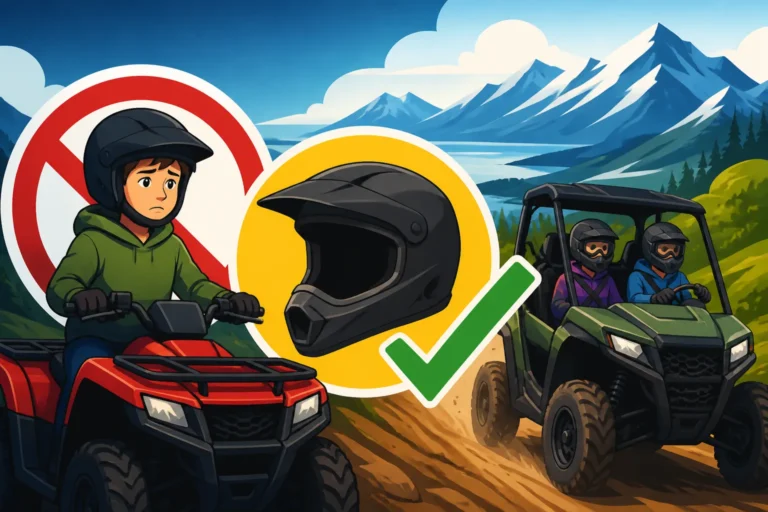
For younger riders, the rules for off-road use are different. Children under 16 must wear an approved helmet when riding an APV, and there are specific rules about supervision and machine size depending on age. You can learn more about this in [Alaska ATV Helmet Law Age]. However, these off-road rules do not extend to public roads. A provisional license also carries its own set of restrictions, such as limits on passengers or nighttime driving, which would then apply to your APV if you're driving it on the road. It's crucial for parents and young riders to understand that while a 14-year-old might be able to ride an ATV on a designated trail with proper supervision and helmet use, they cannot legally drive it across a paved highway, even if it's just to get to another trail.
What If You Don't Have an Alaska Driver's License?
So, what if you're visiting Alaska from another state or country? Or perhaps you're a recent transplant still sorting out your Alaskan residency? The good news is that Alaska generally recognizes valid driver's licenses issued by other U.S. states and Canadian provinces. So, if you're from Washington and have a current driver's license, you're usually good to go for operating your APV on Alaskan roads, provided your machine meets all other requirements. It's always wise to carry your out-of-state license with you, just as you would in your car.
However, the legal ramifications of driving any motor vehicle, including an APV, on public roads without a valid license are severe. You could face significant fines, your machine could be impounded, and you could even face criminal charges depending on the circumstances. This isn't just a slap on the wrist; it can be a major disruption to your life and an expensive lesson. For military personnel stationed in Alaska, generally, a valid driver's license from their home state or military-issued license is recognized. The key takeaway here is that whether you're a long-time Alaskan or a visitor, if you intend to ride your APV on any part of the state's road system, having that valid driver's license in your wallet is not optional – it's absolutely essential. This is one of the first things a trooper will ask to see if they pull you over, as explained in [What a Trooper Can Ask to See].
Navigating Alaska's Mandatory APV Insurance Requirements
Just like driver's licenses, insurance requirements for APVs change dramatically the moment you leave the pure off-road environment and enter public roadways. This is another area where many riders are caught off guard, assuming that their machine's registration is the only "official" document needed. But when it comes to shared public spaces, the state wants to ensure financial responsibility.
Why Liability Insurance is Crucial for Road-Legal APVs
This is a big one, folks. While you don't typically need insurance to ride your ATV on private property or designated off-road trails (though it's always a good idea for your own protection!), the rules are completely different once you're on a public road. Alaska law mandates that if you operate an APV on any public street, road, or highway, you must carry liability insurance. This isn't just a suggestion; it's a legal requirement. You can find more details in [Alaska Requires Liability Insurance for an APV].
Liability insurance is designed to cover damages or injuries you cause to other people or their property. Think about it: if you accidentally swerve and hit a parked car, or if someone on a bicycle collides with your APV because of something you did, liability insurance helps pay for their repairs or medical bills. Without it, you are personally on the hook for potentially devastating costs. Imagine hitting a brand-new pickup truck or seriously injuring another person; the financial burden could easily reach tens or hundreds of thousands of dollars. For many Alaskans, their APV is an essential tool, a workhorse, or a prized recreational machine. Protecting yourself and your assets from unforeseen incidents on public roads is simply a smart, responsible choice.
Minimum Coverage Levels and Policy Considerations
While I can't give you specific dollar amounts for minimum coverage (these figures can change over time and are best verified directly with the Alaska Division of Motor Vehicles or an insurance provider), it's important to understand that the state sets baseline requirements. These minimums typically specify amounts for bodily injury liability per person, bodily injury liability per accident, and property damage liability. These numbers are the floor, not necessarily the ceiling of what you might want or need for adequate protection.
When you're shopping for APV insurance, consider going beyond the absolute minimums. Collision coverage can protect your machine if you're involved in an accident, while comprehensive coverage helps with non-collision incidents like theft, fire, or vandalism. Uninsured/underinsured motorist coverage is also incredibly valuable, as it protects you if someone else hits you and they don't have enough insurance (or any at all). Remember, Alaska is vast, and many areas are remote. Getting into an accident far from help, and then discovering you're not adequately insured, adds a layer of stress and financial burden you definitely want to avoid. Always discuss your specific riding habits and potential risks with an insurance agent to ensure you have a policy that truly fits your needs, not just one that ticks the minimum legal boxes.
How Insurance Affects Your Alaska APV Registration
This is another point of common confusion. Many riders correctly obtain an [Alaska Issues a Decal, Not a Plate] for their APV for general public land use. However, the requirement to have liability insurance becomes active when you intend to operate that APV on public roads. It's not necessarily a prerequisite for the initial registration itself, unless your specific registration application implies road use or you declare intent for such. However, if you're pulled over on a paved road, a trooper will expect to see proof of insurance along with your valid driver's license and current registration.
So, while you might get your initial decal without proving insurance if you're only planning pure off-road use, the moment you decide to take that shortcut across town, or drive down the shoulder of a state highway, you're legally obligated to have that liability policy in force. Failing to do so can lead to fines, suspension of your driver's license, and potentially impoundment of your machine. It's best practice, if you anticipate any road use at all, to secure your insurance before you ever hit the pavement. Think of it as a tiered system: registration for public land access, and then adding a driver's license and insurance specifically for road segments.
Road Use Regulations that Impact License and Insurance
Alaska's approach to APV road use is not a blanket "yes" or "no." It's a patchwork of state statutes and local ordinances that can be incredibly confusing. Understanding these regulations is critical, as they dictate when your license and insurance are even relevant for road travel.
Designated Roads vs. General Road Use Bans
The biggest challenge for APV riders wanting to use public roads in Alaska is the lack of a uniform statewide policy. Instead, Alaska gives communities the power to decide if APVs can be used on their local roads. And many, especially the larger cities, have chosen to ban APV road use outright. For instance, [Alaska Bans APVs in Anchorage], Fairbanks, and Juneau are prime examples of communities where you simply cannot operate your APV on city streets. The same goes for many Mat-Su Valley towns like Wasilla and Palmer, as well as communities on the Kenai Peninsula like Kenai and Soldotna, and even Homer. This means that even if you have a valid driver's license, insurance, and your APV is registered, you could still be ticketed for simply riding on a street in these areas.
However, in some rural areas or smaller communities, APV road use is permitted, often with specific restrictions. For example, communities like Nome or Bethel might have ordinances allowing APV use on certain streets or within city limits, sometimes even as primary transportation. Even where permitted, state law dictates that an APV cannot be operated on a road posted with a speed limit higher than 45 mph. So, if you're on a road where APVs are allowed, you still need to respect [Alaska's 45 mph Road Limit for APVs]. This nuanced system means that you absolutely cannot assume that because you can ride on the road in one village, you can do the same in the next. Always check local ordinances, as detailed in [Checking a City Code Before You Ride], before you embark on a road-based APV journey.
Equipment Requirements for Road-Legal APVs
Beyond having your license and insurance, your APV itself needs to be properly equipped to be road-legal. This isn't just about safety; it's about making your machine visible and controllable in a way that aligns with standard vehicle expectations. The requirements generally include:
- Headlights and Taillights: These must be functional and visible from specific distances, especially during dusk, dawn, or nighttime riding.
- Brakes: A reliable braking system is non-negotiable for safety on public roads.
- Reflectors: Often required on the sides and rear of the machine to enhance visibility.
- Mirrors: Typically, at least one rearview mirror is required for the driver to see traffic behind them.
- Turn Signals: While not always explicitly mandated for all APVs in all situations, they are highly recommended for clear communication with other drivers.
- Horn: A working horn is necessary to alert others.
- Muffler and Emission Controls: Your APV must have an effective muffler system to limit noise, adhering to [Alaska Muffler and Noise Rules]. Loud, modified exhausts are often illegal on public roads.
- Spark Arrester: This is often required to prevent wildfires, particularly when operating in dry conditions, as outlined in [Alaska Spark Arrester Requirements].
- Fenders/Mud Flaps: To prevent throwing debris onto other vehicles.
Failing to meet these equipment requirements, even if you have your license and insurance, can still lead to a citation. It’s a holistic approach to road safety. This is where companies like SuperATV come in handy. They offer a wide range of aftermarket accessories specifically designed to help riders upgrade their machines to meet road-legal specifications. Whether you need a complete turn signal kit, DOT-approved tires, or durable rearview mirrors, SuperATV provides the components to make your machine safer and compliant for those crucial road stretches. Investing in these upgrades isn't just about avoiding a ticket; it's about ensuring your safety and the safety of others when you share the road.
Specific Scenarios: Crossing Highways and Riding Shoulders
Even if your intention isn't to travel down a public road, but merely to cross one, or ride briefly on its shoulder to connect two trails, the rules regarding licenses and insurance still apply. Alaska law permits crossing a highway at a right angle after coming to a complete stop, yielding to all traffic, and crossing only when it's safe and doesn't impede traffic. This is detailed further in [Crossing a Highway on a Quad in Alaska]. While this might seem like a minor maneuver, it's still considered operation on a public highway. Therefore, you need a valid Class D driver's license and proof of liability insurance.
Similarly, riding on the shoulder of a road, even if it's unpaved, is still considered operating within the public right-of-way. This often comes up in rural areas where trails might parallel a highway. If you're on the shoulder, you're expected to have all the same credentials as if you were in the main lane of travel. These specific, short-term road interactions highlight just how pervasive the license and insurance requirements are. It's not just for joyriding down Main Street; it's for any instance where your APV shares space with conventional vehicular traffic. The briefest encounter with a public road environment mandates full compliance.
Common Pitfalls and Misconceptions for Alaska APV Riders
Navigating Alaska's APV rules can feel like trying to find your way through a winding river delta – many paths, some leading to dead ends, and others completely changing course with the tides. It's easy to fall into common traps based on assumptions or outdated information.
Assuming a Decal Means "Road Legal"
This is perhaps the most prevalent misconception among Alaska APV riders. You go through the process, fill out the forms, pay your fee, and get that shiny new decal to place on your machine. The state issues an [Alaska Issues a Decal, Not a Plate], which signifies your registration. For many, this feels like an official endorsement to operate their machine broadly. After all, if the state registered it, doesn't that mean it's street legal?
The short answer is a resounding "no." Your APV registration decal is primarily for identification and to grant you legal access to state and federal public lands for off-road recreation. It says nothing about your ability to operate that machine on public roads. The decal allows wildlife troopers or park rangers to identify your machine when you're out on the trails. It's about accountability for land use, not about street privileges. Many people move to Alaska from states with different ATV laws, or they might have heard anecdotes from friends, and they conflate registration with full street legality. This oversight can lead directly to citations, impoundment, and a lot of unnecessary hassle. It's a critical distinction that every Alaska APV rider needs to internalize.
The "Local Knowledge" Trap
Alaska is a state of strong local traditions and vast, independent communities. What works in one village might be completely illegal just a few miles down the (unpaved) road. Riders often rely on "local knowledge" – what they've heard from neighbors, friends, or what's "always been done." While community wisdom can be valuable in many aspects of Alaskan life, it can be a dangerous guide when it comes to APV laws. Laws can change, new ordinances can be enacted, and what was tolerated by one law enforcement officer might be strictly enforced by another.
The "local knowledge" trap is especially insidious because it feels reliable. "Oh, everyone rides their quad on the main street here," someone might say. But that doesn't make it legal. It's essential to remember that state statutes are paramount, and then local city or borough ordinances can add further restrictions or, in rare cases, specific permissions. Relying solely on informal advice or what you observe others doing can lead to fines, particularly for license, insurance, and equipment violations, which are often the first things checked during a stop. Always cross-reference any local advice with official sources, like the DMV website, state statutes, or the local city clerk's office.
The Cost-Benefit of Compliance vs. Risk
It's tempting to think about cutting corners: maybe you skip the insurance because you only use the road briefly, or you figure your off-road machine is good enough without all the additional road-legal equipment. However, the potential costs of non-compliance far outweigh the perceived savings or convenience.
Consider the following comparison:
| Item | Cost of Compliance (Initial & Ongoing) | Potential Cost of Non-Compliance (If Caught or Incident Occurs) |
|---|---|---|
| Driver's License | Test fees, renewal fees | Fines (potentially hundreds), license suspension, criminal charges, impoundment of machine |
| Liability Insurance | Annual premiums (varies) | Fines (potentially hundreds), license suspension, personal liability for damages/injuries (potentially tens/hundreds of thousands), impoundment |
| Road-Legal Equipment | Purchase/installation of lights, mirrors, etc. (e.g., from SuperATV) | Fines (per item missing), warnings, machine deemed unsafe |
| Registration | Decal fees (two, four, or six years) | Fines (for unregistered vehicle), denial of public land access, impoundment |
| Local Ordinances | Time researching rules | Fines (for illegal road use), impoundment |
The table above illustrates a stark reality. While there's an upfront and ongoing cost to ensuring your APV is fully compliant for road use, these costs pale in comparison to the financial and legal fallout from a single incident or citation. A substantial fine, coupled with impoundment fees and the hassle of retrieving your machine, could easily exceed years of insurance premiums or the cost of SuperATV upgrades to make your machine road-legal. Furthermore, the peace of mind that comes with knowing you're fully legal and protected is truly priceless, allowing you to focus on the enjoyment of your ride rather than worrying about what a trooper might ask to see.
Steps to Ensure Your APV is Road-Ready in Alaska
Okay, so we've covered the complexities and pitfalls. Now, let's talk about how to proactively ensure your APV is genuinely road-ready in Alaska. It takes a little effort, but the peace of mind and legal protection are absolutely worth it.
Obtaining Your Driver's License and Endorsements
The first and most fundamental step is ensuring you have a valid Alaska Class D driver's license. If you don't have one, or if yours is expired, this needs to be your top priority. Head to your local Alaska DMV office to begin the process. If you're new to the state, you'll need to transfer your out-of-state license. If you're a long-time Alaskan who simply let your license lapse, get it renewed promptly. Remember, this is the same license you'd use for your car, so the process will be familiar to most.
Beyond the basic Class D, always ensure your license is current and free of any suspensions or restrictions that might impact your ability to operate a motor vehicle. While there are no specific "APV endorsements" in Alaska, any general endorsements (or lack thereof) on your Class D license for operating a motor vehicle will apply directly to your APV when used on public roads. Make it a habit to check your license expiration date regularly, perhaps linking it to your vehicle registration renewals, so you're never caught off guard.
Securing the Right Insurance Policy
Once your license is in order, the next crucial step is getting the proper liability insurance for your APV. Don't assume your auto insurance policy automatically covers your ATV or UTV; in most cases, it won't. You'll need a specific APV or off-road vehicle insurance policy.
Start by contacting several insurance providers. Many major insurers offer these types of policies, but it's worth getting multiple quotes. When speaking with agents, be very clear that you intend to use your APV on public roads, even if it's just for short stretches or crossings. This ensures they quote you a policy that explicitly includes the required liability coverage for road use. Ask specific questions:
- "Does this policy meet Alaska's minimum liability requirements for APVs operated on public roads?"
- "What exactly is covered if I cause an accident with another vehicle on a paved road?"
- "Are there any exclusions for certain types of road use or locations?"
- "What documentation will I receive as proof of insurance to show a trooper?"
Choosing the right policy isn't just about finding the cheapest premium; it's about adequate protection. Consider additional coverages like collision, comprehensive, and uninsured motorist to protect your machine and yourself. Always carry proof of insurance with you when riding, preferably in a waterproof bag, as it's something a trooper will definitely want to see if you're pulled over on a public thoroughfare.
Equipping Your Machine for Road Legality
With your license and insurance sorted, it's time to ensure your APV itself is up to snuff for road use. As we discussed, there's a list of mandatory equipment that moves your machine from purely off-road to road-legal. This often involves adding components that aren't factory-standard on many ATVs and UTVs.
Here's a checklist of key items to verify or install:
- Working Headlights and Taillights: Ensure they are bright and fully functional.
- Brakes: Test them to ensure they are responsive and effective.
- Reflectors: Install or verify that your APV has adequate reflectors on the sides and rear for nighttime visibility.
- Mirrors: Add at least one rearview mirror, ideally two, for clear rearward visibility.
- Turn Signals: While not always strictly mandated, they are a massive safety improvement for road use and highly recommended.
- Horn: A loud, clear horn is essential for signaling.
- Muffler: Ensure your muffler is intact and meets noise regulations, [Alaska Muffler and Noise Rules].
- Spark Arrester: Verify its presence and functionality, especially critical for fire prevention in dry conditions. More on this in [Alaska Spark Arrester Requirements].
- License Plate Mount: Even though Alaska issues a decal, some locales or specific APV types might require a visible plate-like display for the decal or other identification.
For many of these upgrades, especially turn signal kits, mirrors, and even DOT-approved tires, companies like SuperATV are an invaluable resource. They specialize in aftermarket parts that can transform your trail machine into a more road-capable vehicle. Their products are designed for durability and often come with clear instructions, making it easier for riders to bring their machines into compliance. Don't wait until you get a ticket to realize your machine isn't properly equipped. Conduct a thorough pre-ride inspection of all road-required equipment every time you plan to hit the pavement.
Verifying Local Ordinances
Finally, and this cannot be stressed enough, always verify the specific local ordinances for any community where you plan to operate your APV on a public road. As mentioned, Alaska does not have a statewide blanket rule, and communities have significant authority to regulate APV road use.
Here's how to do it:
- Check City/Borough Websites: Many municipalities post their ordinances online. Look for sections related to "motorized vehicles," "ATVs," "UTVs," or "off-road vehicles."
- Contact Local Offices: If you can't find clear information online, call the city clerk's office or the borough's planning department. They can usually point you to the correct regulations.
- Ask Law Enforcement: While not their primary role to interpret every local law, Alaska State Troopers or local police departments can often provide guidance on common APV road use rules in their jurisdiction.
A simple phone call or quick online search can save you from a major headache. What's legal in Nome might be strictly prohibited in Fairbanks, as highlighted by [Alaska Bans APVs in Fairbanks]. Making this pre-trip check a part of your routine, especially when venturing into new areas, is the mark of a truly responsible and well-prepared Alaska APV rider.
Disclaimer
This article is for general informational purposes only and does not constitute professional advice. Laws, prices and regulations vary by location and change over time. Consult a qualified professional for guidance on your specific situation.