Matching Engine Size to a Young Rider’s Age
Choosing an ATV or UTV for a young rider is not as simple as matching age to engine size. Engine displacement does not tell you how heavy, fast, or manageable a machine feels. This guide explains how to use manufacturer age guidance, assess fit and experience, and account for Alaska’s terrain without treating a single number as a safety guarantee.
Why age and engine size are only a starting point
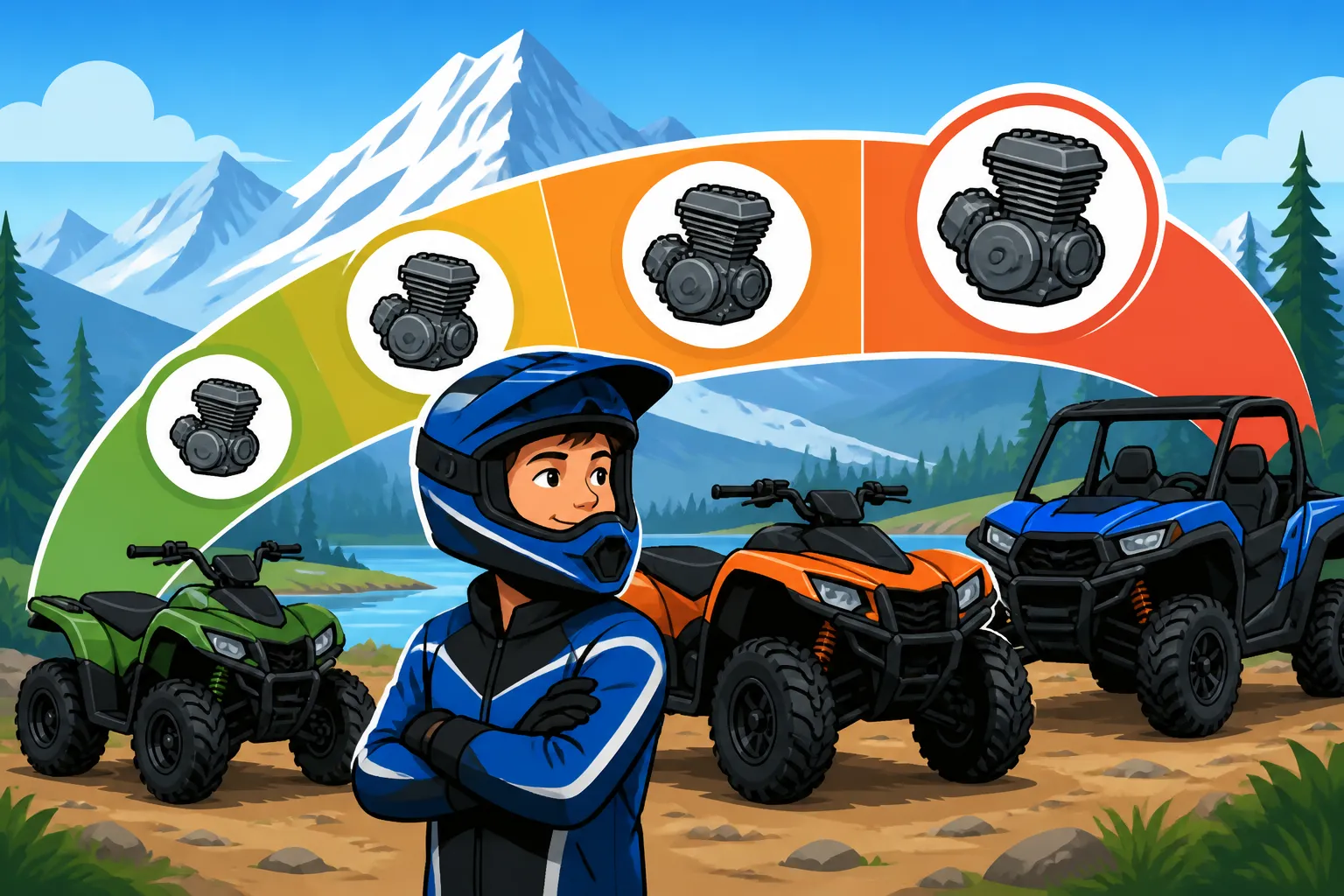
Engine size, usually shown in cubic centimeters, can help distinguish one machine from another, but it is not a complete measure of how suitable it is for a child. Two machines with similar displacement can have different power delivery, throttle response, gearing, weight, braking, and handling. A smaller engine does not automatically make a machine easy to control.
Age guidance from the manufacturer is a useful first screen. It reflects the design and intended use of that particular model, so check the owner’s manual and any labels on the machine rather than relying on a general age-to-cc chart. A child who has outgrown one model’s recommended age range is not automatically ready for a larger or faster one. Physical fit, judgment, supervision, and riding experience still matter.
Age is also an imperfect measure of development. Riders of the same age can differ in height, reach, strength, attention, and confidence. A young rider needs to be able to operate the controls deliberately, stay positioned on the machine, and respond to instructions. If those tasks are difficult while stationary, they will be harder on uneven ground.
Use manufacturer guidance as a boundary, not a promise. It does not mean that every child within the listed age range is ready to ride, nor does a child’s ability to reach the controls mean the machine is appropriate. For broader Alaska-specific considerations, see Manufacturer Age Guidance for Alaska Families and Alaska Rules for Young Riders.
Engine displacement also does not tell you whether a model is an ATV intended for a single rider, a multi-rider ATV, or a side-by-side UTV. These machines have different controls and operating risks. A larger UTV can feel more enclosed, but it is still a motorized vehicle that can roll, slide, or collide. A passenger seat and seat belt do not make a young passenger an appropriate driver.
A practical way to compare machines
Start with the specific machine, not a general chart. Compare its manufacturer’s age guidance with the young rider’s size, ability, and experience. Then assess how the machine behaves at low speed and whether its controls can be used comfortably without stretching, shifting position, or losing a secure grip.
| What to check | Why it matters | What to look for |
|---|---|---|
| Manufacturer age guidance | The model’s design and intended rider matter more than a broad cc chart | Manual, labels, and any model-specific restrictions |
| Seat and body fit | A rider who cannot stay centered or move comfortably may struggle on rough ground | Secure seating, balanced posture, and room to shift weight |
| Control reach | Brakes, throttle, and steering must be manageable without awkward stretching | Hands and feet reach controls while the rider remains stable |
| Machine weight | A heavy machine can be difficult to control or recover if it tips or gets stuck | Whether the rider can manage ordinary low-speed demands with supervision |
| Throttle response | Quick or abrupt acceleration can overwhelm an inexperienced rider | Predictable response and any manufacturer-provided speed-control features |
| Brakes and steering | The rider needs to slow, stop, and turn consistently | Controls work smoothly and the rider can operate them correctly |
| Riding conditions | Mud, ruts, slopes, water, and loose material add difficulty | A machine and route that match the rider’s current skill, not future goals |
Check fit before considering more power
Have the rider sit on the machine with the engine off and the machine secured. Check whether they can hold a stable position, reach the controls, and turn the steering through its range without leaning dangerously or losing balance. For a foot-operated control, confirm they can reach and use it as designed. A rider should not have to stretch to operate a brake or twist into an unstable position to steer.
Then consider whether the rider can manage the machine’s weight. This is not a test of strength alone. A rider may be able to sit comfortably but still be unable to respond safely if the machine shifts, stops unexpectedly, or needs to be held steady. Adult supervision does not remove that mismatch.
Treat speed control as a backup
Some machines have features that limit speed or power. These can help adults introduce riding at a controlled pace, but they are not a substitute for selecting an appropriate machine or supervising closely. A speed setting cannot make an oversized, heavy, or difficult-to-control machine suitable for a child.
Check how any limiter works, whether it can be adjusted, and whether the child can operate the machine predictably at the resulting speed. Avoid assuming that a low speed setting prevents crashes. A machine can still tip, slide, strike an obstacle, or be steered into a hazard.
Consider the rider’s experience
A young rider who has never used a motorized machine should not be treated like a child who has practiced basic controls under close supervision. Start with simple, open terrain and low-speed instruction. Progress only after the rider consistently follows directions, uses the controls correctly, and stops when told.
Do not use a more powerful machine as a reward or as a way to keep up with adults. The adult group should adjust its pace and route to the least experienced rider. If the child is tired, distracted, cold, or frustrated, end the practice session rather than pushing for one more difficult section.
Alaska terrain and access change the decision
An ATV that seems manageable on a smooth, open surface may be a poor match for Alaska riding conditions. Uneven ground, mud, loose gravel, ruts, changing weather, and water crossings can demand quick decisions and careful control. Glacial silt and soft ground can affect traction; a machine can bog down or slide even when the route looks straightforward. A child’s first rides should not begin on challenging terrain simply because the machine has enough power to get through it.
Plan around the rider’s current ability, not the machine’s advertised capability. Choose an appropriate practice area where riding is allowed, keep the route simple, and stay close enough to intervene. Avoid deep water, steep slopes, fast-moving crossings, and situations where a child may feel pressured to follow an adult through an obstacle. Turning back is a sound decision when conditions change.
Confirm the rules for the place you plan to ride
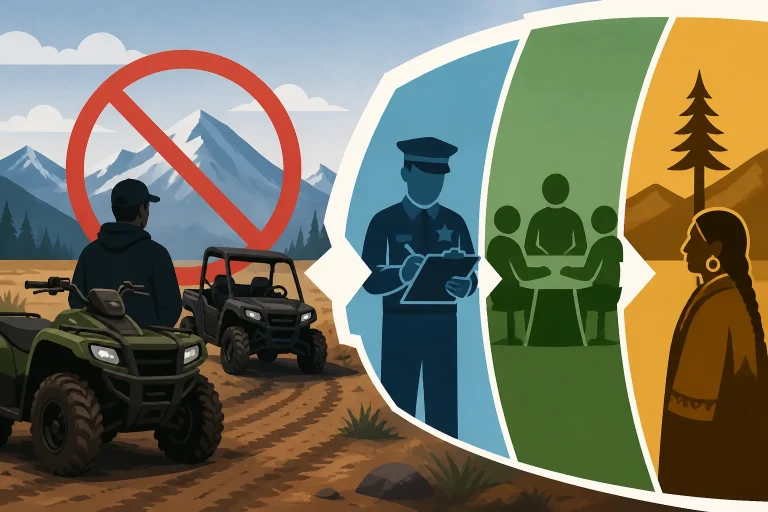
A machine’s age guidance and a child’s physical readiness do not establish where riding is legal. Land ownership, local rules, machine classification, and permit requirements are separate questions. The Alaska Statewide General Permit for ATV Use does not settle access for every parcel or every type of land; check the land manager and local requirements before heading out. A trailhead pass, where applicable, is also not the same thing as permission to ride on all nearby land.
The general permit question is only one part of planning. State parks, private property, Native corporation land, and land managed by other agencies may have different access rules. Alaska Land Ownership and Who to Ask can help frame that check. Do not assume that a route is open because it is commonly used, visible from a road, or shown on a general map.
Rules may also differ between operating an off-road machine and riding an APV on a road. The machine’s classification matters, and road-use requirements can involve a driver’s license, insurance, equipment, and local restrictions. Alaska’s APV Class Explained covers why the class of machine matters. For a child riding on public roads or in a community, check the specific rules rather than applying trail assumptions. See Alaska Rules for a Teen Rider for age-related road riding considerations.
A child’s permit obligations are another separate issue from engine size. Confirm current requirements for the child, machine, and land before riding; Do Alaska Kids Need a Permit? addresses that question. If an adult plans to carry a child as a passenger, check the rules and the vehicle’s seating arrangement rather than assuming any seat or towable setup is acceptable. Alaska Rules for a Child Passenger is a useful companion.
Do not use a UTV’s size as a safety shortcut
A side-by-side may offer a seat, seat belt, and protective structure, but those features do not make it a youth-sized vehicle. A young person should drive only if the manufacturer’s guidance and applicable rules allow it, and only if they can properly operate the controls. For a passenger, use only a designated seat and follow the manufacturer’s instructions for restraints and seating.
Keep children in the appropriate seat, use the restraint system as directed, and do not let a passenger’s confidence replace adult judgment. A UTV can be difficult to maneuver in confined terrain and can roll on slopes or uneven ground. Its weight and momentum may also make consequences more serious than on a smaller machine. The adult driver remains responsible for choosing a safe route and pace.
For a child passenger on an ATV, do not assume that a second person can safely ride just because there is room on the seat. Follow the machine’s intended seating and passenger instructions. More on passenger-specific considerations is available in Alaska Rules for Passengers on a Quad.
Build readiness gradually and protect the rider
Once you have selected a machine that fits the manufacturer’s guidance and the rider, teach the basics in a controlled progression. A short, familiar practice area is better than a long trail ride. Keep the adult close, use clear instructions, and make sure the rider knows how to stop and what to do if they become uncomfortable.
A practical first-session sequence is:
- Read the owner’s manual and inspect the machine together. Identify the throttle, brakes, ignition, and any speed-control feature.
- With the machine off, have the child practice sitting securely and operating the controls as directed.
- Demonstrate starting, stopping, turning, and maintaining a safe following distance.
- Practice at low speed in a clear, permitted area, with the adult positioned to supervise closely.
- Stop and review before adding turns, uneven ground, or other new challenges.
- End the session if the child cannot consistently follow instructions or seems tired, cold, overwhelmed, or distracted.
Protective gear needs to fit the rider, not just be available in a suitable size. Use a properly fitted helmet that meets the applicable standard, along with suitable eye protection, gloves, long sleeves, long pants, and sturdy footwear. The helmet should sit securely and stay in place when fastened. A loose helmet or gear that restricts movement can create its own problems. See Choosing a CPSC Helmet for a Young Rider for helmet selection details.
Alaska weather makes clothing part of the safety plan. A child who gets wet or cold may lose focus and coordination. Bring layers and rain protection appropriate for the route and conditions, and check that the rider can still use the controls while wearing them. Do not let heavy clothing interfere with steering, braking, or secure seating.
Before each ride, inspect the machine and make sure brakes, throttle, steering, tires, and lights are working as intended. Explain the route, boundaries, signals, and stop points. Keep the group small enough that the supervising adult can observe the child rather than focusing on navigating several riders. If the route includes obstacles that require the child to copy an adult’s line at speed, choose another route.
Let readiness, not birthday or displacement, set the next step
A rider is not ready for a larger machine simply because they have reached a particular age or handled a smaller one once. Look for consistent control, careful judgment, and the ability to follow instructions under ordinary riding conditions. Increase one challenge at a time: a little more distance, a different surface, or a slightly more complex route. Do not add power, speed, and difficult terrain all at once.
If the child is uncomfortable, cannot reach controls reliably, or needs repeated reminders to slow down, go back to a simpler setup. That may mean returning to a smaller machine, practicing in a less demanding area, or waiting. A conservative choice is not a failure; it reduces the chance that a small mistake becomes a serious incident.
Ultimately, match a young rider to the particular machine and the particular ride. Manufacturer guidance helps narrow the options, but fit, experience, adult supervision, and Alaska’s changing conditions determine whether the choice makes sense. A suitable engine size is one part of that decision, not the decision itself.
Disclaimer
This article is for general informational purposes only and does not constitute professional advice. Laws, prices and regulations vary by location and change over time. Consult a qualified professional for guidance on your specific situation.