Alaska Riding Areas With Wash Stations
A muddy ride near Knik River or Jim Creek can leave your ATV packed with glacial silt, but a nearby trailhead does not necessarily have a place to wash it. This guide explains how to find and verify wash facilities around Alaska riding areas, what to do when none are available, and how to clean your machine without sending mud and fuel residue into streams or wetlands.
What to expect from wash stations near Alaska riding areas
A trailhead and a wash station are not the same thing
Alaska has popular riding areas where you can spend a day in mud, dust, and glacial silt, but access to a trail does not guarantee access to a machine wash station. A parking area may have room for trailers and a place to pay a fee, yet no hose, drain, or designated wash pad. Even a campground with basic amenities may not be equipped for washing an ATV or UTV.
That distinction matters when you are planning a trip. If you arrive at a trailhead assuming you can rinse off your machine before heading home, you might end up with a muddy trailer, a clogged radiator, or a mess in your driveway. For a general look at riding locations and their different conditions, start with [Alaska ATV Trails: Where to Ride](Alaska ATV Trails: Where to Ride).
Why Alaska mud and glacial silt need extra care
Mud is not just a cosmetic problem. Thick material can collect around suspension parts, brake components, and the underside of a machine. Fine glacial silt is especially easy to spread: it can cling to wet surfaces, dry into a stubborn coating, and become airborne when you blow or brush it off. A rinse in the wrong place can also carry sediment, oil, and other residue into a stream or wetland.
At places such as the Knik River Public Use Area, conditions can change along the route. A machine may pick up fine silt on one section and wet, sticky mud on another. Do not treat a river crossing or a puddle as a wash bay. Riding through water may help loosen dirt, but it does not clean the machine safely or remove what is lodged underneath. See [Alaska Glacial Silt and Machines](Alaska Glacial Silt and Machines) for more on why this material can be hard on equipment.
Verify the facility before you leave home
The most reliable approach is to confirm wash access directly with the land manager, campground, riding-area operator, or nearby service business. Ask specifically whether they allow off-highway vehicle washing, not just whether water is available. A drinking-water tap, restroom sink, or campsite water connection is not automatically intended for washing a muddy machine.
It also helps to ask where the wash water goes. A proper wash area should be designed to manage runoff. If the person you reach cannot confirm that machine washing is allowed, plan as though it is not. You can use a trail map app such as onX Offroad to help locate the riding area and nearby roads, but verify services with the facility itself; a map pin or user-added point is not confirmation of a wash station.
| What you need to verify | Why it matters | Question to ask |
|---|---|---|
| Whether vehicle washing is allowed | Water access does not necessarily mean washing is permitted | “Can I wash an ATV or UTV here?” |
| Where the wash area is | A general campground location may be far from the wash facility | “Is there a designated wash pad, and where is it?” |
| How runoff is handled | Muddy runoff may carry sediment or residue into the surrounding area | “Is the area designed for machine wash water?” |
| Whether the facility is open | Seasonal access and operating hours can change | “Will it be open on the day I visit?” |
| What equipment is provided | You may need to bring your own hose or cleaning supplies | “Is there a hose, pressure washer, or only a water source?” |
| Whether there are restrictions | Some facilities may limit machine size or washing methods | “Are there restrictions on UTVs, soaps, or pressure washing?” |
Checking wash options around popular riding areas
Knik River and Jim Creek
Knik River and Jim Creek are well-known choices for riders near the Mat-Su Valley, but their trail access and recreation facilities should not be confused with a guaranteed ATV wash service. The Knik River area includes varied terrain and a large riding landscape, so the mud and silt on your machine can depend on the route and recent conditions. Before you go, check the specific access point and any facility you plan to use rather than assuming there is a wash station at the end of the ride.
Jim Creek’s campground and day-use facilities are also worth checking separately from the trail itself. A campground may offer services for visitors without offering a place to wash vehicles. If you are planning to camp, review [Alaska OHV Camping With Trail Access](Alaska OHV Camping With Trail Access) and confirm current facility details with the manager. For route planning and area context, [Knik River Public Use Area in Alaska](Knik River Public Use Area in Alaska) is a useful starting point.
Before setting out, decide what you will do if there is no wash facility. Bring a tarp for the trailer area, gloves, a soft brush, and a small supply of clean water for targeted cleaning of critical parts. Do not discharge muddy water onto the ground at a campsite or parking area unless the site specifically allows it.
Mat-Su trailheads and Hatcher Pass
Around Palmer, Wasilla, and the Mat-Su Valley, a trailhead parking pass may apply at some locations. A pass is about access or parking, not a promise of wash amenities. Check the details for the exact trailhead you plan to use, and look for separate information about water, restrooms, and vehicle cleaning. [Alaska Mat-Su Trailhead Parking Passes](Alaska Mat-Su Trailhead Parking Passes) explains why it is useful to distinguish a parking requirement from other services.
Hatcher Pass also requires careful planning because access, weather, and seasonal conditions can affect a ride. If your route includes narrow roads, changing weather, or a long return trip, it is especially helpful to have a cleanup plan that does not depend on finding a wash station at the trailhead. onX Offroad can help you review routes and mark a potential stop, but call or check with that stop to verify it accepts muddy off-highway vehicles.
If you are riding near Palmer or Willow, identify a backup location before leaving the paved road. A car wash or commercial wash bay may or may not accept an ATV or UTV, and some may prohibit heavy mud or require a specific wash area. Ask before unloading. Do not assume that a facility designed for passenger vehicles can handle a trailer, large side-by-side, or heavily muddy machine.
Denali Highway and more remote routes
A ride on the Denali Highway can put you far from services. Even when a nearby community has fuel, lodging, or general vehicle services, that does not mean a wash bay is available or suitable for an ATV. Plan to manage dirt and mud at your destination without relying on a last-minute facility. Review [Denali Highway Riding in Alaska](Denali Highway Riding in Alaska) and [Alaska Trails With Camping](Alaska Trails With Camping) when weighing route length, overnight plans, and nearby services.
For remote rides, consider what a dirty machine means for the trip home. Mud can add weight, cover lights or reflectors, and make it harder to inspect parts. A careful brush-off and inspection at a suitable stopping point may be more practical than a full wash. Take extra time to check tires, brakes, cooling openings, and the underside before loading.
A map app such as onX Offroad may help you mark fuel stops, trailheads, and possible services along your route, but it cannot establish that a business permits ATV washing. Call ahead, explain the type and condition of your machine, and confirm whether the location has an appropriate wash area.
How to clean your ATV or UTV when there is no wash station
Remove the heavy material without spreading it
Start with the machine parked on a stable surface where debris can be collected or managed. Use a plastic scraper or a soft brush to remove large clumps from the tires, fenders, skid plates, and other accessible areas. Avoid scraping aggressively around wiring, seals, hoses, and painted panels. If mud has dried, loosen it gently rather than attacking it with a hard metal tool.
Keep the removed mud from being swept into a ditch, stream, storm drain, or wetland. If you are at a developed site, follow its waste and cleanup rules. If you are in the backcountry, do not create a wash area beside a water source. The practical goal is to keep the machine manageable while containing debris, not to make the ATV look showroom-clean in the field.
Inspect the parts that can cause trouble
After removing loose material, check areas where dirt can affect operation. Mud packed around the radiator can reduce airflow. Debris around brakes may interfere with inspection or operation. Caked material beneath the machine can conceal a damaged hose, a loose guard, or a fluid leak. Check the controls and lights, too, especially after a rough or wet ride.
If the machine has been through deep mud or water, consult its owner’s manual for the correct cleaning and inspection steps. Avoid directing high-pressure water at bearings, electrical connectors, seals, or other sensitive areas. More pressure is not always better: it can force grit and moisture into places that should remain protected.
Save the thorough wash for an appropriate facility
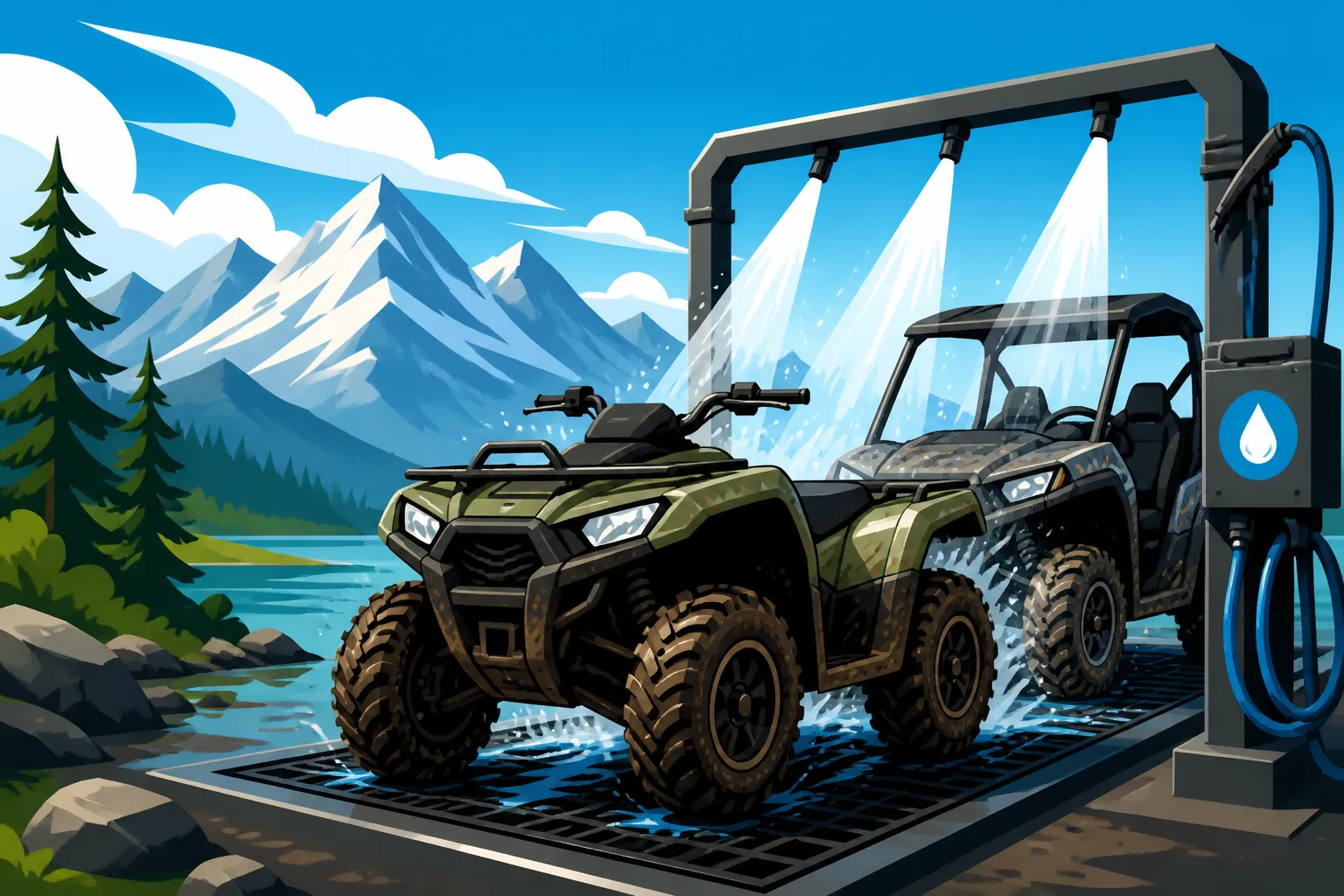
Once you reach a place where washing is permitted, use the facility’s instructions. If it provides a designated pad, keep the machine within that area and avoid letting runoff escape. Use only cleaning products permitted by the facility, and do not leave clumps of mud or debris behind. Some wash sites may have specific procedures for rinsing off vehicles from muddy or dusty roads; follow those rather than improvising.
If you cannot locate an approved wash facility, a limited cleanup is still useful. Remove large clumps, clear essential openings, wipe exposed controls, and inspect the machine. Then complete a more thorough wash later at a location designed to handle vehicle runoff. For upkeep after a ride, [Washing Glacial Silt Off Before You Return a Rental](Washing Glacial Silt Off Before You Return a Rental) offers related cleaning considerations, particularly when a rental agreement sets its own return expectations.
Plan your wash strategy before the ride
Build a simple pre-ride checklist
A few minutes of planning can prevent a frustrating scramble after the ride. Before leaving, write down the riding area, the nearest town, the facility you have confirmed, and a backup plan. Save contact details in case cell coverage disappears. If the destination has a fee or access requirement, check that separately from wash availability. [Alaska Trailhead Fees and Passes](Alaska Trailhead Fees and Passes) can help you keep those questions distinct.
For a day ride near Anchorage or the Mat-Su Valley, your backup might be a confirmed commercial wash facility on the way home. For a more remote trip, it may simply be a contained field cleanup followed by a proper wash once you return to a suitable location. Avoid making a long detour based only on a map listing that says “car wash” or “water.”
Your checklist could include:
- Confirm the riding area is open and suitable for your machine.
- Ask whether a specific wash facility permits ATV or UTV cleaning.
- Confirm whether you need to bring a hose, water, or cleaning supplies.
- Pack a scraper, soft brush, gloves, and a tarp for loading.
- Identify how you will contain loose mud if no wash station is available.
- Check the machine before loading, especially lights, tires, brakes, and cooling openings.
Match the plan to the machine and route
A compact ATV and a large side-by-side do not present the same cleanup problem. A UTV may be too wide or tall for a typical wash bay, and its tires can carry more mud. A heavily modified machine may also require extra care around snorkels, electrical accessories, or aftermarket components. Tell the facility what you are bringing rather than asking only whether it “has a wash.”
Route conditions matter, too. A dry gravel ride may leave dust but little caked mud; a wet day or a glacial crossing can create a different cleanup job. Check local conditions before departure, and allow time for a careful inspection on the way back. If your plans change, adjust the cleanup strategy instead of assuming a wash station will appear at the next trailhead.
onX Offroad can be useful for planning and keeping potential stops organized, especially when you are comparing access routes or traveling beyond a familiar area. Use it as one part of the plan, alongside direct confirmation from the trailhead, land manager, or business. For help thinking through seasonal conditions and access, [Alaska Riding Seasons and Breakup](Alaska Riding Seasons and Breakup) is also relevant.
A practical rule for Alaska riders
Treat wash access as a service you must verify, not an amenity that comes automatically with a trailhead, campground, or parking pass. This is particularly important around places such as Knik River, Jim Creek, Hatcher Pass, and the Denali Highway, where terrain, distance, and facility types vary.
A confirmed wash pad is convenient, but a good backup plan matters just as much. Remove heavy debris responsibly, protect streams and wetlands from runoff, inspect the machine before loading, and finish the wash at a location that allows it. That approach helps you get home without turning a muddy ride into a preventable cleanup problem.
Disclaimer
This article is for general informational purposes only and does not constitute professional advice. Laws, prices and regulations vary by location and change over time. Consult a qualified professional for guidance on your specific situation.