Crossing a Salmon Stream
A salmon stream can look like an easy shortcut until a tire cuts into the bank, stirs up gravel or reaches water that is deeper than it appears. Before crossing on an ATV or UTV in Alaska, check who manages the land, whether the route is authorized and whether habitat rules apply. Then assess the water and choose a crossing—or turn back.
Check permission before entering the stream
A public trail or a statewide land-use permit does not automatically authorize every stream crossing. The crossing may be on land with a different owner or manager, and rules can differ between state land, state parks, federal land, municipal land and private property. Start by figuring out exactly where the trail and stream are, rather than assuming that an open-looking route is open to motorized travel.
Alaska’s Statewide General Permit for ATV Use explains the scope of the state permit. It does not replace landowner permission, local rules or requirements set by another land manager. State parks, private land and some designated areas have separate rules. A trailhead parking pass, where required, is also not a land-use permit.
Use land-status information and current route details together. A map can help show property boundaries and managed areas, but it may not show temporary closures or the specific route a land manager allows. If the route crosses Native corporation land, private property or land administered by another agency, check with the relevant owner or manager before riding. Alaska Land Ownership and Who to Ask and Checking a Land Status Map can help you identify the next step.
The stream itself raises a separate question: could the crossing affect fish habitat? Alaska has protections for fish-bearing waters, including rules that can require authorization for work affecting a stream or its habitat. The details depend on the waterbody and the activity. Driving an existing, authorized route is not the same as building a ford, moving gravel or placing material in the channel. But do not assume that an existing tire track, a shallow-looking spot or a state land permit settles the question.
Alaska Department of Fish and Game information can help you check whether a waterbody is listed as anadromous, meaning it supports fish that migrate between freshwater and the ocean. The Anadromous Waters Catalog and Atlas are useful starting points. A listing is a reason to take habitat rules seriously and check what authorization applies to your planned activity. A waterbody not appearing in a map search is not, by itself, proof that crossing or altering it is allowed.
If your plan involves making, repairing or relocating a crossing, ask the appropriate agency before doing the work. Examples include pushing gravel into a channel, cutting a bank, filling a low area, installing a culvert or building a more permanent ford. Contact the Alaska Department of Fish and Game Habitat Section to ask whether a fish habitat permit is needed; depending on the work and location, other permits or approvals may also apply. For a straightforward ride over an established route, ask the land manager and habitat office what rules apply to that particular crossing instead of guessing.
| Situation | What to check before you ride |
|---|---|
| Existing, authorized trail crosses a stream | Confirm the route is open and ask the land manager about crossing conditions or restrictions |
| The stream is listed as anadromous | Check with the appropriate fish habitat office before crossing, especially if the route or crossing is being changed |
| You plan to move gravel, alter a bank or install a structure | Ask about required permits before starting work |
| The crossing is on private or Native corporation land | Get permission from the owner or land manager; public access nearby does not establish access across that parcel |
| The water is high, fast, turbid or changing | Do not enter; wait for safer conditions or turn back |
| You cannot confirm the route or applicable rules | Stop and verify before proceeding |
For more on the regulatory question, see When Alaska Requires a Fish Habitat Permit and Alaska Stream Crossing Rules. Those rules should be checked alongside access permission, not treated as a substitute for it.
Understand why a crossing can damage habitat
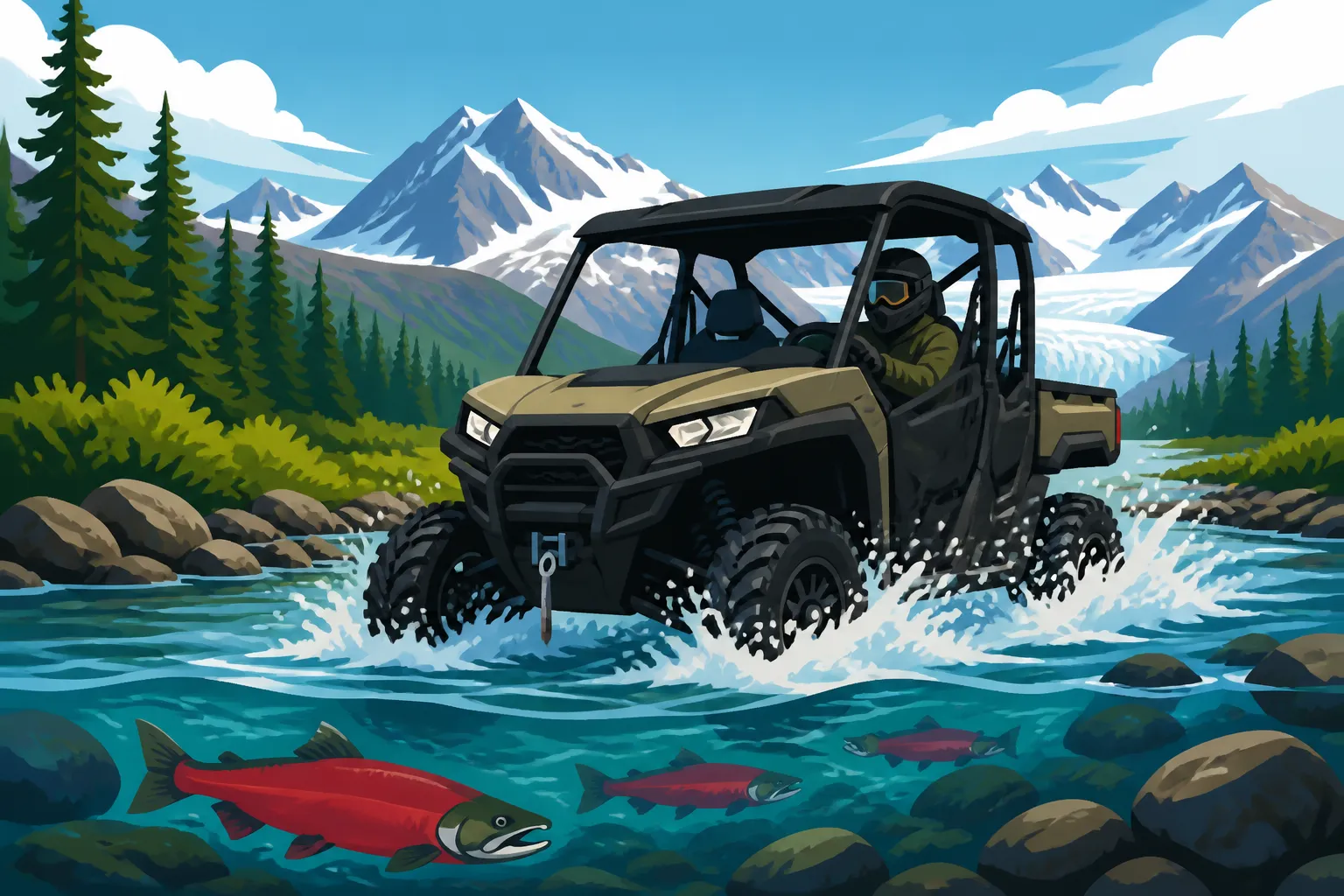
A salmon stream is more than the water visible at the crossing. Salmon use streams for migration and, depending on the species and location, for spawning and rearing. Eggs can be buried in gravel, and young fish may use shallow edges and sheltered areas. A vehicle can affect habitat even when it does not strike a fish.
Tires can dislodge gravel, crush or expose eggs, and break down a bank. They can also stir fine sediment into the water. Suspended sediment may reduce water quality and settle over gravel downstream. Repeated passes can make a small disturbance worse by widening the entry and exit points, creating ruts and encouraging more riders to use the streambed as a trail.
The risk is not limited to obvious construction. A rider who turns around in the channel, spins the tires on a soft bottom or repeatedly crosses at several points can disturb more of the stream than a single careful pass over an established crossing. A muddy plume or newly cut bank is a sign to stop, not a signal to try another line through the water.
The route may also cross a wetland or a side channel that is easy to mistake for firm ground. Alaska’s landscape changes with rain, snowmelt and glacial water. A crossing that was shallow on an earlier trip may be deeper or faster now. See Alaska Wetland Travel Restrictions Explained for a broader look at wet ground and travel impacts.
Before leaving, identify the intended crossing on a map or from reliable local route information. A general trail map may not show the exact ford, seasonal restrictions or land boundary. If the stream has shifted, if a familiar trail now enters a different channel, or if the route is visibly damaged, do not make a new crossing on your own. Check with the land manager for a permitted alternative.
Assess the water and choose a safe response
Even a legal crossing may be unsafe. Water depth is difficult to judge from the bank, and current strength can be deceptive. Glacial streams can change quickly, while rain or snowmelt can raise water levels. Gravel bars and channels may shift, leaving a familiar crossing with a different approach or exit. Reading a Glacial River Before You Cross and Crossing a Braided Channel cover those hazards in more detail.
Before committing, stop on firm ground well back from the water. Look at the current, the bottom, both banks and the exit route. Check whether the water is rising, whether the channel is carrying debris and whether there is a safe place to turn around. If you cannot see a stable route across and out, do not enter.
A practical decision checklist:
- Confirm that the crossing is allowed. Check the route, land manager and any applicable habitat guidance. Do not treat tire tracks as proof of permission.
- Look for safer alternatives. Use an established bridge or authorized crossing if one is available. Do not create a new route around a damaged crossing.
- Read the water from the bank. Consider depth, current, visibility, bottom conditions and the condition of the exit.
- Check the machine and group. Confirm that the machine can handle the crossing and that riders understand the plan. A UTV carrying passengers or cargo may be less forgiving than a lightly loaded ATV.
- Turn back if the conditions are uncertain. A schedule, short distance or previous successful crossing does not make today’s water safe.
Never ride into water that is too deep or fast for the machine, or where you cannot identify a stable bottom and exit. A current can push a machine off line; water can enter components, and a stalled vehicle may create a recovery problem in the channel. A winch is not a reason to attempt a crossing that is unsafe or unauthorized.
If the crossing is suitable and permitted, use the established route and minimize disturbance. Keep the approach and exit as direct as conditions allow; avoid unnecessary turns, wheelspin and stopping in the water. Do not drive along the streambed to search for a better line. If another rider is crossing, wait in a safe place rather than crowding the bank or entering behind them.
A group should decide in advance what will happen if one machine cannot cross. Keep riders and machines out of the channel while a plan is made. Do not let several people attempt improvised recovery techniques that scrape the bed or cut into the bank. If the only way through involves altering the crossing, leave the work for the appropriate manager or permit process.
If the crossing is damaged or conditions change
A crossing can become unsafe or harmful before a formal closure sign appears. Watch for fresh bank cuts, deep ruts, exposed roots, a muddy plume, newly deposited debris or a channel that has shifted across the route. Those conditions call for caution and a pause, not an attempt to force the machine through.
If the established route appears damaged, turn around where it is safe and report the problem to the land manager. Include the location, the condition you observed and whether the route seems blocked or washed out. A clear report can help the manager decide whether to close the route, repair it or direct riders elsewhere. Do not repair the crossing yourself unless you have authorization.
If you accidentally disturb the stream, stop further damage. Do not make repeated passes to clear a rut or push gravel back into place. Move out only if you can do so without causing more harm; otherwise, contact the land manager for instructions. Take note of the location and what happened so you can give a useful report. Avoid posting directions that encourage others to use a damaged or unauthorized crossing.
Season matters, but there is no single calendar rule that makes every crossing safe or unsafe. Fish use, water levels, weather and local management vary by stream. Ask about seasonal closures or sensitive periods for the specific location rather than relying on a general assumption about when salmon are present. Even outside a known spawning period, banks and streambeds can remain vulnerable to vehicle damage.
A useful final check is to ask three questions: Do I have permission to ride this route? Have I confirmed what rules apply to this waterbody and crossing? Can I cross safely without altering the stream or causing avoidable disturbance? If any answer is unclear, stop and get advice before riding through.
Disclaimer
This article is for general informational purposes only and does not constitute professional advice. Laws, prices and regulations vary by location and change over time. Consult a qualified professional for guidance on your specific situation.