You Cannot Register an Alaska OHV Online
It’s a common frustration in our increasingly digital world: you have an important task to do, you assume you can hop online, click a few buttons, and be done. But if you've recently purchased an ATV, UTV, or other off-highway vehicle (OHV) in Alaska and tried to register it from the comfort of your living room, you've likely hit a wall. That's because, unlike many other states or even other types of vehicle registrations within Alaska, you simply cannot register an Alaska OHV online. This guide will walk you through exactly why that is, what steps you do need to take, and how to make your in-person registration as smooth as possible.
The Reality of Alaska OHV Registration: No Online Option
I know, it's frustrating. We're all used to managing so much of our lives online these days—banking, shopping, even renewing car tabs in some places. So, when you try to register your brand-new side-by-side or that reliable used quad you just picked up, and there's no obvious link on the DMV website, it can be a real head-scratcher. But for OHVs, Alaska operates a bit differently, and it’s important to understand why the digital shortcut just isn’t available.
Why the DMV Prefers the Personal Touch
Think of it this way: OHV registration often involves unique circumstances that are best handled face-to-face. Sometimes, the paperwork isn't as straightforward as a new car purchase from a dealership with a clear title transfer. You might be registering a used machine from a private seller where the bill of sale needs a closer look, or perhaps you're dealing with a lost title scenario. These situations can be complex, and a real person at the counter can clarify details, ask probing questions, and ensure everything is correctly processed right then and there. It helps prevent errors down the line and ensures compliance with Alaska's specific APV laws. There's also the matter of verifying ownership and ensuring the vehicle isn't stolen, which can be more thoroughly vetted in person.
What "No Online" Truly Means for You
When we say "no online option," it means exactly that: you won't find a portal to upload documents, pay fees, or receive a digital decal. This isn't just about convenience; it fundamentally shapes your process. You'll need to physically gather all your documents, make a trip to an authorized registration location, and complete the transaction in person. It means dedicating specific time out of your day for this task, rather than fitting it in during a lunch break or late at night. You can't even print out a temporary registration to ride while you wait for something to arrive in the mail. The registration is complete when you walk out with your decal in hand. In fact, if you want to understand more about the specifics, you can check out [Alaska Has No Online OHV Registration].
The Upside of an In-Person Transaction
While the lack of an online option might feel like a step backward in convenience, there are some real advantages to handling your OHV registration in person. First, you get immediate confirmation and your decal right away. No waiting for mail, no wondering if your submission went through. Second, if you have any questions or unusual circumstances, a knowledgeable clerk can provide direct assistance and guidance. This is invaluable, especially if you're a new resident or this is your first time registering an APV. They can help you understand [Alaska Registration Terms of Two, Four or Six Years] or clarify specific ownership requirements. Third, it ensures all documents are reviewed and approved on the spot, significantly reducing the chance of an incomplete submission that could delay your ability to hit the trails.
Navigating the In-Person Registration Journey
Since online registration isn't an option, understanding the in-person process is crucial. It's not overly complicated, but a little preparation goes a long way in saving you time and headaches. This journey typically involves knowing where to go, what to bring, and what to expect when you get there.
Finding Your Closest Registration Point
The good news is that you don't always have to trek to a full-fledged Division of Motor Vehicles (DMV) office. Alaska has a network of designated "partner offices" throughout the state that are authorized to handle OHV registrations. These often include specific license plate agencies or even certain rural offices that serve as community hubs. While larger cities like Anchorage and Fairbanks will have DMV branches, in smaller towns, a partner office might be your best bet. It's always wise to check the official state website or call ahead to confirm hours and services available at your chosen location. Knowing your options can make a big difference in convenience, especially if you live outside of a major population center. For more on where to go, see [Alaska Partner Offices That Register OHVs].
Preparing for Your DMV Visit
Preparation is key to a smooth registration experience. Before you even leave your driveway, make sure you've gathered every single required document. This isn't a situation where "most of it" will do. You'll need original documents or certified copies for proof of ownership, a valid photo ID, and the necessary funds for registration fees. It's also a good idea to have a pen handy and be prepared to fill out forms on-site. The primary form you'll be dealing with is the Vehicle Transaction Application, often referred to as Form V1. Having all your information readily available will speed up the process significantly. Imagine getting to the counter, waiting your turn, only to realize you left a critical piece of paper at home – that's a trip you want to avoid!
What to Expect at the Counter
When you finally get to the counter, the process is pretty straightforward. You'll present your documents to the clerk, who will review them for accuracy and completeness. They’ll likely have you fill out or confirm information on the [The Vehicle Transaction Application Every OHV Owner Files]. This form is essential, detailing your personal information, the machine's VIN, and how you acquired it. Once everything is verified and the applicable fees are paid, they will issue your official Alaska OHV registration decal right there. This decal is not a license plate; it's a sticker that needs to be properly affixed to your machine. For guidance on where exactly it goes, you can look up [Alaska Decal Placement on the Tunnel Side] or [Alaska Decals Visible When Seated]. You'll leave with your decal and a temporary registration certificate, valid until your official registration card arrives in the mail (usually within a few weeks). This instant decal means you can legally hit the trails immediately.
Essential Paperwork: What You'll Need to Bring
The success of your in-person registration hinges entirely on having the correct paperwork. It's not enough to just have the machine; you need to prove you own it and that it meets Alaska's classification requirements. This part can feel daunting, especially if you're dealing with an older machine or a private sale, but breaking it down makes it manageable.
Proving Ownership: The Foundation of Registration
This is the absolute cornerstone of OHV registration. Alaska needs to know that the machine legally belongs to you. Without proper proof of ownership, you won't be able to register it, full stop. For a new machine purchased from a dealership, this is usually straightforward: you'll have a Manufacturer's Certificate of Origin (MCO) and a bill of sale. For a used machine, it gets a bit trickier, but still manageable. You'll primarily rely on a clear chain of ownership, typically demonstrated through a bill of sale signed by the previous owner, or a previously issued title. It’s crucial that the VIN (Vehicle Identification Number) on all your documents matches the VIN on your machine exactly. Any discrepancies can lead to significant delays.
Specifics for New and Used Machines
Let’s lay out the common scenarios for proof of ownership:
-
For a New Machine: You'll generally need the Manufacturer's Certificate of Origin (MCO or MSO). This document is like the machine's birth certificate, proving it's new and hasn't been titled before. You’ll also need a bill of sale from the dealer. Sometimes, the warranty card can also serve as supporting documentation. If you're picking up a new machine, make sure the dealer provides all of this clearly. You can read more about [Using a Warranty Card as Proof of Ownership].
-
For a Used Machine: This is where most people have questions. The ideal document is a signed-over title from the previous owner. However, if the machine was previously registered in a state that doesn't title OHVs, or if it's an older model that pre-dates titling requirements, you might rely solely on a bill of sale. This bill of sale should clearly state the buyer and seller's information, the machine's make, model, year, and VIN, and the purchase price. It must be signed by the seller. If you don't have a formal bill of sale, or if it's incomplete, you might need an affidavit. This is where tools like LawDepot can be very helpful for drafting a legally sound [Alaska Affidavits Naming a Seller] when traditional paperwork is missing or inadequate.
When You Lack Traditional Documents
Sometimes, you acquire an OHV, especially an older one, and the traditional paperwork is nowhere to be found. Maybe it's a family machine, or you bought it from someone who didn't keep meticulous records. This doesn't necessarily mean you're out of luck, but it does require extra steps.
-
Affidavits of Ownership: If you have a bill of sale but the seller can't be reached for a signature, or if the original title is truly lost, an affidavit of ownership can sometimes be used. This is a sworn statement, often notarized, detailing how you acquired the machine and why you don't have the typical proof of ownership. You might use a service like LawDepot to help you generate a compliant affidavit that covers all the necessary legal ground. This document essentially puts your claim of ownership on record, under penalty of perjury. Be prepared for the DMV to scrutinize these more closely.
-
No Title Issued (NTI) Registrations: Alaska offers a pathway for machines that have no verifiable title history. This is known as a No Title Issued (NTI) registration. It allows you to register the machine, but a title won't be issued immediately. Instead, you enter a waiting period, typically two years, during which your ownership is essentially provisional. After this period, if no other claim to the machine arises, you can apply for a title. This is a critical option for many Alaskans with older machines. You can find more detailed information on [Alaska No Title Issued Registrations]. Just be aware that if there are any [Alaska Security Interests and NTI Titles], these will need to be addressed.
Here's a quick reference table for common ownership documents:
| Proof of Ownership Type | Used For (Common Scenario) | Key Requirements | Availability |
|---|---|---|---|
| Manufacturer's Certificate of Origin (MCO) | New machines from a dealer | Original document, VIN must match | Dealer supplies |
| Bill of Sale | Used machines, private sale | Seller & buyer info, VIN, price, seller's signature | Created by seller/buyer |
| Signed-Over Title | Used machines with existing title | Previous owner's signature, complete assignment | Previous owner supplies |
| Affidavit of Ownership | Missing MCO/title/bill of sale, or incomplete | Notarized statement of acquisition, specific details | Self-generated (e.g., via LawDepot) |
| Registration Record (from state that doesn't title OHVs) | Used machines from non-titling states | Copy of prior registration, accompanying bill of sale | Previous owner supplies |
Alaska's All-Purpose Vehicle (APV) Class: What It Means for Your Ride
Before you can register your machine, it's essential to understand what Alaska defines as an "All-Purpose Vehicle" or APV. This classification determines whether your quad, side-by-side, or dirt bike is eligible for registration under state law. It's not just a label; it dictates the rules of the road (or trail!) and the registration process itself.
Defining an APV in the Last Frontier
In Alaska, an APV is broadly defined as a motor vehicle, other than a snowmobile, that is designed to travel on land other than a highway, and includes a multi-track or multi-wheel vehicle, or motorcycle. The key phrase here is "designed to travel on land other than a highway." This is what differentiates your OHV from a regular car or truck. The APV class encompasses a wide range of machines that Alaskans use for recreation, subsistence, and transportation across our vast and rugged landscape. This classification is the basis for [Registering an ATV Under Alaska's All-Purpose Vehicle Class].
What Machines Are Included and Excluded
It's not always intuitive which machines fall under the APV umbrella and which don't, so let's clarify:
-
Included: This category most commonly includes ATVs (all-terrain vehicles), UTVs (utility terrain vehicles), often referred to as side-by-sides, dirt bikes (off-road motorcycles), and even some six-wheelers. Essentially, if it's built for off-road adventure, typically has an engine, and isn't a snowmobile, it's a strong candidate for APV registration.
-
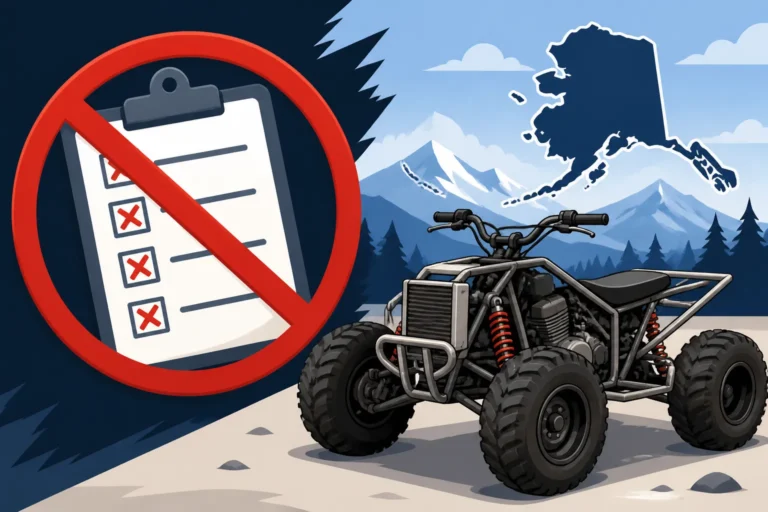
Excluded: There are some notable exclusions you need to be aware of. Snowmobiles are specifically excluded from the APV class and have their own distinct registration system (though they also get a decal). Tracked vehicles (other than certain specialized multi-track APVs) are often excluded, as are most homemade ATVs or heavily modified machines that no longer resemble a manufacturer's design. And, perhaps surprisingly to some, three-wheelers (three-wheeled ATVs) are generally not registrable as APVs in Alaska, largely due to safety concerns. These exclusions are important because attempting to register a machine that falls outside the APV definition will be a wasted trip to the DMV. You can learn more about specific exclusions like [Alaska Excludes Snowmobiles From APV] and [Alaska Excludes Three-Wheelers].
The Importance of Classification for Registration
The APV classification isn't just bureaucratic red tape; it's fundamental to your ability to register and legally operate your machine on public lands. If your machine doesn't fit the APV definition, you simply won't be able to get an Alaska registration decal for it. This means you wouldn't be able to ride it on public trails, state lands, or designated OHV areas where registration is required. Understanding this classification upfront can save you considerable frustration and ensure you're compliant with state law before you even attempt to register. It also helps you understand why [Machines Alaska Will Not Register as an APV] are off-limits.
Beyond Registration: Understanding Alaska's Titling Requirements
Many people confuse registration with titling, or assume they're the same thing. In Alaska, for APVs, they are distinct processes with different implications. While registration gives you the decal to legally operate your machine, titling establishes clear, legal ownership.
The Difference Between a Title and a Registration Decal
Let's break down the core difference:
-
Registration Decal: This is what you get when you register your APV. It's a sticker that displays your registration number and expiration date, signifying that your machine is legally permitted to operate on public lands in Alaska. It proves you've paid the necessary fees for a specific period (two, four, or six years). Think of it like a temporary permit to use the machine. [Alaska Issues a Decal, Not a Plate] for APVs, emphasizing its temporary operational status. The registration number on your decal is also your [Why Your Decal Number Is the Registration Number].
-
Vehicle Title: This is a more permanent document that proves who owns the machine. It's essentially the legal deed to your APV. It's a much more robust document used for proving ownership, especially when selling the machine, securing a loan against it, or resolving ownership disputes. While registration is about legal operation, a title is about legal possession.
You can register an APV without immediately getting a title (as in NTI situations), but you generally can't get a title without first establishing a clear chain of ownership, which often involves the same documents used for registration.
New Titling Rules for APVs Since 2022
Alaska made a significant change to its APV laws in 2022 by requiring titles for these vehicles. Prior to this, many OHVs in Alaska were never titled, relying solely on registration and bills of sale. This change was implemented to help combat theft, improve ownership tracking, and streamline transactions. This means that if you're buying or selling an APV that was manufactured after a certain date (usually 1999, but check current regulations), or if you’re registering one for the first time, you will likely need to go through the titling process as well. This is a crucial detail, especially for anyone buying or selling a used machine. Knowing about [Alaska APV Titling Required Since 2022] is key to compliance.
Dealing with No Title Issued (NTI) Situations
As mentioned earlier, the "No Title Issued" (NTI) process is a critical pathway for many Alaskans. This typically applies to older machines that were manufactured before the state began titling APVs, or those brought in from states that don't title OHVs, where a verifiable title history simply doesn't exist.
Here's how NTI generally works:
- Initial Registration: You'll register your machine and receive a decal, just like any other APV. However, instead of a title being issued, the state records your ownership as "No Title Issued." You'll need to submit the [What Alaska's ATV Registration Form Asks For] and all available proof of ownership, such as a [Alaska Bills of Sale for a Used Machine] or an affidavit.
- Waiting Period: After the initial registration, there's a mandatory waiting period, typically two years. During this time, the state's record shows your ownership, and if no other party comes forward to claim legal ownership of the machine, your claim solidifies.
- Applying for a Title: Once the two-year waiting period has passed, you can then apply to have a full, clear title issued in your name. This converts your provisional NTI registration into full, recognized ownership documentation. This is an excellent option for ensuring your ownership is fully legal and documented, especially if you plan to sell the machine in the future. You can find more details in [Alaska NTI Title Steps].
It's important to understand this process, as it's a common scenario in Alaska, given our unique history with OHV titling. Always keep all your initial registration paperwork, as you'll need it when you apply for the title after the waiting period.
Avoiding Common Registration Headaches
Nobody wants to spend more time than necessary at the DMV or a partner office. By being prepared and understanding common pitfalls, you can ensure your OHV registration is as quick and painless as possible. Forewarned is forearmed, especially in Alaska where rules can sometimes have specific local nuances.
Double-Checking Your Paperwork Before You Go
This is perhaps the most critical step to avoid frustration. Before you even get in your car, lay out all your documents and go through a checklist.
- VIN Match: Does the Vehicle Identification Number on your machine match exactly what's on your bill of sale, MCO, or title? One digit off can halt the process.
- Signatures: Are all required signatures present on your bill of sale or title transfer? For example, if it's a used machine, did the seller sign the title over to you in the correct spot? If you used a service like LawDepot to generate an affidavit, is it properly filled out and notarized if required?
- Identification: Do you have your current, valid photo ID? This seems basic, but it's easy to forget if you're used to digital transactions.
- Fees: Do you have the correct payment method for the registration fees? Alaska offers various registration terms like [Alaska Charges $10 for Two Years], [Alaska Charges $20 for Four Years], and [Alaska Charges $30 for Six Years], so know which term you prefer and the associated cost.
- Complete Forms: If you downloaded any forms ahead of time, are they fully filled out and legible?
Missing any of these small details can result in being turned away and having to come back another day, wasting your precious time.
Understanding Expiration Dates and Renewals
Unlike vehicle license plates, which might have staggered expiration months, all Alaska APV registrations expire on a single, unified date: September 30th. This applies regardless of when you initially registered your machine or whether you chose a two, four, or six-year term. For example, [Every OHV Registration Term Expires on September 30] is a crucial detail many new owners miss.
- Initial Registration: If you register in, say, March, your two-year decal will still expire on September 30th of the following year, not two full years from March. This is why some choose longer terms, to maximize their value.
- Renewal Notices: The state typically sends out renewal notices, but it's ultimately your responsibility to keep track of your expiration date. Don't rely solely on a mailed notice, as sometimes they get lost in the mail or you might have moved.
- Renewal Process: Like initial registration, you cannot renew your Alaska OHV registration online. You'll need to go to a DMV or partner office in person, or renew by mail. The good news is that renewals are generally simpler than initial registrations, often just requiring your current registration card and payment. You can find more specific renewal information under [Alaska ATV Registration Renewal].
What to Do If Your Decal or Information Changes
Life happens, and sometimes your decal can get damaged, lost, or your personal information might change.
- Lost or Damaged Decal: If your decal is lost, stolen, or becomes unreadable (which can happen with all the mud and snow in Alaska!), you'll need to apply for a replacement. This also requires an in-person visit or mail request. They'll issue a new decal with the same registration number. For more on this, check out [Alaska Decal Replacement If Lost]. Keeping a decal readable in our harsh environment is tough, so knowing this process is important.
- Address Change: If you move, it's vital to update your registration with your new address. This ensures you receive any important notices, including renewal reminders. While this may not require a full in-person visit depending on the state's current rules, it’s always best to contact the DMV to confirm the process.
By staying on top of these administrative details, you can ensure your Alaska OHV adventures remain compliant and hassle-free, leaving you more time to enjoy the incredible trails and backcountry that Alaska has to offer.
Disclaimer
This article is for general informational purposes only and does not constitute professional advice. Laws, prices and regulations vary by location and change over time. Consult a qualified professional for guidance on your specific situation.