Do Alaska Kids Need a Permit?
Alaska parents often hear “permit” used for several different things: a land-use authorization, vehicle registration, or a safety course. Those requirements are not interchangeable, and a child’s age does not answer every question. The key is to identify the ground the ATV or UTV will cross, who is operating it, and what the relevant permit actually covers.
The short answer: there is no one child-specific ATV permit
There is not a single statewide ATV permit that a child must obtain simply because they are a child. The permit question depends mainly on where the machine will be ridden and what kind of authorization that land requires. A child may be covered by a land-use permit under its terms, but a parent should not assume that an adult’s permit automatically covers every young rider or every machine.
Alaska’s statewide general permit concerns certain recreational OHV use on eligible state land. It is a land-use authorization, not a child’s license to operate an ATV, proof of vehicle registration, or permission to ride on any property in the state. Start by identifying the land and checking whether the permit applies there. Alaska’s Statewide General Permit for ATV Use explains the authorization, while Alaska General Permit Requirements covers the basic conditions riders need to consider.
The practical answer is therefore conditional:
- If the ride is on land covered by the statewide general permit, check the current permit’s wording for who must hold it and what operators or machines it covers.
- If the route crosses land managed by another agency, a state park, private property, or Native corporation land, a different rule or permission may apply.
- If the ATV will be used on a public road or other regulated area, separate operating and vehicle requirements may apply regardless of whether the child has land-use permission.
A parent or guardian should confirm the requirements before the ride, especially if a child will operate the machine independently. The relevant question is not only “Does my child need a permit?” but also “Does the authorization cover this operator, this vehicle, and this route?”
| What people call a permit | What it generally addresses | Does it replace the other requirements? |
|---|---|---|
| State land-use permit | Whether specified OHV use is authorized on eligible state land | No. It does not replace registration or road-use rules |
| Vehicle registration | The machine’s registration status where registration is required | No. Registration does not grant permission to cross land |
| Property-owner permission | Access to land controlled by a private or other landowner | No. It does not satisfy state registration or equipment rules |
| Safety course or certificate | Training or course requirements that may apply in a particular setting | No. Training is not land access or vehicle registration |
| Road-use authorization and requirements | Whether and how a machine may be operated on a road | No. A land-use permit does not make an ATV street legal |
First identify whose land the child will ride on
A route that looks like one continuous trail can cross more than one kind of land. Public access at a trailhead does not necessarily mean every parcel farther along the route is open to riding, and a statewide permit should not be treated as a universal pass.
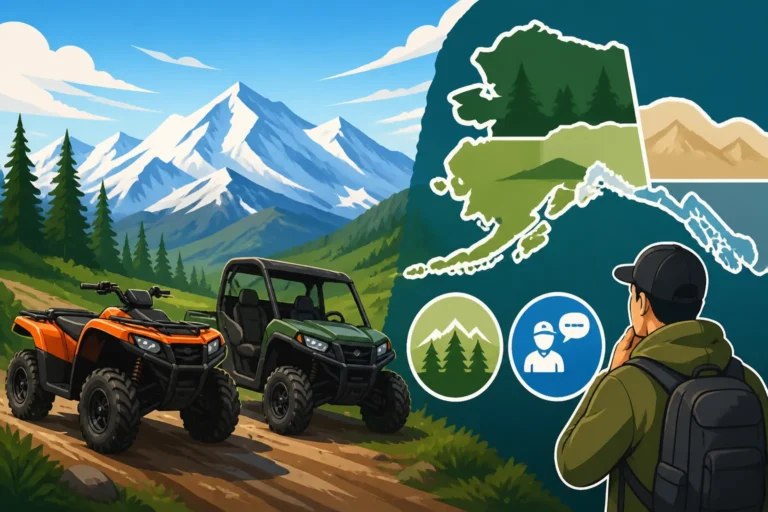
For each planned ride, identify the land manager or owner and check the rules for that specific area. The statewide permit has boundaries and exceptions; state parks and other designated areas may have separate restrictions. Private property requires the owner’s permission, and land managed by another agency may have its own access rules. Do You Have to Carry Alaska’s General Land Permit? and Which Permit Covers Riding in an Alaska State Park? help distinguish these situations.
A simple way to check is to:
- Map the intended route. Include the trailhead, crossings, turnaround point, and any connecting route to town or a cabin.
- Look up land status along the route. Do not rely only on a trail name, a map symbol, or the fact that other riders have used it.
- Identify the land manager or owner. The rules may change when a route leaves eligible state land.
- Ask what authorization is needed for a minor operator. Give the manager the child’s age, machine type, and route details.
- Check for additional conditions. A permit may not authorize riding in a closed area, across a wetland, through a stream, or over land the permit excludes.
This step matters even if a parent already holds a permit. A parent’s authorization may not grant access to private ground or a neighboring agency’s property. Likewise, a child being accompanied by an adult does not automatically make every crossing lawful. For help sorting out property boundaries, see Alaska Land Ownership and Who to Ask and Alaska’s Permit Excludes Private Land.
The distinction between a land permit and a trailhead pass is also important. A parking or day-use pass may cover parking or a facility fee; it is not necessarily permission to ride on all nearby land. For a more detailed look at that difference, see A Trailhead Pass Is Not a Land Permit.
A child’s permit question is separate from registration and riding rules
Families often ask about permits when they are really trying to work out several requirements at once. Keep them separate. A child’s land-use authorization, if needed for the route, does not register the ATV, satisfy equipment rules, or decide whether that child may legally operate the machine.
Registration is about the machine
Alaska’s all-purpose vehicle registration requirements are a separate issue from land access. Where registration is required, it concerns the vehicle, not whether its operator is a child or adult. An owner should check the machine’s class and intended use rather than assuming that a land-use permit covers registration. Alaska APV Registration Requirements explains the registration side of the question.
The opposite assumption is just as risky: having a registration decal does not by itself authorize riding on every trail or parcel. Registration and land permission answer different questions. Depending on where the machine will be used, both may matter.
Road use has its own rules
A land-use permit does not make an ATV or UTV legal to drive on a road. If a child’s route includes a public road, shoulder, or crossing, check the rules for that specific use and community. Road requirements may involve the machine’s equipment and the operator’s qualifications. A ride that is allowed on a trail may still be prohibited on the road leading to it.
Do not use “we have a permit” as the only road-use check. The local rules and the road’s posted conditions matter. Alaska Rules for Young Riders is a useful place to start when checking the broader youth-riding issues.
Supervision, helmets, and equipment still matter
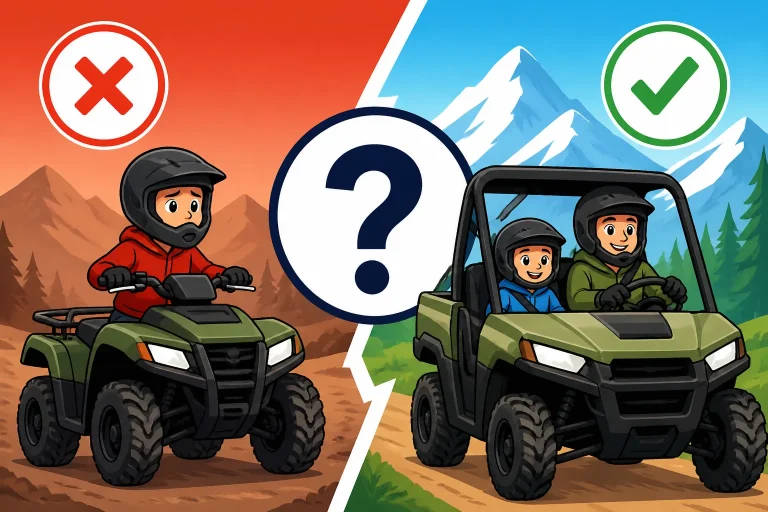
A permit does not establish that a child is ready for a particular machine, and it does not remove age-related safety requirements. Parents should check the applicable rules for the child’s age, the vehicle, the passenger arrangement, and the riding location. They should also follow the manufacturer’s age and size guidance and make sure the child can control the machine before attempting a trail.
Helmet and passenger rules deserve particular attention. Alaska has age-specific helmet requirements, so do not assume that a land-use permit, adult supervision, or a short ride creates an exception. Check Alaska Helmet Law for Riders Under 16 and Alaska Rules for a Child Passenger before carrying a child or allowing a young rider to operate.
A course can be a good safety decision even when no general certificate rule applies to the family’s planned ride. Training, however, is different from legal permission. A course does not substitute for a land authorization, registration, or road-use compliance. See Alaska Has No General Safety Certificate Rule for the distinction between a general certificate requirement and other rules that may apply in a particular setting.
A practical pre-ride check for parents
Before a child rides, use a short checklist rather than relying on one permit or decal to cover everything.
- Confirm the route’s land status. Identify whether the ride is on eligible state land, a state park, private property, or land managed by another agency or owner.
- Check the permit terms. Confirm whether the authorization applies to the child as an operator, whether it covers the machine, and whether it has route or use restrictions.
- Get any additional permission. Contact the landowner or manager if the route leaves the area covered by the permit or enters land with separate access rules.
- Check the machine’s registration status. Determine whether the ATV or UTV must be registered for the planned use.
- Review youth and road rules. Check the child’s age, helmet requirements, passenger rules, and any road segment or crossing.
- Match the ride to the child and machine. Consider the child’s ability to steer, brake, reach controls, and respond to changing trail conditions. A legal ride is not automatically a suitable ride.
- Carry the required documents and contact details. Bring whatever proof the permit or land manager requires, and make sure an accompanying adult knows the route and turnaround plan.
If the permit language is unclear, ask the land manager directly whether a minor operating the machine must be named, have a separate authorization, or be accompanied by the permit holder. Be specific: provide the child’s age, the vehicle type, the intended land, and whether the child will drive or ride as a passenger. A clear answer for that route is more useful than a general assumption based on what another family did elsewhere.
The safest takeaway is that a child does not need a special statewide ATV permit merely because of age, but that does not mean every child can ride under an adult’s authorization everywhere. Check the land-specific permit terms, keep registration separate from land access, and verify youth and road rules before setting out.
Disclaimer
This article is for general informational purposes only and does not constitute professional advice. Laws, prices and regulations vary by location and change over time. Consult a qualified professional for guidance on your specific situation.