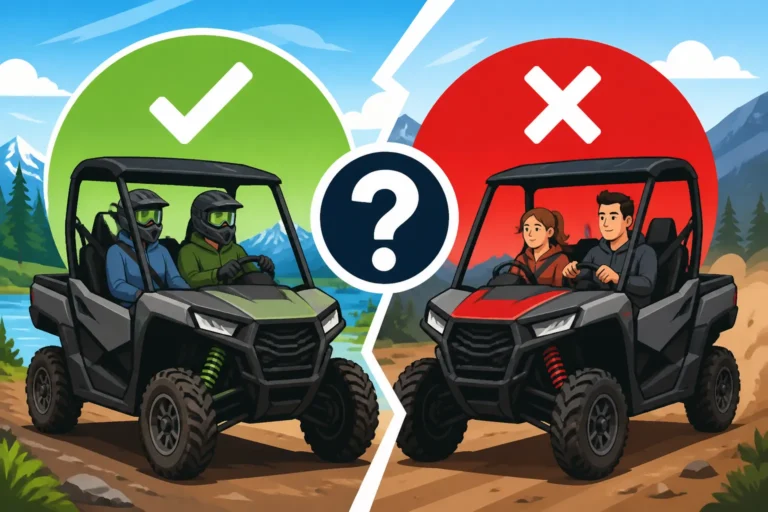
Alaska Requires a Class D License
It’s a common frustration for many new ATV and UTV owners in Alaska to feel like they need a law degree just to figure out where they can legally ride and what they need to have to do it. You've got this awesome machine, perfect for getting out into the backcountry, but the minute you think about touching a paved or gravel road, suddenly everything feels complicated. This guide is here to untangle the confusion surrounding licensing, road rules, and equipment requirements for operating your All-Purpose Vehicle (APV) on Alaska’s roads, making sure you understand exactly why that standard Class D license is so crucial.
Understanding Alaska's APV Classification and Licensing
Getting your head around Alaska's rules for ATVs and UTVs starts with understanding how the state officially classifies these machines. It’s not just a casual designation; it dictates everything from where you can ride to what kind of license you need. And trust me, getting this straight from the beginning will save you a lot of headaches (and potential tickets!) down the trail.
What is an All-Purpose Vehicle APV in Alaska?
First things first, let's talk about what Alaska considers an "All-Purpose Vehicle," or APV. This is the official term you’ll see in state statutes, and it specifically refers to vehicles like your typical ATV (quad) or UTV (side-by-side) that are designed for off-road use but, under certain conditions, can be operated on public roads. The definition is pretty specific: a motorized vehicle, other than a snowmobile, that is 50 inches or less in width, has an unladen dry weight of 1,200 pounds or less, travels on three or more low-pressure tires, and has an engine displacement of 800 cubic centimeters or less.
Now, you might be thinking, "Wait, my side-by-side is wider than 50 inches and heavier than 1,200 pounds!" You’re not alone in that thought. The good news is that Alaska’s definition of an APV actually includes many larger utility vehicles, often referred to as UTVs or side-by-sides, even if they exceed those traditional ATV specs. The key is that they are generally designed for off-highway travel. This broad classification means that whether you're on a smaller quad or a beefy four-seater side-by-side, many of the same rules for road use and licensing apply. It's really about the type of machine and its primary purpose, rather than sticking strictly to the old, narrow ATV definition. For a deeper dive, check out [Alaska APV Class Explained].
The Class D Driver's License Requirement
This is where many new APV owners get caught off guard, especially if they're used to riding purely off-road in other states or if they mistakenly think an ATV is somehow exempt from standard road rules. In Alaska, if you plan on operating your APV on a public road or highway where APVs are allowed, you absolutely must possess a valid Class D Alaska driver's license. This isn't some obscure permit; it's your standard operator's license for cars and light trucks.
Imagine you've just bought a new side-by-side, maybe you've even added some cool aftermarket parts from SuperATV to make it more capable on the trails. You're eager to take it for a spin, perhaps just across town to a friend's house or to access a nearby trailhead. If that journey involves any public road, even for a short stretch, that Class D license is non-negotiable. Without it, you're essentially driving an unregistered and unlicensed vehicle, which can lead to significant fines and penalties. It’s the same basic requirement as driving your pickup truck.
Why a Standard Driver's License is Essential for Road Use
The reason Alaska requires a standard Class D driver's license for APV road use boils down to safety and responsibility. Operating any motor vehicle on public roads, even an APV, requires a certain level of knowledge about traffic laws, defensive driving skills, and an understanding of road etiquette. The state views an APV as a legitimate vehicle when it's on the road, and therefore, its operator must be qualified to share that road with cars, trucks, and motorcycles.
Think about it: you’ll be making turns, signaling (or using hand signals), obeying stop signs and traffic lights, and sharing the lane. These are all things that a licensed driver is expected to know and do. It’s not just about controlling the machine; it’s about interacting safely within the broader traffic system. This requirement underscores Alaska's stance that APVs are not just toys; they are capable vehicles that demand responsible operation, especially when crossing into the public road domain. Without this licensing standard, the roads would become a chaotic free-for-all, which nobody wants. This is why [Alaska Requires a Class D License] for any public road use.
Navigating Alaska's Road Rules with an APV
So, you’ve got your Class D license – fantastic! Now comes the next layer of complexity: where exactly can you use that license to ride your APV on Alaska’s vast network of roads? It's not a blanket permission slip to go anywhere your heart desires. Alaska has specific regulations dictating where APVs are permitted, what speed limits you need to adhere to, and even local ordinances that can override state rules.
Where Can You Legally Ride an APV on Alaska Roads?
This is perhaps the most crucial question for any APV owner looking to connect trails or access areas via public roads. Generally, Alaska law allows APVs to be operated on certain public highways and roads, but with significant caveats. The primary rule of thumb is that APVs are typically allowed on roads with a posted speed limit of 45 mph or less. This immediately restricts them from major highways, interstates, and many primary arterial roads.
You’ll often find APVs permitted on rural gravel roads, secondary roads within smaller communities, and specifically designated routes. These are the places where the speed limit is naturally lower, and traffic volume is typically less dense. However, it's not always as simple as looking at a speed limit sign. Some communities have local ordinances that completely ban APV road use, regardless of the state's general provisions. Always assume that if you're venturing onto a public road, you need to be absolutely certain it's permitted. A quick call to the local police department or borough office can save you a lot of trouble. This careful balance of state and local rules is detailed in [Alaska APV Road Rules Explained].
Speed Limits and Road Types for APVs
Even on roads where APVs are permitted, you can't just open up the throttle. Alaska has a specific maximum speed limit for APVs when they are operating on a public road or highway, which is 45 mph. This is a hard limit, regardless of what the posted speed limit might be for other vehicles. So, if you're on a rural road that allows APVs and the car speed limit is 55 mph, your APV still cannot exceed 45 mph.
This limit is in place for safety, recognizing the different handling characteristics and speeds of APVs compared to typical passenger vehicles. These machines, while incredibly capable off-road, are not designed to perform like a car at higher speeds on pavement. Their suspension, tires, and braking systems are optimized for rough terrain, not high-speed road use. Therefore, staying within that 45 mph cap is not just a legal requirement but a crucial safety measure to protect both yourself and others on the road. Remember, it's about blending responsibly with traffic where permitted, not racing to your destination. You can learn more about this specific limit in [Alaska's 45 mph Road Limit for APVs].
Communities with Specific APV Bans or Restrictions
This is where things can get particularly tricky for APV owners. While the state of Alaska might set general guidelines, individual cities and boroughs have the authority to enact their own, more restrictive ordinances regarding APV use within their boundaries. And many have done exactly that. Major cities like Anchorage, Fairbanks, and Juneau, for example, have outright bans on APV use on public roads.
This means you can’t just assume that because you’re on a 40 mph road, you’re good to go. Before you ever pull onto a paved street in an Alaskan community, you must check the local municipal code. What's legal in a remote village or rural borough might be strictly prohibited in a more populated area. This patchwork of rules can be frustrating, especially if you're traveling through different jurisdictions. Always do your homework. These local bans are incredibly important to know about, as ignoring them can lead to significant fines. For a full rundown, refer to [Alaska Communities That Ban APV Road Use].
Beyond the License: Other Requirements for Riding in Alaska
Having your Class D license is a huge step, but it’s just one piece of the puzzle. Alaska has other crucial requirements for APV operation, especially when you venture onto public roads. These range from mandatory insurance to specific equipment you must have, all designed to ensure safety and accountability for everyone on the trail and the road.
The Mandate for APV Insurance
Just like with your car or truck, if you're going to operate an APV on any public road in Alaska, you are legally required to carry liability insurance. This isn't just a suggestion; it's the law. The insurance must meet the state’s minimum coverage requirements for motor vehicles. This coverage is essential to protect you and others in the event of an accident.
Think about the potential costs if you were to be involved in a collision with another vehicle on a public road, or if you accidentally damaged property. Without liability insurance, you would be personally responsible for all damages and medical expenses. It’s a sobering thought, but one that underscores the importance of this requirement. Most insurance providers offer specific policies for ATVs and UTVs, so make sure your coverage explicitly includes road use if you plan on taking your machine onto public ways. This requirement is clearly laid out in [Alaska Insurance Requirements for an APV].
Essential Equipment for Street-Legal APVs
Making your APV "street legal" in Alaska isn't just about having a license and insurance; it also involves equipping your machine with specific safety features. When an APV is used on public roads, it essentially needs to meet many of the same equipment standards as other motor vehicles to ensure visibility and safe operation.
Here’s a general checklist of what you'll typically need:
- Headlights and Taillights: Your APV must have working headlights (visible from at least 100 feet ahead at night) and taillights (visible from at least 1,000 feet to the rear at night). These are non-negotiable for low-light or night riding.
- Brakes: A properly functioning braking system, including both front and rear brakes, is critical.
- Muffler and Emission Controls: Your machine needs to have a muffler that is in good working order and not modified to be excessively loud. Emission controls must also be intact.
- Spark Arrester: A U.S. Forest Service-approved spark arrester is often required, especially for reducing fire risk when riding in dry conditions. Many aftermarket exhaust systems, like those you might find from SuperATV, will specify if they are spark-arrestor compliant.
- Reflectors: Adequate reflectors must be installed on the machine to increase its visibility to other drivers, particularly from the sides and rear.
- Mud Flaps: Some regulations may require mud flaps or other splash guards to prevent debris from being thrown onto other vehicles.
- Self-Closing Throttle: The throttle must be designed to automatically return to the idle position when the operator removes their hand.
These requirements ensure your APV is as visible and safe as possible when sharing the road with other traffic. It’s not just about compliance; it’s about reducing risk. For more details on these vital components, consult [Alaska OHV Equipment Requirements].
Helmets and Passenger Rules
Alaska has specific helmet laws that apply to APV riders, particularly for younger individuals. If you are operating an APV on public land or a public highway, and you are under 16 years of age, you are legally required to wear a protective helmet that meets specific safety standards (like those set by the CPSC). While adults over 16 are not required by state law to wear a helmet when operating an APV, it is always highly recommended for safety, regardless of age or experience level. A simple fall or collision can have devastating consequences without head protection.
When it comes to passengers, the rules can get a bit more nuanced. Generally, passengers are allowed on an APV only if the machine is specifically designed and equipped to carry more than one person. This means if your ATV is a single-seat model, carrying a passenger is illegal and incredibly dangerous. Side-by-sides, by their very design, are built for multiple occupants and typically have seatbelts and roll cages, making them much safer for passengers. However, even in a multi-seat UTV, young passengers often fall under the same helmet requirements as young operators. Always prioritize safety over convenience. You can find specific details on age requirements for helmets in [Alaska Helmet Law for Riders Under 16].
Specific Scenarios: Youth Riders, Out-of-State, and Private Land
The general rules are a great starting point, but Alaska is a vast and diverse state, and APV use isn't always a one-size-fits-all situation. There are specific considerations for younger riders, those visiting from out of state, and when you're lucky enough to ride on your own private property. Understanding these nuances can prevent confusion and ensure everyone stays compliant.
Rules for Young Riders Operating APVs
Alaska takes the safety of young APV riders seriously. While there isn't a statewide minimum age to operate an APV on private land, the rules tighten considerably when public land or roads are involved. As mentioned earlier, any operator under 16 must wear a helmet on public lands or roads. Beyond that, the state mandates that a child under 10 years of age may not operate an APV on a public highway or public land. For children between 10 and 16, they can operate on public roads or public land only if they are supervised by an adult who is at least 18 years old and capable of controlling the APV.
This means a responsible adult needs to be actively supervising, not just theoretically "in the area." They need to be close enough to intervene if necessary. These rules are put in place because younger riders may lack the judgment, experience, and physical strength required to safely operate these powerful machines in varying conditions, especially when sharing space with other vehicles. Teaching a child to ride responsibly is a great family activity, but it has to be done within legal and safety boundaries. For more on this, check out [Alaska Rules for a Teen Rider].
Out-of-State Riders and Their Licensing
Are you visiting Alaska and planning to bring your APV along for some epic adventures? Great! But don't assume your home state's rules automatically apply. When it comes to road use, if your machine is legally registered and titled in another state and you possess a valid driver's license from that state, you generally won't need to get an Alaska driver's license to operate your APV on Alaska's permissible roads.
However, your out-of-state APV still needs to meet Alaska's equipment requirements (headlights, taillights, etc.) if you plan to use it on public roads. And crucially, you must still adhere to all of Alaska's APV road rules, including the 45 mph speed limit, local bans, and insurance requirements. Your out-of-state registration and driver's license serve as your credentials, but the rules of the road are Alaska's. It's always a good idea to carry proof of your vehicle's registration, title (if applicable), and your driver's license with you at all times when riding.
Riding on Private Land vs. Public Access
One of the biggest distinctions in APV law is the difference between riding on private land and public land/roads. If you own the land, or have explicit permission from the landowner, the state's specific APV registration and road-use licensing requirements generally do not apply. This means if you're just tooling around your own property, or a friend's back forty with their blessing, you don't necessarily need an Alaska APV registration decal, insurance, or even a Class D license (though safe operation is always paramount!).
This exemption is critical for many Alaskans who primarily use their machines for work, hunting access, or recreation solely on their own property or private trails. However, the moment your tires touch public land (like state trails, designated public areas, or borough roads) or a public highway, then all the state laws kick in: registration, insurance, and that Class D driver's license for road use. It's a common trap to accidentally cross from private to public land without realizing you're suddenly under a different set of rules. Always be aware of property boundaries and land status.
Ensuring Compliance and Avoiding Penalties
Nobody wants to deal with a traffic stop or a citation, especially when you're out enjoying the Alaskan wilderness on your APV. Understanding what law enforcement looks for and how to proactively avoid common pitfalls can save you a lot of hassle and money. Being prepared and informed is your best defense.
What Troopers Look For During a Stop
If you happen to be stopped by an Alaska State Trooper or a local law enforcement officer while operating your APV, especially on a public road, they will primarily be checking for a few key things to ensure compliance. The first thing they’ll likely ask for is your driver’s license. Since you're on a public road, that Class D license is paramount. If you don't have one, or if it's suspended or expired, you're in for a significant issue.
Next, they’ll want to see proof of insurance for the APV, verifying that you meet the state's liability requirements. They'll also check for your Alaska APV registration decal, which should be properly displayed on your machine. Beyond paperwork, an officer will visually inspect your APV for the required safety equipment: working headlights and taillights, functional brakes, a non-modified muffler, and visible reflectors. If you have passengers, especially minors, they'll check for appropriate seating and helmet use where required. Being able to calmly present all your documentation and having a machine in good working order will make the stop much smoother. For a more detailed understanding of what to expect, refer to [What a Trooper Can Ask to See].
Common Mistakes and How to Avoid Them
It’s easy to make mistakes, especially with complex regulations, but some are more common than others for APV riders in Alaska. Avoiding these can prevent unnecessary fines and ensure a safer riding experience.
- Riding on Banned Roads: The biggest mistake is assuming you can ride anywhere. Always verify local ordinances and the speed limit of the road before riding your APV on a public way. Just because a road is gravel doesn't mean it's open to APVs.
- No Driver's License: Operating an APV on a public road without a valid Class D driver’s license is a direct violation and will result in a citation. Period.
- Lack of Insurance: Riding on public roads without the required liability insurance can lead to hefty fines and can leave you financially vulnerable in an accident.
- Missing or Faulty Equipment: Forgetting to turn on your lights at dusk, having a broken taillight, or running an aftermarket exhaust that removes the spark arrester can lead to tickets. Do a quick pre-ride check of all safety equipment. Even if you have a top-of-the-line winch from SuperATV, it won't matter if your taillights aren't working.
- Unregistered Machine: If you’re on public land or a public road, your APV needs to be registered with the state and display a current decal.
The best way to avoid these pitfalls is through proactive planning and staying informed. When in doubt, err on the side of caution or contact the local authorities for clarification.
The Consequences of Non-Compliance
Ignoring Alaska’s APV laws, especially those related to road use, can lead to a range of unpleasant consequences. These aren't minor infractions; they can impact your wallet and your driving record.
- Fines: The most immediate consequence is typically a fine. Operating an unregistered APV, riding on a prohibited road, or lacking required equipment can all result in citations with associated monetary penalties. These fines can quickly add up, making a simple ride a very expensive outing.
- Impoundment: In some cases, especially for serious offenses like riding without a license or insurance, your APV could be impounded, incurring towing and storage fees on top of any fines.
- Driving Record Points: Many violations, particularly those related to licensing or insurance on public roads, can result in points on your driving record, potentially affecting your insurance rates or even leading to license suspension if you accumulate too many.
- Liability in Accidents: If you are involved in an accident while operating your APV illegally (e.g., without insurance or a license), you could face severe civil penalties and be personally responsible for all damages and injuries.
It’s far easier and less costly to simply comply with the regulations upfront than to face the repercussions of non-compliance. Understanding and respecting the rules ensures you can continue to enjoy Alaska's incredible riding opportunities for years to come. For specific penalty information, it's worth reviewing [Alaska Penalties for Riding Unregistered].
Alaska APV Road Use Quick Reference
To help clarify the core requirements for operating an APV on Alaska's public roads, here's a handy table summarizing the key points:
| Requirement | Applies to Public Road Use | Details |
|---|---|---|
| Driver's License | YES | Valid Class D Alaska driver's license required. |
| APV Registration | YES | Current Alaska APV registration decal required, properly displayed. |
| Liability Insurance | YES | Must meet state minimum requirements for motor vehicles. |
| Speed Limit | YES | Maximum 45 mph, regardless of posted speed limit for other vehicles. |
| Headlights | YES | Must be operational and visible from 100 ft (night). |
| Taillights | YES | Must be operational and visible from 1,000 ft (night). |
| Brakes | YES | Functional front and rear brakes required. |
| Muffler/Spark Arrester | YES | Must be intact, not excessively loud, and often requires USFS-approved spark arrester. |
| Reflectors | YES | Required for visibility from sides and rear. |
| Helmet (Under 16) | YES | Required for operators/passengers under 16 years old. |
| Community Ordinances | YES | Local bans or restrictions may override state law; always check local rules. |
| Out-of-State Riders | Reciprocal | Valid out-of-state license/registration typically honored, but must follow all Alaska road rules and equipment mandates. |
This article is for general informational purposes only and does not constitute professional advice. Laws, prices and regulations vary by location and change over time. Consult a qualified professional for guidance on your specific situation.