Alaska Rules for an Out-of-State Machine
Moving to Alaska or just visiting with your beloved ATV or UTV can bring a lot of excitement, but also a fair bit of head-scratching when it comes to understanding the local rules. You've got your machine registered and perhaps even titled back home, but does that automatically grant you free rein on Alaska's vast trails and public lands? The short answer is usually "no," and misunderstanding these regulations can lead to fines, frustrating encounters with law enforcement, or worse, getting turned around before your adventure even begins. This guide will walk you through everything you need to know about bringing an out-of-state machine into the Last Frontier, ensuring your rides are legal, safe, and stress-free.
Navigating Alaska's Registration for Your Out-of-State Machine
One of the first hurdles many out-of-state riders encounter is the question of registration. It's a natural assumption that if your machine is legal in your home state, it's good to go everywhere. Alaska, however, has its own unique system and requirements that often supersede out-of-state credentials, especially if you plan on extended stays or extensive use of public lands.
When Your Out-of-State Registration is Recognized (and When It's Not)
Let's clear the air on this upfront. While Alaska may recognize a valid out-of-state registration for a very limited period for non-residents visiting, it's generally understood that any All-Purpose Vehicle (APV), which includes your ATV or UTV, used on Alaska's public lands needs an Alaska decal. This isn't just a suggestion; it's a requirement under state law. Imagine a family from Washington State driving their truck and trailer up the Alaska Highway for a two-week fishing trip. They plan to use their quad to reach a remote fishing hole in a state recreation area. Their Washington registration is technically valid for this short visit. However, if that two-week trip turns into a full summer of exploring the vast wilderness, they absolutely need to get an Alaska APV decal.
The confusion often arises because "public land" in Alaska is a much broader concept than many realize. It encompasses not just national parks (where ATVs are generally not allowed anyway) but also state lands, borough-managed lands, and even certain public easements or trails that might pass through privately owned parcels. If you're going to be here for more than a quick jaunt, or if you're seriously considering moving to the state, plan on getting an Alaska decal. It simply removes any ambiguity and potential hassle with law enforcement. You might be asking, [Does an Out-of-State Machine Need Alaska Registration?] The simple answer is almost always yes, for significant use.
The Process for Establishing Alaska Residency with an ATV/UTV
So, you've made the big move, packed up your life, and your ATV or UTV is now sitting in your new Alaskan driveway. Congratulations! But now comes the paperwork. Unlike cars, where there's often a grace period to transfer your plates, if you intend to use your APV on any public land in Alaska, you'll need to get it registered in Alaska almost immediately. This means obtaining an Alaska APV decal.
The process involves visiting a local Division of Motor Vehicles (DMV) office or a partner office. You'll need several key documents:
- Proof of Ownership: This could be your existing out-of-state title, a bill of sale, or the Manufacturer's Certificate of Origin (MCO) if your machine is relatively new.
- Photo Identification: Your driver's license will work.
- Completed Vehicle Transaction Application (Form V1): This form is critical for any registration in Alaska, including APVs. You’ll be [Filling Out Alaska's Form V1 Line by Line] to ensure all your machine's details are correctly recorded.
What if your machine is an older model and your previous state didn't issue a title for ATVs, only a registration? This is a very common scenario. Alaska has a "No Title Issued" (NTI) process for such cases. You'll still get an Alaska decal to legally ride, but it might take a two-year waiting period before a formal Alaska title is issued to you. For instance, John moves from Oregon to Wasilla with his trusty 2005 Yamaha Kodiak. Oregon only ever gave him a registration card, no title. When John goes to the Wasilla DMV to register his quad, he'll be guided through the [Alaska No Title Issued Registrations] process. He'll show his Oregon registration and a bill of sale, get his Alaska decal, and then wait two years for the title to be formally issued by the state. It's a bit of a workaround, but it ensures older machines can still be legally ridden and eventually obtain an Alaska title.
What If Your Home State Doesn't Require Registration?
This is perhaps the most confusing situation for many new arrivals or visitors. Some states have very relaxed or non-existent registration requirements for off-highway vehicles, especially if they're used exclusively on private property or farm land. The key takeaway for Alaska is this: if you plan to ride on any public land in Alaska, your machine must have an Alaska APV decal, regardless of your home state's rules. The absence of registration back home does not grant you an exemption here.
You will still need to prove ownership to get that Alaska decal. If you don't have a title or even a past registration, you'll need something like a dated bill of sale, a warranty card, or even a sworn affidavit of ownership if the original documents are completely lost. This situation often leads directly to the NTI process, as described above. A college student from Texas brings his dad's old Honda FourTrax up to Anchorage. It was never registered in Texas because it was only used for chores on their ranch. If he wants to explore the Knik River Public Use Area, he'll have to present whatever proof of ownership he has – perhaps a very old bill of sale or an affidavit – and go through the Alaska registration process to get his decal. Without it, he's risking a citation even if he believes his machine is legitimate. It is possible to pursue [Alaska Registration Without a Bill of Sale], but it will require additional steps to prove ownership.
Understanding Alaska's Specific Equipment and Operation Laws
Beyond registration, Alaska has distinct laws regarding how your APV must be equipped and where and how it can be operated. Many out-of-state riders, accustomed to different rules in their home states, often overlook these crucial details.
Key Equipment Requirements for All APVs in Alaska
Alaska is particular about the safety and environmental equipment on APVs, and these requirements apply to all machines, regardless of where they were originally purchased or registered. Your out-of-state machine needs to comply with Alaska's standards before you hit the trails. Essential equipment includes:
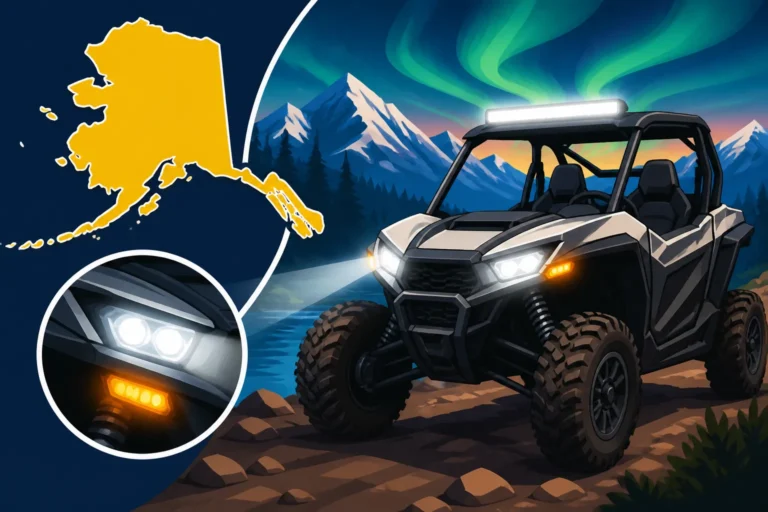
- Headlights: Must be operational and visible from at least 100 feet.
- Taillights: Must be operational and visible from at least 1,000 feet.
- Brakes: Reliable and effective.
- Muffler: Must be in good working order to keep noise levels reasonable. Exhaust cutouts are explicitly prohibited.
- Spark Arrester: This is critical, especially during the dry summer months to prevent wildfires. Your machine must have a U.S. Forest Service-approved spark arrester.
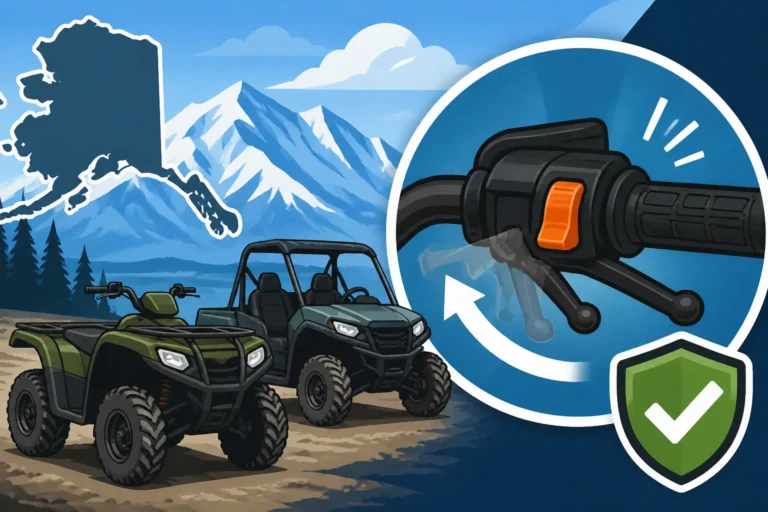
- Throttle: Must be a self-closing twist grip or lever type.
- Reflectors: White reflectors on the front, red on the rear, and amber or red on each side.
- Mud Flaps: Some areas or conditions may require mud flaps to prevent excessive debris from being thrown.
Many out-of-state riders find their machines, while perfectly fine in their home state, might need a few upgrades for Alaska's challenging terrain and regulatory environment. Companies like SuperATV offer a wide range of aftermarket accessories, from robust skid plates to high-quality LED lighting, which can help ensure your machine meets Alaska's requirements while also enhancing its durability for the Last Frontier's rugged trails. For example, a visitor from Nevada might have a quad perfectly suited for desert riding, but it might lack the proper spark arrester or robust mud flaps needed for Alaska's diverse terrain and fire prevention regulations. Before hitting the Knik River Public Use Area, a quick check of the [Alaska OHV Equipment Requirements] and perhaps an upgrade to an approved spark arrester and some heavy-duty mud flaps from a company like SuperATV would be a very wise move.
Road Use, Speed Limits, and Community-Specific Bans
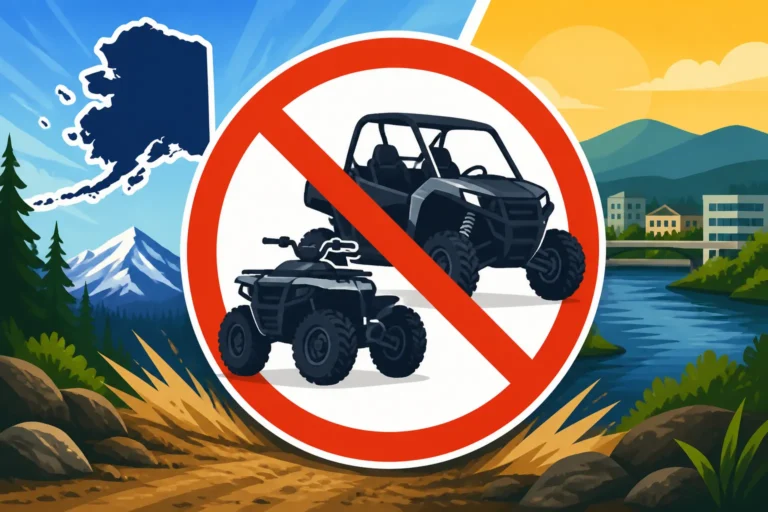
This is arguably the most common pitfall for out-of-state riders. In many Lower 48 states, it's common to see ATVs or UTVs being ridden on rural roads or even through small towns. Alaska's rules are drastically different and highly restrictive. Generally speaking, ATVs and UTVs are not street legal on public roads in Alaska. There are very few exceptions, typically on certain roads in specific remote communities, and even then, strict conditions apply.
Where APV road use is permitted (usually on designated rural roads with a posted speed limit of 45 mph or lower, or for crossing a highway at a 90-degree angle), there's a strict speed limit of 45 mph. More importantly, many of Alaska's larger population centers and boroughs have opted to ban APV road use entirely within their boundaries. You need to be acutely aware of [Alaska APV Road Rules Explained]. This includes major cities and towns such as Anchorage, Fairbanks, Juneau, Wasilla, Palmer, Kenai, Soldotna, and Homer. These are [The Eight Alaska Towns That Ban APV Road Use], and attempting to drive your UTV down a city street in one of them will almost certainly result in a citation. Imagine a tourist from Oregon, used to riding his UTV on rural roads back home, trying to drive his machine from his rental cabin outside Palmer into town for groceries. He'd quickly learn that Palmer has a ban on APV road use, and he'd risk a costly citation. He absolutely needs to trailer his machine to designated riding areas.
The All-Important Helmet and Insurance Rules
Safety and financial responsibility are paramount in Alaska, and these rules apply to out-of-state riders just as they do to residents.
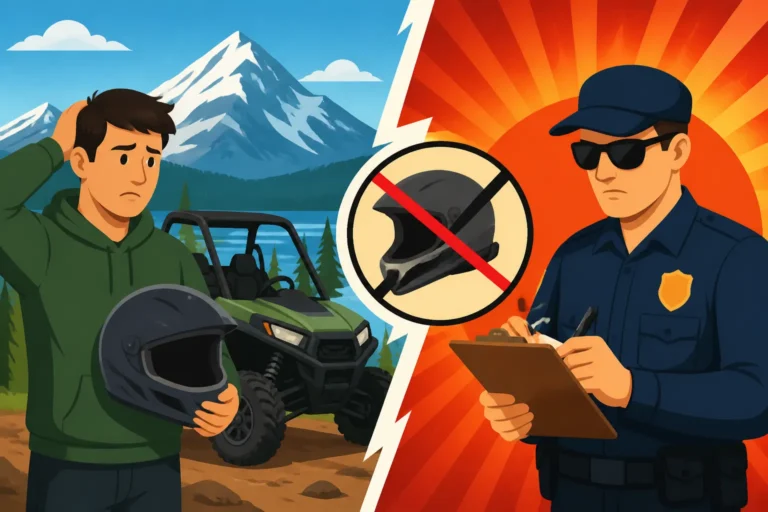
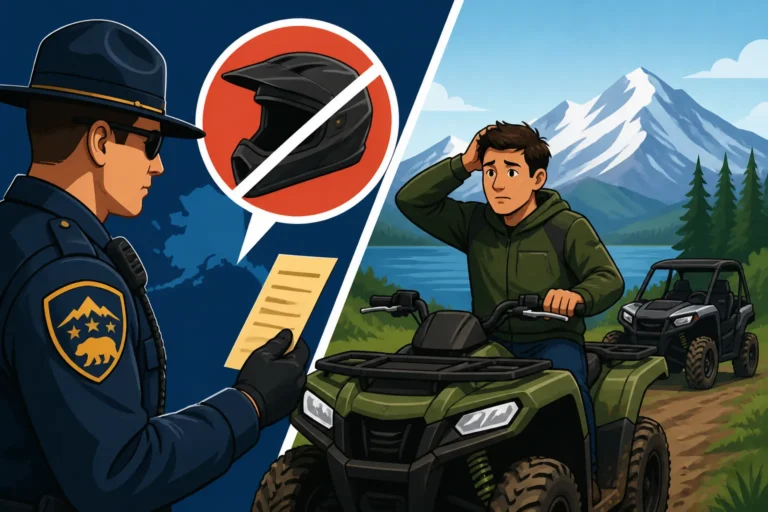
- Helmet Law: Alaska has a mandatory helmet law for all APV riders under the age of 16. If you're bringing children or teens to ride, ensure they have a CPSC-compliant helmet that fits properly. While adults are not strictly mandated to wear helmets statewide, it is always highly recommended, especially given the rugged and often unpredictable terrain in Alaska. An injury miles from the nearest road can become a life-threatening situation quickly. You can learn more about the specifics of the [Alaska ATV Helmet Law Age] before your trip.
- Insurance: This is a big one for many visitors. Alaska does require liability insurance for APVs operated on public roads or trails where such use is allowed. This means that if you're riding in an area where APVs are legally permitted on a public thoroughfare (even a designated trail that acts as a public corridor), you need proof of liability insurance. Your existing home state policy might not cover Alaska use, or your home state might not even require OHV insurance. It’s crucial to verify your insurance coverage before you leave home or before your first ride in Alaska. Failure to have it can result in a significant fine. Make sure to review [Alaska ATV Insurance Requirements].
Consider a family from California letting their 14-year-old ride an ATV on a designated trail system. If the child isn't wearing a CPSC-compliant helmet, the parent could face a fine. Meanwhile, the adult rider might be pulled over by a state trooper and cited if they don't have proof of liability insurance, even if their home state doesn't require it for OHVs. Beyond mandatory equipment, responsible riders often look to enhance safety. While Alaska mandates helmets for young riders, many adults choose to upgrade their protection. For those looking for added security and functionality, SuperATV offers various protective accessories like full windshields and robust roll cages, which, while not always legally required, can significantly improve safety and comfort on Alaska’s often unforgiving trails.
Avoiding Common Pitfalls for Out-of-State Riders
Alaska is truly the Last Frontier, and its unique challenges extend to riding ATVs and UTVs. Out-of-state riders can easily find themselves in a predicament if they don't prepare for the distinct Alaskan environment and regulatory landscape.
Verifying Land Ownership and Access Permissions
One of the most complex aspects of riding in Alaska is navigating the patchwork of land ownership. Unlike many states with simpler designations, Alaska has a mosaic of federal lands, state lands, borough lands, Native Corporation lands, and private holdings. What looks like an open trail might cross multiple jurisdictions, each with its own rules, or lead directly onto private property. Trespassing here is not taken lightly and can lead to serious legal consequences, not to mention creating ill will with local landowners.
Before you ever leave the pavement, you must know [Alaska Land Ownership and Who to Ask]. For state lands, the Alaska Statewide General Permit for ATV use is typically required. While this permit covers many state-owned areas, it does not cover state parks, federal lands, or Native Corporation lands, all of which may have their own specific rules or require separate permits. A group of friends from Idaho sees an inviting track leading into the wilderness near the Denali Highway. Unbeknownst to them, a section of that track traverses Native Corporation land, which requires a specific land-use permit they don't have. They could face trespassing charges or be told to immediately turn around by a landowner or law enforcement. Always check land status maps and inquire locally before venturing onto unfamiliar ground.
Seasonal Considerations and Environmental Protections
Alaska's environment is incredibly fragile, and APV riders have a responsibility to minimize their impact. This is particularly true for out-of-state riders who might not be familiar with the unique ecological characteristics of the region.
- Tundra and Wetlands: Riding off-trail, especially on delicate tundra or through wetlands, can cause irreparable damage that takes decades to heal. Many areas have strict rules or outright bans on riding in these environments, particularly during warmer months. [Alaska Wetland Travel Restrictions Explained].
- Breakup and Freeze-up: Alaska experiences distinct seasons of "breakup" (spring thaw) and "freeze-up" (fall freeze). During breakup, trails become extremely muddy and soft, making riding difficult and causing severe damage. Many trails close during this period. Conversely, during freeze-up, ice might not be thick enough to support machines on frozen rivers or lakes. Out-of-state riders often underestimate the power of these seasonal shifts.
- Fire Season: In dry summers, wildfires are a serious threat. This reinforces why a working, U.S. Forest Service-approved spark arrester is not just a legal requirement but an absolutely critical piece of equipment to protect Alaska's forests and wilderness.
When preparing for Alaska's unique environmental challenges, such as crossing muddy sections or protecting sensitive terrain, aftermarket parts can be invaluable. Products from SuperATV, like their heavy-duty mud flaps or robust skid plates, not only help meet equipment regulations but also minimize environmental impact by reducing mud spray and protecting the machine's underside from damage, making your ride more responsible.
Documentation to Keep Handy While Riding
It's not enough to simply have the correct registration, proof of ownership, and insurance. You need to have those documents readily accessible and protected from the elements while you're out riding. An Alaskan trail can be muddy, wet, and harsh, and a sudden downpour can render paper documents illegible.
Always carry physical copies of:
- Your Alaska APV registration decal permit (the small card that comes with your decal).
- Proof of ownership (e.g., a copy of your title or bill of sale).
- Proof of liability insurance.
- Your valid driver's license (if applicable for the area you are riding).
It's a smart practice to laminate copies of these essential documents or store them in a durable, waterproof bag that's always on your machine or on your person. Imagine a state trooper stopping a rider from Wisconsin on a Mat-Su trail. The rider has photos of his documents on his phone, which promptly dies due to the cold or an unexpected splash. Having physical, protected copies ensures you can always provide proof of compliance, avoiding unnecessary hassle. It's truly vital for [Carrying Documents in the Rain] and other harsh Alaskan weather conditions.
| Requirement/Scenario | Out-of-State Registered Machine (Visitor) | Alaska Registered Machine (Resident/Long-Term Visitor) | Notes |
|---|---|---|---|
| Registration | May be recognized for short visits; check local ordinances | Required for all public land use | Alaska APV decal needed for most public riding; out-of-state may be accepted for brief tourist visits, but it's safer to get an Alaska decal. |
| Titling | Out-of-state title or verifiable proof of ownership | Alaska title or No Title Issued (NTI) process | NTI process common for older machines without titles; Alaska title will be issued after a waiting period for NTI. |
| Equipment | Must meet Alaska standards (lights, brakes, muffler, spark arrester) | Must meet Alaska standards | May require aftermarket upgrades for out-of-state machines to meet Alaska's strict safety and environmental rules. |
| Road Use | Highly restricted; generally banned in most communities | Highly restricted; generally banned in most communities | Maximum 45 mph where allowed (very rare); many cities and boroughs ban APVs on roads entirely. Always trailer your machine. |
| Helmets | Required for riders under 16 | Required for riders under 16 | Recommended for all ages in Alaska due to rugged terrain and potential for remote incidents. |
| Insurance | Required (liability) for public road/trail use | Required (liability) for public road/trail use | Verify your existing policy covers APV use in Alaska, or purchase a local policy. |
| Land Access | Requires permission/permits for private/Native Corp. land; Alaska State Permit for state land | Requires permission/permits for private/Native Corp. land; Alaska State Permit for state land | Research land ownership before riding; obtain specific permits for Native Corporation lands or state parks. |
Disclaimer
This article is for general informational purposes only and does not constitute professional advice. Laws, prices and regulations vary by location and change over time. Consult a qualified professional for guidance on your specific situation.