Alaska Wetland Travel Restrictions Explained
Riding an ATV or UTV in Alaska offers some of the most breathtaking backcountry experiences on the planet, but it also comes with a unique set of responsibilities, especially when it comes to delicate ecosystems like wetlands. It can be incredibly frustrating to encounter a beautiful, seemingly open area only to realize you can't ride through it, or worse, accidentally cause damage and face consequences. This guide is here to untangle the complexities of Alaska's wetland travel restrictions, helping you understand why these rules exist and how to navigate them responsibly so you can keep enjoying our incredible landscape for years to come without worry.
Why Wetlands Are So Sensitive in Alaska
When we talk about wetlands in Alaska, we're not just talking about a muddy puddle. We're referring to vast, intricate ecosystems that are incredibly vital to the health of our environment, and unfortunately, very easy to damage. The slow pace of nature here in the far north means that any impact we make can take decades, even centuries, to heal.
The Ecological Importance of Alaska's Wetlands
Alaska is absolutely teeming with wetlands. From the coastal marshes to the interior's vast expanses of muskeg, bogs, and fens, these areas act as crucial arteries and organs for our natural world. They're not just soggy ground; they're bustling nurseries for fish and wildlife, providing essential breeding grounds for migratory birds, spawning habitats for salmon, and year-round homes for moose, bears, and countless smaller creatures. Think about the sheer volume of waterfowl that descend upon Alaska every year – they rely on these wetlands for survival.
Beyond wildlife, wetlands are natural sponges. They filter pollutants from water, acting like giant purifiers, and they help control flooding by absorbing excess water during heavy rains or snowmelt. This keeps our rivers cleaner and our communities safer from high water events. The vegetation in these areas, often mosses, sedges, and dwarf shrubs, forms a dense mat that holds the soil together, preventing erosion, especially on slopes. When an ATV or UTV tears through this mat, it creates ruts that can quickly become channels for water, leading to accelerated erosion and irreversible changes to the hydrology of the area. The permafrost that underlies many of these wetlands also makes them uniquely vulnerable; disrupting the surface can lead to permafrost thaw, causing subsidence and further habitat destruction.
The Legal Framework Protecting Wetlands
Given their critical role, it's no surprise that wetlands in Alaska are protected by a maze of regulations at federal, state, and even local levels. This can make understanding where you can and cannot ride feel like solving a riddle. Federally, the Clean Water Act, primarily administered by the U.S. Army Corps of Engineers, regulates discharges into "waters of the U.S.," which include many wetlands. This means any activity that might alter or fill a wetland could require a federal permit.
At the state level, agencies like the Alaska Department of Natural Resources (DNR) and the Alaska Department of Fish and Game (ADF&G) have significant oversight. ADF&G, for example, is concerned with fish habitat and often requires permits for activities that could impact streams and associated wetlands. The Alaska DNR manages vast tracts of state land and issues permits, including the Statewide General Permit for ATV Use, which comes with its own set of rules regarding wetland travel. The involvement of multiple agencies means that a single wetland area might have several layers of protection, and what's allowed on one type of land (say, state land) might be strictly prohibited on another (like federal or Native Corporation land). This patchwork of jurisdiction is a common frustration for riders, but it's designed to ensure these precious ecosystems receive comprehensive protection.
Understanding Alaska's Specific Wetland Travel Rules for ATVs and UTVs
Navigating Alaska's vast landscapes with your ATV or UTV is an incredible experience, but knowing the rules for different land types, especially concerning wetlands, is paramount. What's permissible on state land might land you in hot water on federal or private property. It's a critical distinction every rider needs to understand before hitting the trails.
The Statewide General Permit for ATV Use
For many Alaska riders, the Alaska Department of Natural Resources (DNR) Statewide General Permit for ATV Use is your primary guide for riding on state lands. This permit is a vital document, authorizing ATV and UTV use on unencumbered state land, but it's not a free pass to ride anywhere. Crucially, it comes with specific stipulations regarding wetlands. The permit generally allows for incidental crossings of wetlands on established trails or frozen ground, but it strictly prohibits activities that cause "undue damage" or "unnecessary disturbance" to vegetation, soils, or water quality. This "undue damage" clause is where many riders get into trouble because what one person considers minimal impact, a land manager might see as significant environmental harm.
For example, churning up soft, wet tundra or creating deep ruts that fill with water and remain for seasons would almost certainly fall under "undue damage." The intent is to allow access while protecting the land, which means riders are expected to exercise extreme caution and good judgment. It's also important to remember that this permit only covers state-owned land. It does not apply to state parks, federal lands, Native Corporation lands, or private property. If you're planning a trip, familiarize yourself with [Alaska's Statewide General Permit for ATV Use] to ensure you're riding within its guidelines.
Local Ordinances and Designated Trails
While the statewide permit offers a general framework, many boroughs and cities in Alaska have their own specific ordinances that can either be more restrictive or provide designated routes for ATV and UTV travel, especially concerning wetlands. For instance, areas like the Knik River Public Use Area in the Mat-Su Valley are popular riding destinations and are managed by the state, but even within such areas, specific zones might have additional restrictions on wetland access to protect sensitive habitats. It's not uncommon for local jurisdictions to designate specific trails as open to OHV use, often with clear signage, and prohibit off-trail travel, particularly in wetland areas.
Before you head out, always check the local regulations for your intended riding area. A quick call to the borough or city planning department, or a visit to their website, can save you a lot of grief. Some communities might even have maps detailing approved OHV routes that avoid wetlands entirely, guiding you to areas better suited for riding. Just because a general permit exists doesn't mean local rules don't apply. Remember, [Alaska State Park Riding Rules] are entirely separate, and you might find that while state land might be open, an adjacent state park could have outright bans on ATV or UTV use.
Federal and Native Corporation Lands
This is where the rules become significantly stricter. Federal lands in Alaska, managed by agencies like the Bureau of Land Management (BLM), U.S. Forest Service, National Park Service, and U.S. Fish and Wildlife Service (for refuges), generally have very stringent rules regarding off-road travel, and wetland protection is often a top priority. On most federal lands, you are typically restricted to existing roads and designated trails, and off-trail travel, especially through wetlands, is almost universally prohibited unless explicitly permitted. Penalties for violating these rules can be substantial, including hefty fines and impoundment of your machine. For more details on specific agency rules, you might want to look into [Alaska National Park Machine Rules] or [Alaska Refuge Access by Machine].
Native Corporation lands present another distinct category. These lands are private property, owned by Alaska Native Corporations, and riding on them almost always requires explicit permission, often in the form of a paid land use permit. These permits come with their own set of terms and conditions, which frequently include strict prohibitions or limitations on wetland travel to protect subsistence resources, cultural sites, and the delicate environment. Never assume you can ride on Native Corporation land without checking first and securing the proper authorization. Trespassing laws apply, and responsible riders always seek permission. Understanding [Alaska Native Corporation Land Permissions] is crucial if your ride takes you across these lands.
Practical Tips for Responsible Wetland Riding (or Avoiding It)
Alaska's wetlands are stunning but fragile. As responsible riders, it's our duty to minimize our impact. Sometimes that means avoiding them entirely, and other times it means being prepared to navigate them with the utmost care, always within legal bounds.
When to Avoid Wetlands Altogether
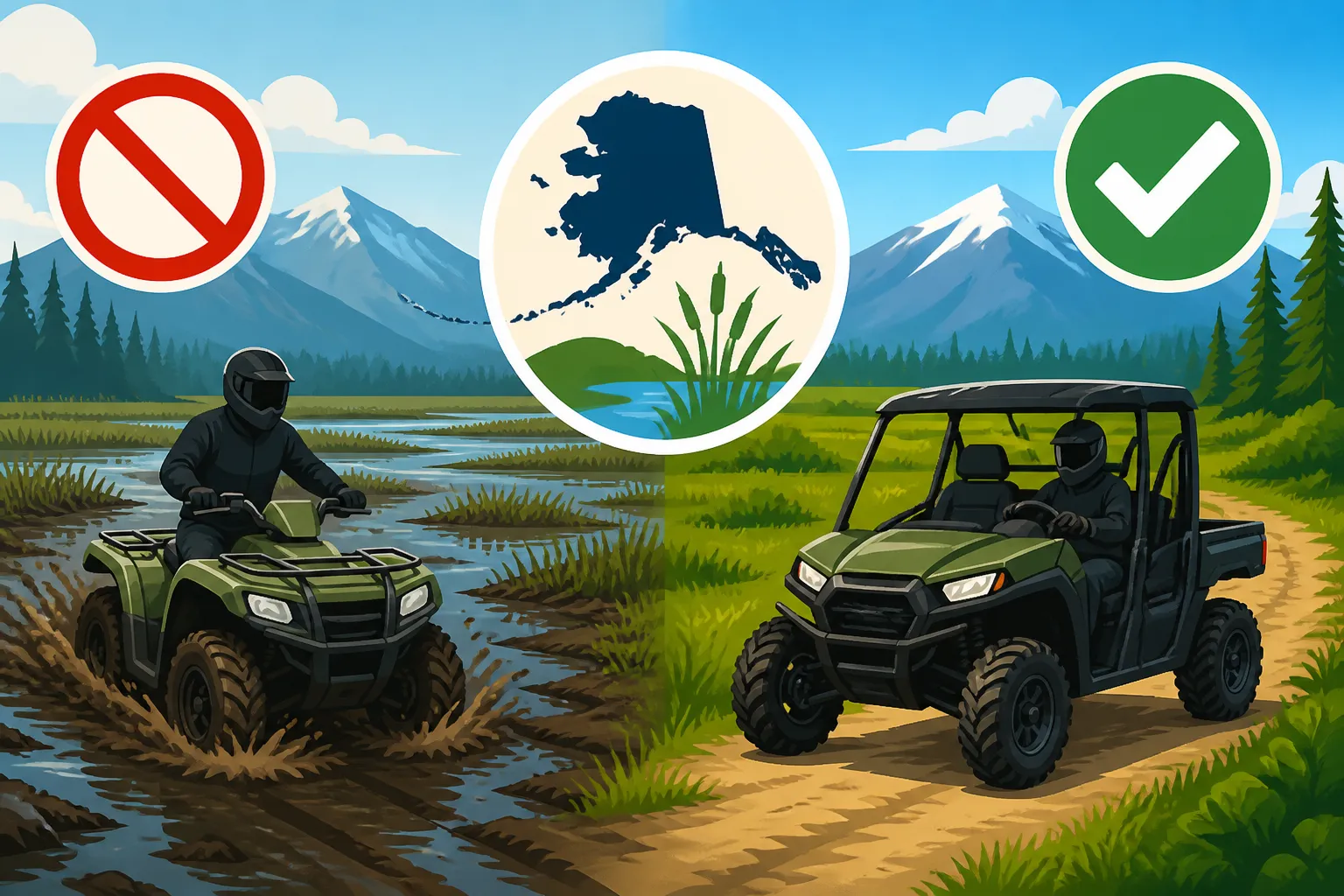
The easiest and often most environmentally sound way to deal with wetland restrictions is to simply avoid them. This is especially true during "breakup" in the spring, or after heavy rains in the summer. During these times, the ground is soft, saturated, and incredibly vulnerable to damage. Ruts created in spring can remain visible for years, disrupting drainage patterns and destroying vegetation that takes a very long time to recover in our cold climate. Understanding [Alaska Riding in Breakup] is key to protecting these areas. If you see open water, standing water, or very soft, squishy ground, it’s best to find an alternate route or turn back.
Winter, however, offers a different story. When the ground is thoroughly frozen and covered with a good layer of snow, many wetland areas become accessible on a solid, protective base. This is often the ideal time for traversing areas that would be impassable or highly susceptible to damage in warmer months. Always ensure the ground is truly frozen solid, though, and be mindful of thin ice over water bodies. For more insights on this, check out [Alaska Winter Travel on Frozen Ground]. The bottom line: if in doubt, stay out. The short-term enjoyment of cutting across a wetland isn't worth the long-term environmental cost or the potential legal repercussions.
Equipping Your Machine for Wetland Crossings (If Allowed)
If you're going to be riding in an area where legal wetland crossings are part of the designated trail system, or if you simply anticipate encountering water features (streams, shallow crossings) that are explicitly allowed, having the right equipment can make a huge difference for both safety and minimizing impact. Tires designed for mud and soft terrain, with good tread patterns, can provide better traction and flotation, reducing the likelihood of getting stuck and spinning your tires, which causes significant rutting. A winch is practically a necessity in Alaska's backcountry; it’s not just for getting unstuck, but for recovering your machine with minimal damage to the surrounding environment.
For those deep (and legal!) water crossings, a snorkel kit that raises your engine's air intake and vent lines is a smart investment. Companies like SuperATV offer a range of products, from snorkel kits to lift kits and portal gear lifts, that can significantly increase your machine's ground clearance and water-fording capabilities. While these modifications can help you navigate challenging terrain, remember that they don't give you a free pass to ignore regulations. Equipping your machine should always be done with the understanding of what is allowed and where. For example, knowing the details about [Snorkels for Deep Crossings] will help you understand their purpose and limitations. Always carry recovery gear like straps, shovels, and a first-aid kit. And never ride alone in remote or challenging terrain, especially if water crossings are involved.
Reading the Landscape and Minimizing Impact
Even when riding on designated trails through wetlands, responsible riding is about minimizing your footprint. Learn to "read" the ground before you commit. Look for existing ruts or hard-packed sections. If a wetland crossing is unavoidable and permitted, try to ride in the deepest part of an existing rut, if one is present and stable. This helps prevent widening the trail and creating new parallel ruts. Avoid swerving or sliding, which tears up more ground. The principle of "ride it, don't slide it" applies here – maintain steady momentum through a crossing rather than accelerating and braking harshly.
Always look ahead for potential hazards or areas that look particularly soft. If a crossing looks too deep, too soft, or too long, turn around. There's no shame in exercising caution. The damage from a single stuck machine can be immense, requiring extensive recovery efforts that further harm the ecosystem. Be mindful of areas showing signs of erosion or excessive rutting; these are indicators that the area is already stressed, and further travel might exacerbate the problem. Educate yourself on the long-term effects of [Tundra Damage in Summer] and the general implications of [Alaska Wetland Travel Restrictions Explained]. Carrying a satellite messenger for a backcountry ride, as discussed in [Carrying a Satellite Messenger for a Backcountry Ride], is always a wise decision, giving you peace of mind if you encounter an unforeseen issue.
Consequences of Ignoring Wetland Restrictions
Riding an ATV or UTV in Alaska is a privilege, and that privilege comes with responsibilities, especially when it comes to sensitive environments like wetlands. Ignoring the rules isn't just about a potential fine; it has far-reaching consequences for both the individual rider and the entire riding community.
Fines and Legal Penalties
The most immediate and tangible consequence of violating wetland travel restrictions is the legal penalty. Depending on where you're riding and the severity of the damage, these can range from a simple citation to substantial fines, seizure of your machine, and even potential jail time in extreme cases, especially on federal lands or if serious environmental harm is caused. State and federal agencies, like the Alaska State Troopers, federal park rangers, and BLM officers, actively patrol public lands and are trained to identify wetland damage caused by off-road vehicles. They are not shy about issuing citations.
For example, a violation of federal regulations concerning resource damage or off-road vehicle use could result in fines that quickly climb into the hundreds or even thousands of dollars. Repeated offenses can lead to escalating penalties, and in some situations, a court might even order you to pay for the environmental restoration of the damaged area, which can be astronomically expensive. Moreover, your machine could be impounded, leaving you stranded in the backcountry and facing additional costs for recovery. Understanding [Alaska Penalties for Riding a Closed Area] can give you a clearer picture of what's at stake. It's simply not worth the risk.
Environmental Damage and Public Perception
Beyond the legal ramifications, the environmental damage caused by irresponsible wetland riding is profound and long-lasting. As we discussed, Alaska's cold climate means that damage to vegetation and soil heals incredibly slowly. Deep ruts can alter natural drainage patterns, creating new channels that accelerate erosion, disrupt water tables, and effectively destroy habitats for fish, birds, and other wildlife. This isn't just a temporary disruption; it can permanently change the ecological character of an area, impacting entire food webs and ecosystem services like water filtration.
Furthermore, these visible scars on the landscape heavily influence public perception of ATV and UTV riders. When images of rutted wetlands or damaged tundra circulate, it fuels negative stereotypes and can lead to increased restrictions or outright bans on OHV access across wider areas. The actions of a few irresponsible riders can jeopardize access for the entire community of responsible riders who cherish Alaska's outdoors and strive to protect it. Preserving our access to these incredible trails means adhering to regulations and showing respect for the environment. Every time a rider makes a conscious choice to avoid a wetland or to ride responsibly through an allowed crossing, they are contributing to the longevity of OHV access in Alaska. It's about protecting the land, yes, but also about protecting our right to enjoy it.
Land Type and Wetland Riding Rules Summary
| Land Type | General Wetland Riding Rule | Key Considerations |
|---|---|---|
| Alaska State Land | Generally allowed for incidental crossings on established trails, or on frozen ground. | Requires [Alaska's Statewide General Permit for ATV Use]. Strictly prohibits "undue damage" or "unnecessary disturbance." Check for specific area management plans. |
| Alaska State Parks | Often prohibited or restricted to paved/gravel roads only; very limited wetland access. | [Alaska State Park Riding Rules] are distinct from general state land rules. Check park-specific regulations. |
| Federal Land (BLM, Forest Service, Refuges, Parks) | Typically restricted to designated roads and trails. Off-trail wetland travel is almost universally prohibited. | Very strict regulations. [Alaska National Park Machine Rules] and [Alaska Refuge Access by Machine] often ban ATVs entirely or limit them to specific routes. High penalties for violations. Always check with the specific land management agency. |
| Native Corporation Land | Requires explicit permission, often a paid land use permit. Rules vary but are often strict regarding wetlands. | These are private lands. [Alaska Native Corporation Land Permissions] are essential. Never ride without authorization. Land use permits will outline specific restrictions, including those for wetlands. |
| Private Land | Requires landowner permission. | Wetland rules might be subject to federal/state environmental protections even on private land, particularly concerning stream crossings or large wetland impacts. |
| Borough/City Land | Rules vary widely by community. Some may have specific designated trails, others outright bans. | Always check local ordinances. Some communities have enacted [Alaska Municipal ATV Ordinances] that can be more restrictive than state law, especially near population centers or sensitive areas. |
Disclaimer
This article is for general informational purposes only and does not constitute professional advice. Laws, prices and regulations vary by location and change over time. Consult a qualified professional for guidance on your specific situation.