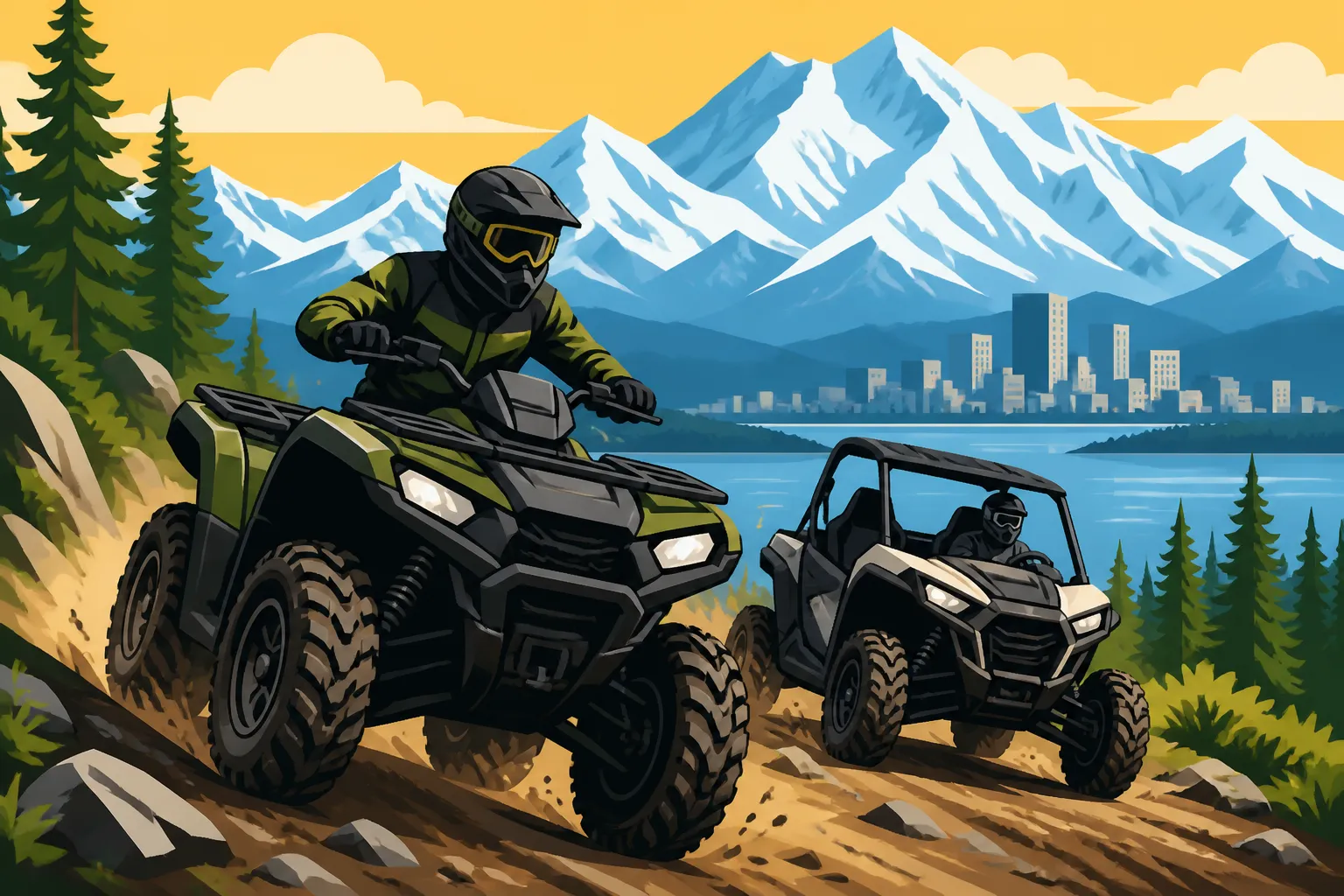
Alaska Riding in Anchorage
It's a common dream for folks moving to or living in Alaska's largest city: picturing yourself hopping on your ATV or UTV and cruising down the street from your garage, heading straight for an adventure. But the reality of riding your all-purpose vehicle (APV) in Anchorage is often a frustrating wake-up call, as city ordinances are designed to keep these machines off most public roads and lands. This guide is here to untangle the complexities, explain why those rules are in place, and—most importantly—point you towards the incredible, legal riding opportunities that Anchorage residents actually enjoy just outside the city limits.
The Reality: Why You Can't Just Ride Your ATV Through Anchorage
Let's cut right to the chase: if you're hoping to ride your ATV or UTV on the streets, sidewalks, or most public trails within the Municipality of Anchorage, you're going to be disappointed. Unlike many other parts of Alaska, particularly the more rural communities where APVs are a primary mode of transportation, Anchorage has very strict rules that largely prohibit their use. This isn't just about a preference; it's about deeply entrenched city ordinances designed to manage traffic, noise, and safety in a densely populated area.
Understanding Anchorage's APV Road Use Bans
The Municipality of Anchorage has taken a definitive stance on the operation of ATVs and UTVs (which fall under the state's broader "all-purpose vehicle" or APV classification) within its boundaries. Generally, these machines are not permitted on city streets, bike paths, sidewalks, or in most parks and public open spaces. This policy is starkly different from many other Alaskan towns where an APV might be considered a perfectly legitimate means of getting groceries or visiting a neighbor.
The reasons behind Anchorage's restrictive approach are multi-faceted. Firstly, there's the sheer volume of traffic and population density. Introducing off-road vehicles onto busy city streets creates significant safety concerns, both for the APV operators and other motorists, pedestrians, and cyclists. Secondly, noise is a major factor. The distinct sound of an ATV or UTV, while perhaps part of the charm in the backcountry, can be a significant disturbance in a residential neighborhood or urban core. Community quality of life is a high priority for local governance. Thirdly, environmental concerns play a role, particularly regarding emissions and the potential for damage to maintained green spaces or sensitive ecosystems within the city's parks. It's an unfortunate truth for those who love to ride, but the city views widespread APV use as incompatible with its urban and suburban character. For a more direct explanation, you can read about [Alaska Bans APVs in Anchorage].
Limited Exceptions and Crossing Rules
While the general rule is "no riding," it's natural to wonder if there are any exceptions or specific scenarios where an APV might legally interact with Anchorage's road system. And the answer, unfortunately for riders, is that these exceptions are incredibly narrow and do not amount to widespread riding privileges.
For instance, state law might permit an APV to cross a highway, but even then, it's typically under very specific conditions, such as crossing at a 90-degree angle, yielding to all other traffic, and only when doing so to access a legitimate trail or private property. This is a far cry from being able to drive down a city street. You'll definitely want to review [Alaska APV Road Rules Explained] to understand the nuances of state regulations, but remember that local ordinances in Anchorage often add further restrictions that override state-level permissions within city limits. So, even if the state allows a certain action, the city might still prohibit it.
Private land access is another area where an APV might technically be used, but this requires explicit permission from the landowner and strict adherence to property boundaries. This means you can't just cut across someone's backyard to get to a friend's house, even if they've given you permission to ride on their property. And let's be clear: this doesn't extend to accessing private land by driving on public roads to get there. The moment your wheels touch a public street, sidewalk, or city-owned greenspace, you're likely in violation of Anchorage's rules. The idea of making an APV "street legal" with turn signals, mirrors, and a horn, while possible in some jurisdictions, generally doesn't grant you carte blanche to ride within Anchorage due to those overarching municipal bans.
Essential Gear and Prep for Riding Near Anchorage
Since riding in Anchorage is largely off the table, the real adventure begins when you trailer your machine out of the city and head to the designated riding areas nearby. Preparing for these excursions means outfitting both your machine and yourself for the rugged, unpredictable Alaskan backcountry. This isn't just about fun; it's about safety and ensuring your machine can handle the demands of the terrain.
Outfitting Your Machine for Alaska's Wilds
Alaskan trails, even those relatively close to Anchorage, are no joke. You'll encounter everything from silty riverbeds and deep mud bogs to rocky climbs and braided glacial stream crossings. This environment demands a robust machine, and often, that means making some key modifications and carrying specific accessories. Think of it less like a casual Sunday drive and more like preparing for a wilderness expedition.
First and foremost, robust underbody protection is critical. Skid plates are your best friend against hidden rocks and submerged obstacles in creek crossings. A brand like SuperATV offers a wide range of heavy-duty skid plates and A-arm guards designed to protect your vital components from Alaska's unforgiving terrain. A good winch is practically non-negotiable. Sooner or later, you'll find yourself (or a riding buddy) stuck in mud, sand, or a challenging climb. A reliable winch can be the difference between a minor delay and a multi-hour recovery operation. You'll also want to consider tire upgrades. Stock tires might be fine for groomed trails, but for deep mud and loose rock, aggressive treads that can clear mud and grip uneven surfaces are a game-changer. Some riders even opt for lifted suspension systems, which can provide crucial extra ground clearance for navigating deep ruts and larger obstacles, further enhancing your machine's capability with aftermarket parts often found at SuperATV. Don't forget basic tools, a tire repair kit, and extra fuel for those longer backcountry runs where gas stations are non-existent.
Rider Safety and Awareness Beyond City Limits
Your own preparation is just as important as your machine's. Riding outside the immediate Anchorage area means you're venturing into true wilderness, often far from cell service or immediate emergency assistance.
Helmet Use: Even if you're an adult, wearing a helmet is a smart choice for any off-road riding. For younger riders, it's the law. [Alaska Helmet Law for Riders Under 16] mandates helmet use for anyone under 16 years of age operating or riding as a passenger on an APV. But really, everyone should wear one; a head injury in the backcountry is something you absolutely want to avoid.
Safety Gear: Always carry a well-stocked first-aid kit. A satellite messenger or personal locator beacon (PLB) is paramount if you're heading into areas without cell service – which is most of Alaska's backcountry. These devices can literally save your life by allowing you to call for help when no other communication is possible. Bear spray is also a wise item to carry, easily accessible, as bear encounters are a real possibility on many Alaskan trails.
Riding in Groups: Whenever possible, ride with at least one other person and machine. If one machine breaks down or gets stuck, you have immediate help. This also enhances safety in case of an injury. Before you head out, always let someone know your planned route and estimated return time. Being prepared means understanding that help might be hours away, so self-sufficiency is key. Remember, you'll need a valid [Alaska Requires a Class D License] to operate an APV on any public land where a driver's license is required.
Where Anchorage Residents Actually Ride Their ATVs and UTVs
So, if Anchorage is a no-go, where do locals head to get their off-road fix? Fortunately, some of Alaska's most renowned and extensive riding areas are just a short drive—and a trailer ride—from the city. These are the places where the spirit of Alaskan adventure truly thrives, offering vast landscapes and challenging trails.
The Knik River Public Use Area
Without a doubt, the Knik River Public Use Area (KRPUA) is the crown jewel for ATV and UTV riders in the Anchorage area. Located northeast of Anchorage, a scenic drive up the Old Glenn Highway will lead you to this expansive wilderness. It encompasses over 200,000 acres of state land, interlaced with glacial rivers, forests, and alpine tundra, offering an incredible diversity of riding experiences. Here, you can truly open up your machine and explore.
Popular spots within the KRPUA include the trails around Jim Creek, which offers a trailhead and campground, making it a fantastic base for day trips or longer camping excursions. From Jim Creek, riders can access routes leading to the Knik Glacier, which is a truly spectacular destination. The terrain at Knik varies from wide-open gravel riverbeds to challenging mud bogs and technical forest trails. This is where those SuperATV suspension upgrades and winches really earn their keep! Riders need to be prepared for dynamic conditions, including braided river crossings where water levels can change quickly. Before heading out, always ensure your machine is properly registered according to state law; you can learn more about this by reading [Alaska Registration Before Riding Public Land]. Detailed information about this incredible area can be found in our guide on the [Knik River Public Use Area in Alaska] and specific riding at [Jim Creek Riding in Alaska].
Other Nearby Riding Opportunities
While the Knik River area tends to be the primary destination, other regional options exist for Anchorage residents willing to travel a bit further. The broader Mat-Su Valley offers various access points to state lands and trails, though many of these also require trailering your machine from Anchorage. Places near Willow or Palmer might have localized riding opportunities, but it's crucial to consult local borough and state land use regulations meticulously before venturing out. For those planning longer trips, sections of the Denali Highway, though a significant drive, offer unparalleled backcountry access in certain seasons. The key takeaway for all these locations is that they are generally not accessible by riding directly from your home in Anchorage; trailering your APV is a fundamental part of the experience. Find out more about regional options in [Alaska Riding in the Mat-Su Valley].
The Importance of Land Ownership and Permits
It's critical to understand that even once you're outside Anchorage, you can't simply ride anywhere you please. Alaska has a patchwork of land ownership: state lands, federal lands (like national parks, forests, and wildlife refuges), Native Corporation lands, and private property. Each category often comes with its own set of rules, restrictions, and sometimes, permit requirements.
Before embarking on any ride, particularly in new areas, it is your responsibility to know whose land you're on and what the rules are. For state lands, there's often a statewide general permit for ATV use, but even this has exceptions, such as within state parks or specifically designated areas. Federal lands have their own varying regulations, often much stricter, especially within national parks or wilderness areas. Native Corporation lands, which are private, almost always require specific permission or a paid land-use permit. Trespassing, even accidentally, can lead to fines, confiscation of your machine, or other legal consequences. Always check land status maps and consult with the managing agency or landowner. For further details on navigating land access, consult [Alaska State Land Riding Explained] and [Alaska Native Corporation Land Permissions].
To help you visualize the difference in riding experiences, here's a quick comparison:
| Feature | Riding In Anchorage (Generally Prohibited) | Riding Near Anchorage (e.g., Knik River PUA) |
|---|---|---|
| Legality | Largely illegal on public roads/lands due to city ordinances | Legal and encouraged in designated public use areas |
| Access | Direct from garage is not permitted | Requires trailering your machine out of the city |
| Terrain | Paved roads, sidewalks, city parks (all off-limits) | Glacial rivers, mud, forests, mountains, diverse natural trails |
| Permits/Registration | Not applicable for riding, only for ownership | State APV registration required; some areas may have additional fees/permits |
| Gear Needed | Basic safety gear (helmets for youth) | Heavy-duty skid plates, winch, aggressive tires, satellite messenger, bear spray, first aid kit |
| Environmental Impact | High risk of damage to city infrastructure/green spaces | Managed use in designated areas to minimize impact; "Tread Lightly" principles |
| Emergency Services | Readily available, but APV riding is mostly prohibited | Often hours away; self-reliance is crucial |
| Social Aspect | High potential for conflict with residents and law enforcement | Community of riders, shared passion for the outdoors |
While the dream of zipping around Anchorage on your ATV might be quickly dashed by local rules, don't despair! Alaska's vast wilderness truly begins where the paved roads end, just a short drive from the city. By understanding the regulations, preparing your machine with essential gear (perhaps some robust aftermarket parts from SuperATV!), and educating yourself on land access, you can unlock incredible, legal, and memorable off-road adventures that are truly Alaskan. So, get that trailer hitched, pack your gear, and head out to experience the wild beauty that awaits beyond Anchorage's city limits.
Disclaimer
This article is for general informational purposes only and does not constitute professional advice. Laws, prices and regulations vary by location and change over time. Consult a qualified professional for guidance on your specific situation.