Alaska Rules Riders Get Wrong
It's incredibly frustrating when you're trying to do the right thing, trying to understand the myriad of rules and regulations for riding your ATV or UTV in Alaska, only to find conflicting information or realize that what you thought was common knowledge is actually dead wrong. Many riders, both long-time Alaskans and newcomers, often operate under a few critical misconceptions about what it means for an all-purpose vehicle (APV) to be "street legal" or what's truly required to ride on public roads here. This guide will clarify the most common mistakes and set the record straight on Alaska's APV road rules, helping you avoid unnecessary tickets and keep your machine rolling safely and legally.
The Myth of a "Street Legal" ATV in Alaska
Let's get straight to it: there's no official "street legal" designation for ATVs or UTVs in Alaska in the same way there is for cars or motorcycles. This is one of the biggest points of confusion, leading many riders down a rabbit hole of aftermarket parts and modifications that, while useful, don't change the fundamental classification of their machine or its permitted use on public roadways. The state recognizes a specific category called the All-Purpose Vehicle (APV), and it comes with its own set of rules, which are often misinterpreted.
Understanding Alaska's All-Purpose Vehicle APV Class
Alaska's legal framework groups ATVs and UTVs under the umbrella of "All-Purpose Vehicles" or APVs. This designation is crucial because it dictates where and how you can operate these machines, especially concerning public roads. An APV isn't suddenly a car just because you bolt on turn signals and a horn. It remains an APV, and its road use is severely restricted. The core principle is that APVs are primarily intended for off-road use, and any on-road allowance is an exception, not the rule. It's not about making your quad become a car, but understanding the specific conditions under which your APV can interact with the existing road system. You can dive deeper into this with [Alaska APV Class Explained].
The frustration often stems from seeing vehicles like Polaris Rangers or Can-Am Commanders, modified with windshields, wipers, and even full cabs, and assuming these modifications automatically grant them full road access. But the law doesn't work that way. The APV class is defined by its design and intended use, not by how many bells and whistles you add to it. Even if your machine looks like a mini-truck, it's still considered an APV in the eyes of Alaskan law, and therefore subject to the same limitations as a stripped-down sport quad.
Equipment That Doesn't Make You "Street Legal"
Many aftermarket accessories are sold with the promise of making your machine "street legal." While some of these parts are indeed required if you plan to utilize the limited road access Alaska grants APVs, they do not inherently transform your vehicle into something that can drive anywhere a car can. For example, adding turn signals, a horn, mirrors, and even a DOT-approved windshield doesn't magically permit you to cruise down the Glenn Highway at 65 mph. These are simply components that help you meet the minimum equipment standards for specific, permitted on-road travel.
Consider things like a full lighting kit, including headlights, taillights, brake lights, and turn signals. Yes, [Alaska OHV Equipment Requirements] mandate these for certain types of road use, especially during low light or night riding. A sturdy set of mirrors, perhaps from a company like SuperATV, can improve your visibility, which is always a good idea, but again, it's about meeting a specific condition, not changing the vehicle's classification. The misconception is believing that once you've checked off all these equipment boxes, your APV has the same rights as a passenger car. It does not. The state of Alaska simply has specific equipment rules if you do ride on a road where it's permitted.
Where APVs Can Legally Ride on Roads
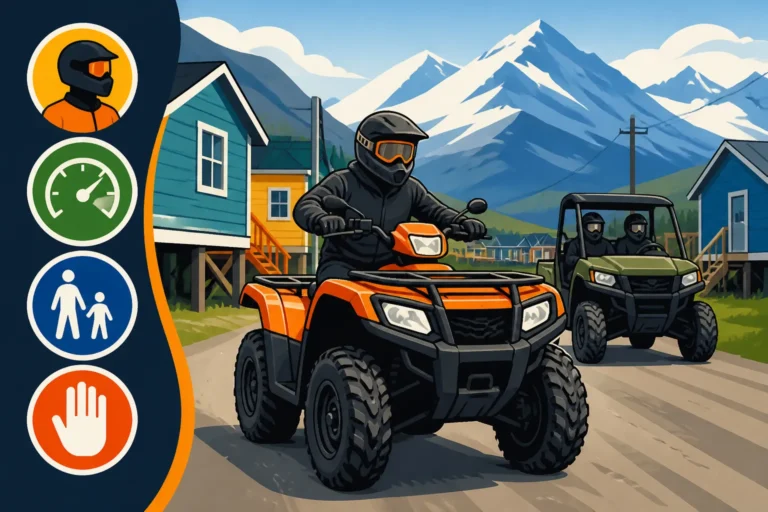
So, if APVs aren't truly "street legal," where can you ride them on a road? This is where many riders get it wrong, often leading to citations. Alaska law allows APVs to operate on certain public roads, but with significant caveats. Generally, APVs are permitted on roads with a posted speed limit of 45 mph or less. This is a critical distinction that many overlook. You might be able to ride a gravel road connecting two trails, but you cannot hop onto the Parks Highway. The rules are designed to allow passage or limited access, not to facilitate general transportation.
Furthermore, APVs can cross highways, but they must do so as directly as possible and after yielding to all traffic. You can't just meander across a four-lane highway. Riding on the shoulder of a state-maintained highway is also generally prohibited unless it's explicitly designated for APV use, which is rare outside of specific rural communities. [Crossing a Highway on a Quad in Alaska] details the proper procedure for this limited allowance. It’s vital to understand that this limited road access is a privilege, not a right, and it comes with strict conditions that vary based on the type of road and local ordinances.
Common Misconceptions About Licenses, Insurance, and Age
Beyond the "street legal" myth, there's often confusion surrounding the human elements of riding: who can ride, what they need to carry, and what protections are in place. These aren't just minor details; they can lead to significant legal trouble if you're caught without the proper credentials or if an accident occurs.
Driver's License Requirements for APVs
Many assume that because an ATV or UTV is an off-road vehicle, you don't need a driver's license to operate one, even on roads where they are permitted. This is a dangerous misconception. If you're operating an APV on any public road or highway in Alaska where APVs are allowed, you absolutely need a valid Class D driver's license. That's the standard automobile driver's license most people carry. There's no special "APV license" or "off-road license." If you can't legally drive a car, you can't legally operate an APV on a public road in Alaska.
This rule is in place to ensure that anyone operating a vehicle on shared public thoroughfares has at least a basic understanding of traffic laws and responsible driving practices. It's not about your skill level on a trail, but your ability to safely interact with other vehicles and pedestrians when you're on a road. For a comprehensive overview, see [Alaska Requires a Class D License]. Remember, even if you're just crossing a highway or riding a low-speed gravel road, that license needs to be in your wallet.
The Truth About APV Insurance on Roads
Another common misbelief is that APVs don't require insurance. While liability insurance typically isn't mandatory for APVs strictly operated off-road on private property, if you plan to ride your APV on any public road or highway where it is allowed, Alaska law does require you to carry liability insurance. This is a major point of contention and surprise for many riders who might only insure their APV for theft or damage, overlooking the liability aspect for road use.
The state mandates this to protect other drivers and property in the event of an accident involving your APV on a public road. Imagine a scenario where you're crossing a state highway, as permitted by law, and you misjudge an oncoming vehicle, causing a collision. Without liability insurance, you'd be personally responsible for all damages and medical costs, which can be catastrophic. Therefore, if your riding plans include any use of public roads, however brief, ensure your insurance policy covers APV liability for on-road operation. More details can be found in [Alaska Requires Liability Insurance for an APV].
Age Restrictions and Passenger Rules
Alaska has specific rules regarding the age of APV operators and passengers, especially concerning helmets. It's not a free-for-all, particularly for younger riders. For instance, while there isn't a specific minimum age to operate an APV off-road in Alaska, anyone under the age of 16 is generally required to wear a helmet when operating or riding as a passenger on an APV. This applies whether they are on a trail or a permitted road. This isn't just a suggestion; it's law, and it's enforced.
| Rider Age Category | Driver's License Required (on Public Road) | Helmet Required (anywhere) | Passengers Allowed? |
|---|---|---|---|
| Under 16 | No | Yes | Yes (with helmet) |
| 16-17 | Yes (Class D) | Yes | Yes (passengers under 16 need helmet) |
| 18+ | Yes (Class D) | No | Yes (passengers under 16 need helmet) |
Note: This table summarizes general state law. Local ordinances may have stricter helmet or age requirements, especially regarding specific roads or trails.
Many parents assume that if they're supervising, their child can ride anywhere. While supervision is always encouraged, it doesn't override the helmet law for those under 16. Furthermore, carrying passengers is only legal if the APV is specifically designed by the manufacturer to carry more than one person. Trying to squeeze two adults onto a single-seat ATV, even with a strong grab bar from a company like SuperATV, is illegal and incredibly dangerous. Understanding [Alaska Helmet Law for Riders Under 16] is crucial for families who enjoy riding together.
Navigating Local Ordinances and Specific Road Types
One of the trickiest aspects of riding an APV in Alaska is that state laws provide a baseline, but local municipalities often have their own, more restrictive ordinances. What's legal in one borough or city might be strictly prohibited just a few miles down the road. This patchwork of regulations is a constant source of frustration and confusion for riders.
Boroughs and Cities That Ban APV Road Use
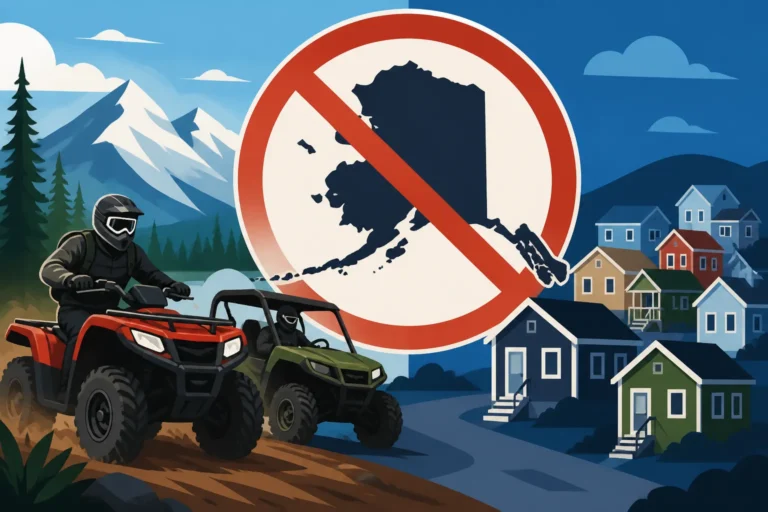
This is perhaps the biggest surprise for new riders, and a frequent trap for those who assume statewide consistency. Many urban and even some rural communities in Alaska have local ordinances that completely prohibit APV operation on any public roads within their city limits, regardless of what state law might allow. Major cities like Anchorage, Fairbanks, and Juneau are prime examples where you generally cannot operate an APV on city streets. The idea of "street legal" often falls completely flat here because local bans override the limited state permissions.
Before you trailer your rig into a new area and decide to run down the main street to grab gas, it is absolutely imperative to check local city or borough ordinances. A quick search for "Anchorage APV ordinance" or checking with the local police department can save you a hefty fine. What might be perfectly fine in a remote village or on a forest service road could land you in serious trouble in a developed area. The list of [Alaska Communities That Ban APV Road Use] is growing, and it's essential to stay informed about the specific area you plan to ride in.
The 45 MPH Speed Limit Rule
As mentioned earlier, a core component of Alaska's APV road rules is the 45 mph speed limit. APVs are generally only permitted on roads where the posted speed limit is 45 mph or less. This rule is often misinterpreted as "you can only drive your APV at 45 mph" rather than "you can only drive your APV on roads posted 45 mph or less." It's not a maximum speed for your vehicle; it's a condition for the road itself. If the road is posted 55 mph, even if you drive 40 mph, you're still on an illegal road for an APV.
This rule is designed to keep slower-moving, less protected APVs off high-speed roadways where they pose a greater risk to themselves and other traffic. It's a pragmatic safety measure. So, if you're cruising a county road in the Mat-Su Valley and the speed limit signs jump from 45 to 55, that's your cue to find an alternative route or trail. Don't push it; a trooper will absolutely ticket you for violating this. The details are clarified in [Alaska's 45 mph Road Limit for APVs].
Crossing Highways and Riding Shoulders
While APVs are generally prohibited from traveling on major highways (those with speed limits above 45 mph), Alaska law does allow for crossing these highways. However, this is not a casual maneuver. When crossing a highway, an APV operator must do so at approximately a 90-degree angle to the roadway, yielding the right-of-way to all oncoming traffic, and only after coming to a complete stop. It's about getting from one side to the other as quickly and safely as possible, not about traveling down the highway itself.
Riding on the shoulder of a highway is another area of frequent misunderstanding. Many riders assume that if they stay off the main travel lane, they're fine. Generally, riding on the shoulder of a state-maintained highway where the speed limit is over 45 mph is not permitted. There are exceptions for maintenance, emergency, or in specific communities where local ordinances might allow it, but these are rare. For most public roads, the shoulder is considered part of the highway right-of-way and is subject to the same restrictions as the main lanes. This rule is often a point of frustration for riders who want to connect trails but don't want to load their machine back onto a trailer. However, maintaining clear and safe shoulders for emergencies is paramount. You might consider adding some high-visibility lighting from SuperATV to your machine, even for legal crossings, to make yourself as visible as possible.
Disclaimer
This article is for general informational purposes only and does not constitute professional advice. Laws, prices and regulations vary by location and change over time. Consult a qualified professional for guidance on your specific situation.