The Eight Alaska Towns That Ban APV Road Use
It’s a truly frustrating experience to load up your ATV or UTV, head into a new town, and then discover that the very streets you planned to traverse are completely off-limits to your machine. Alaska offers incredible riding opportunities, but local rules can throw a wrench in your plans faster than a broken axle. This guide will shine a light on the specific communities in Alaska where riding your All-Purpose Vehicle (APV) on public roads is explicitly prohibited, helping you plan your adventures without unwanted surprises or fines.
Alaska's Statewide Approach to APV Road Use
Before we dive into the communities with outright bans, it’s helpful to understand the general landscape of APV road use across Alaska. The state actually has a framework that, under specific conditions, does allow ATVs and UTVs on certain public roads. This often catches newcomers and even some long-time residents off guard, as many states have much stricter, blanket prohibitions.
For instance, state law permits APVs on roads with a posted speed limit of 45 mph or less, provided the driver holds a valid Class D driver's license and the machine is insured. There are also specific equipment requirements, like working headlights, taillights, brakes, and a muffler. You can find more details on these general guidelines in [Alaska APV Road Rules Explained]. This statewide flexibility is fantastic for connecting trails, accessing remote cabins, or simply getting from your driveway to a local store in many parts of the state. It recognizes the utility of these machines as essential transportation in many rural and even semi-rural Alaskan communities. However, this flexibility isn't universal. Local jurisdictions, exercising their home rule authority, have the power to implement stricter regulations or even outright bans within their city limits, and that's where the confusion often arises.
The Eight Alaska Towns That Ban APV Road Use
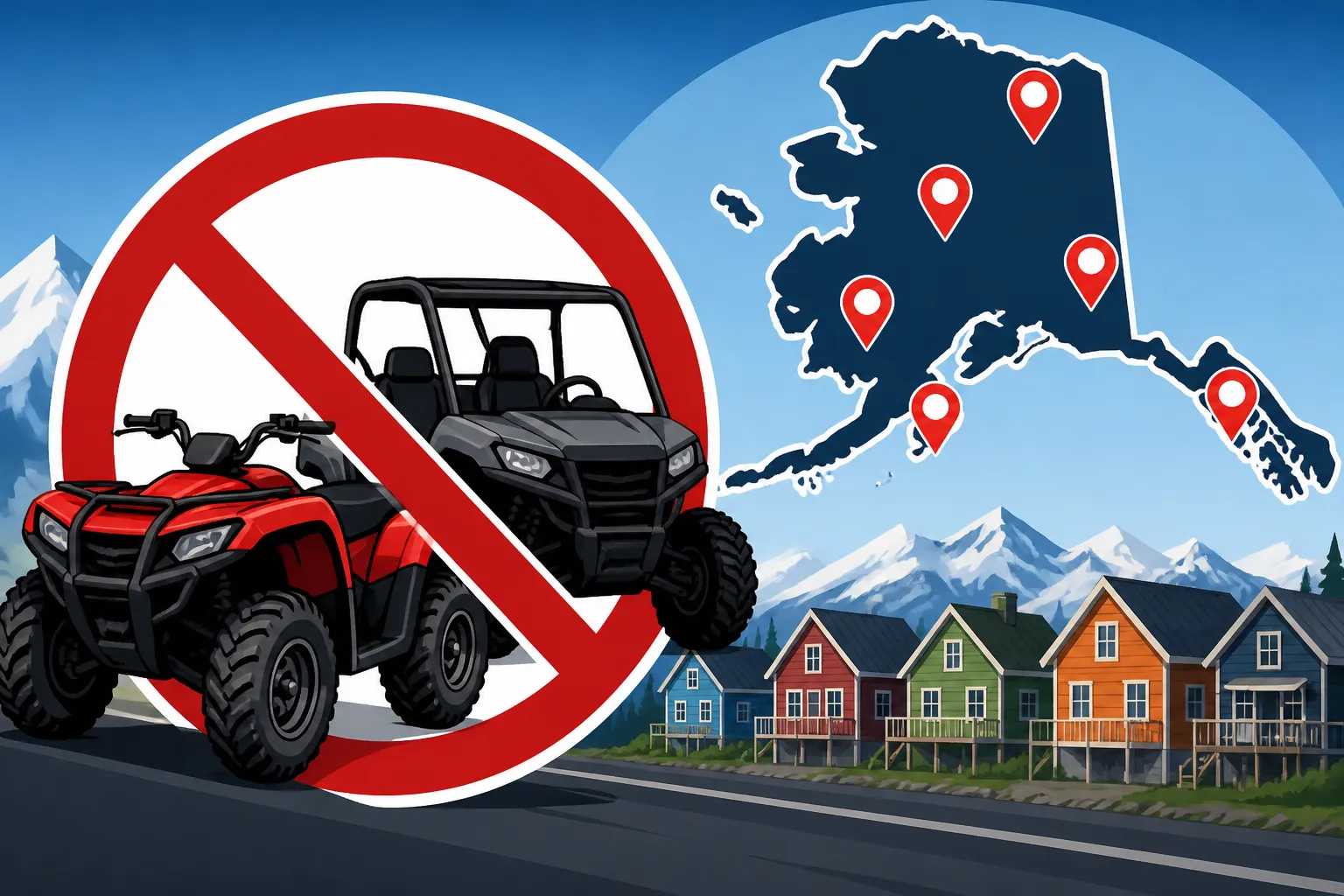
While the state gives a certain amount of leeway, eight specific communities have decided that APVs simply don't belong on their public roadways. These bans are a significant point of contention for many riders who rely on their machines for transportation, but they reflect local concerns about safety, noise, and traffic management. Knowing these places is crucial for any rider venturing off the main trails.
Here are the towns where you'll need to keep your APV off the paved and gravel public roads:
Anchorage Bans APVs on Its Streets
The largest city in Alaska, Anchorage, has a very clear stance: no APV road use within city limits. This means if you're pulling into town, whether you're heading to a trailhead or just passing through, your quad or side-by-side needs to be on a trailer. This ban extends across the entire municipality, from the bustling downtown streets to the more residential areas on the edges. The reasons are pretty straightforward for a city of this size: high traffic volume, concerns about vehicle compatibility, and public safety. Trying to navigate busy streets on an ATV, even if it has all the right lights and mirrors, is seen as an unnecessary risk in such a densely populated area. You won't see anyone casually cruising down Dimond Boulevard or Northern Lights on a quad here, and for good reason—a trooper won't hesitate to issue a citation.
Fairbanks: A Northern City With Road Restrictions
Much like Anchorage, Fairbanks, the Interior's largest city, also prohibits APV road use. While Fairbanks might feel a bit more spread out and some might argue its streets are less congested than Anchorage's, the city council has maintained a ban for similar reasons of safety and urban planning. This ban covers all public roads within the city of Fairbanks. If you're visiting for an event or just passing through on your way to a remote hunting spot, ensure your machine is trailered. You'll find fantastic riding outside the city, but within the city proper, your APV stays off the asphalt.
Juneau: No APV Road Access in the Capital
Alaska's state capital, Juneau, accessible primarily by air or sea, is another municipality that bans APV road use. Its unique geography, with narrow roads winding through mountainsides and limited space, makes it particularly challenging to integrate APV traffic safely into the mix with cars and pedestrians. The city's focus on maintaining its unique character and ensuring pedestrian safety on its often-crowded streets means APVs are restricted to specific trails, not public roads. So, if you're ferrying your machine to Juneau, plan your route to and from the trails carefully, ensuring you're not using public streets for transit. You can learn more about specific local rules in [Alaska Municipal ATV Ordinances].
Wasilla and Palmer: Mat-Su Valley Bans
These two fast-growing cities in the Mat-Su Valley, Wasilla and Palmer, also have prohibitions against APV road use. This often surprises riders because the Mat-Su Borough itself is a mecca for ATV and UTV enthusiasts, with vast public lands like the Knik River Public Use Area easily accessible. However, the cities themselves have implemented their own restrictions.
- Wasilla: Within the city limits of Wasilla, APVs are not allowed on public roads. This means if you're staying at a hotel or visiting shops in Wasilla, your machine needs to stay on your trailer or be parked off-road.
- Palmer: Similarly, Palmer maintains a ban on APV road use. The historic downtown and surrounding residential areas prioritize traditional vehicle traffic. These bans reflect the challenges of balancing popular outdoor recreation with growing urban populations and their associated traffic and noise concerns.
Kenai and Soldotna: Kenai Peninsula Restrictions
The Kenai Peninsula is another hugely popular destination for outdoor enthusiasts, including ATV and UTV riders. However, its two largest cities, Kenai and Soldotna, have implemented bans on APV road use within their municipal boundaries.
- Kenai: If you're heading to the coast or fishing the Kenai River, remember that riding your APV on the streets of Kenai is prohibited.
- Soldotna: Similarly, Soldotna, a central hub on the Peninsula, also bans APV road use. These cities see significant tourist traffic, especially during fishing season, and the local governments have decided to keep APVs off their public roads to manage congestion and ensure general public safety. For riders, this means trailering your machine to designated riding areas outside of city limits.
Homer: The End of the Road with an APV Ban
At the very end of the paved road system on the Kenai Peninsula lies Homer, a town famous for its Spit and stunning views. Despite its somewhat remote location, Homer also bans APV road use within its city limits. The unique character of Homer, its narrow roads, and its high pedestrian traffic (especially on the Spit) make it another location where local authorities have deemed APV road use incompatible with their community’s environment and safety goals. So, enjoy the incredible riding opportunities around Homer, but keep your quad off the city streets themselves. For more on navigating specific city rules, check out [Checking a City Code Before You Ride].
Why These Bans Exist: Safety, Noise, and Local Ordinances
It’s easy to feel a pang of frustration when you encounter an APV road ban, especially if you've invested in making your machine compliant for road use elsewhere. However, these bans aren't arbitrary. They typically stem from a combination of very real local concerns:
Public Safety Concerns
The primary driver behind most APV road bans is public safety. While modern ATVs and UTVs, especially those from reputable brands like SuperATV, can be equipped with lights, mirrors, and other accessories to enhance visibility and control, they are still fundamentally designed for off-road use. They handle differently than cars, have different braking characteristics, and often lack the same crash protection as street-legal vehicles.
- Traffic Volume: In urban environments like Anchorage or Fairbanks, the sheer volume of cars, trucks, and buses creates a hazardous environment for APVs. A misjudgment by an APV rider or an unaware car driver can lead to serious accidents.
- Speed Differentials: Even on roads posted 45 mph or less, the speed capabilities and acceleration of APVs can differ significantly from other vehicles, leading to dangerous interactions, especially during turning or lane changes.
- Pedestrian and Cyclist Safety: In towns like Juneau or Homer, where pedestrian and bicycle traffic is common, introducing APVs to shared roadways raises concerns about collisions, especially given the machines' off-road capabilities which might tempt some riders to drive less cautiously.
Noise Pollution and Community Nuisance
Let's be honest, ATVs and UTVs can be noisy. While manufacturers, and accessory providers like SuperATV, offer exhaust systems that meet regulations, the characteristic sound of a roaring engine can be a significant source of complaint for residents, particularly in denser residential areas.
- Residential Peace: Imagine living on a quiet street and having several APVs rumble past your house throughout the day and night. For city planners, balancing the recreational desires of some with the need for peace and quiet for others is a constant challenge.
- Exhaust Emissions: While less often cited than noise, exhaust emissions from multiple APVs on city streets can also be a concern for air quality, especially in areas with poor air circulation.
Local Control and Ordinances
Alaska's system of governance allows cities and boroughs a significant degree of local control over their affairs, including traffic regulations. When a community votes to ban APVs from its roads, it's often a reflection of local values, priorities, and demographics.
- Specific Community Needs: A village in rural Alaska might embrace APV road use as a necessity for transportation, while a larger, more urbanized community might see it as an incompatible recreational activity on public thoroughfares.
- Historical Context: Some bans might predate the wider acceptance or modification capabilities of modern APVs, or they might be a direct response to past issues with irresponsible riding within city limits. These ordinances are legally binding, and as riders, we must respect them. Understanding [Alaska Communities That Ban APV Road Use] can help you differentiate between state and local authority.
Navigating the Rules: How to Ride Legally and Responsibly in Alaska
Encountering a ban can be disappointing, but it doesn't mean your Alaskan adventure is over. It simply means you need to be a more informed and adaptable rider.
Always Check Local Ordinances Before You Ride
The first and most crucial step for any APV rider in Alaska is to always, always check the local city or borough ordinances before you plan to ride on any public land or road. A quick call to the city clerk's office or a visit to the local government's website can save you a lot of grief. What's allowed in one borough might be strictly prohibited just across the border in a city. This is especially true for communities not on the list of eight; just because they aren't listed here doesn't automatically mean they allow APV road use. They might have their own specific restrictions or permit systems.
Trailer Your Machine Through Banned Areas
If you know you're heading into or through one of the eight banned towns, your machine needs to be on a trailer. This is non-negotiable. Don't try to "just quickly run to the gas station" or "only go a block." Troopers and local police are aware of these rules and will enforce them. Having your APV securely trailered not only keeps you compliant with the law but also prevents any misunderstandings or potential conflicts with local residents or law enforcement.
| City/Town | APV Road Use Status | Primary Reason Cited (General) |
|---|---|---|
| Anchorage | Banned on all public roads | High traffic, safety, urban compatibility |
| Fairbanks | Banned on all public roads | Safety, urban planning, noise |
| Juneau | Banned on all public roads | Limited space, pedestrian safety |
| Wasilla | Banned on all public roads within city limits | Growing urban population, traffic |
| Palmer | Banned on all public roads within city limits | Urban growth, historic character, safety |
| Kenai | Banned on all public roads within city limits | Tourist traffic, congestion, public safety |
| Soldotna | Banned on all public roads within city limits | Tourist traffic, congestion, public safety |
| Homer | Banned on all public roads within city limits | Narrow roads, high pedestrian traffic |
Explore Nearby Riding Opportunities
The good news is that Alaska is vast, and many of these cities are gateways to incredible riding areas.
- Anchorage: While Anchorage itself is off-limits, nearby areas like Jim Creek or the Knik River Public Use Area offer hundreds of thousands of acres of trails. You'll just need to trailer your machine to the trailhead.
- Fairbanks: Outside of Fairbanks, you'll find extensive opportunities on state and federal lands.
- Mat-Su Valley: For Wasilla and Palmer, the Mat-Su Borough is still a prime destination for riding, with numerous trailheads just a short drive outside city limits. You can find comprehensive details about these riding zones in resources like [Alaska ATV Trails: Where to Ride].
Equipping Your Machine for General Safety
Even when riding in areas where APV road use is permitted, or simply on trails, ensuring your machine is properly equipped for safety is paramount. While this won't override a local ban, having a well-maintained machine is always a good idea. Manufacturers and aftermarket companies offer a wide array of accessories that can enhance your visibility and control. For instance, whether it's robust skid plates for river crossings or high-quality LED light bars for those long Alaskan nights, companies like SuperATV provide components that make your machine more capable and visible. While these additions are great for general safety and compliance in areas where road use is allowed, they don't give you a free pass to ignore city-specific bans. Always prioritize safety gear like helmets, proper clothing, and emergency supplies for any ride, regardless of where you're going. You can also explore [Alaska OHV Equipment Requirements] to ensure your machine is compliant with statewide mandates.
The beauty of Alaska is its wildness and the freedom it offers, but with that freedom comes the responsibility to know and respect the rules of the land – and the towns. By understanding where APVs are restricted, you can avoid costly mistakes and ensure your Alaskan adventures are both thrilling and legal.
Disclaimer
This article is for general informational purposes only and does not constitute professional advice. Laws, prices and regulations vary by location and change over time. Consult a qualified professional for guidance on your specific situation.