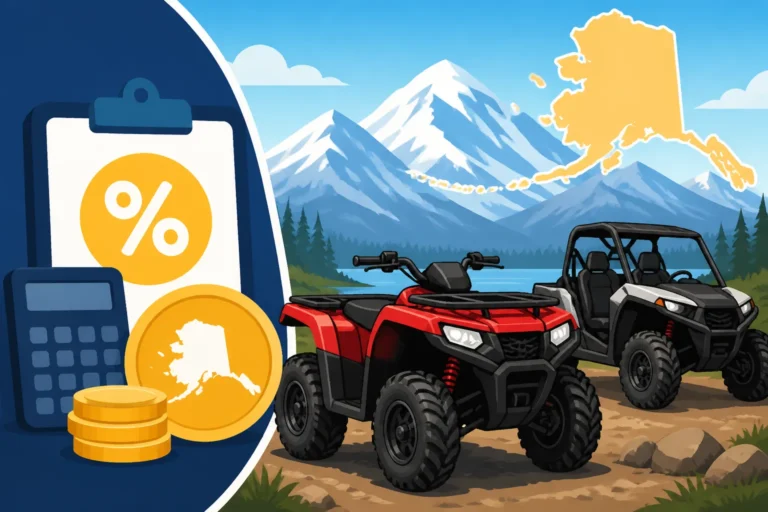
No Statewide Sales Tax
It's a common misconception that buying anything in Alaska means no taxes, period. While the Last Frontier famously boasts no statewide sales tax, many folks get a rude awakening when they realize that local municipalities can, and often do, levy their own sales taxes on everything from groceries to that brand-new ATV or UTV you've been eyeing. This guide is here to help you understand the real tax landscape for your off-road machine in Alaska, so you can budget accurately and avoid any unpleasant surprises.
The Good News: No Alaska Statewide Sales Tax on Your ATV or UTV
Let's start with the big win that draws many to Alaska: the absence of a statewide sales tax. This isn't just a small perk; it's a fundamental difference that sets Alaska apart from nearly every other state in the nation. For big-ticket purchases like an ATV, a side-by-side, or even a snowmachine, not having to tack on an additional 4-8% state sales tax right off the bat can feel like a huge relief. It means more money in your pocket, or perhaps, more budget for those essential accessories like a winch, a good helmet, or that fancy GPS unit.
When you walk into a dealership in Anchorage, Fairbanks, or anywhere on the road system, you won't see a line item for "Alaska State Sales Tax" on your bill of sale. This immediately makes the initial cost of ownership more approachable compared to, say, Washington state or any other region in the Lower 48 where state sales tax can add hundreds, if not thousands, to the final price of your off-road vehicle. For folks moving up here, it's often one of the first pleasant financial surprises they discover. It feels good to know that your hard-earned money isn't immediately going to a state tax authority before you even get to spin the tires.
Why Alaska Stands Out for Vehicle Purchases
Alaska's approach to taxation is unique, prioritizing other revenue streams like oil and gas royalties, severance taxes, and property taxes, rather than leaning on a broad-based sales tax that would affect every transaction. This economic model has historically meant that consumers don't face the direct financial burden of sales tax on goods and services at the state level. For ATV and UTV enthusiasts, this translates into a tangible saving on the purchase price of their machine. It’s a compelling reason why some might even consider purchasing their vehicle in Alaska if they're close to the border, though customs and shipping costs could quickly eat into those savings.
This lack of statewide sales tax simplifies the buying process too. There’s no complex calculation to perform based on varying state rates or exemptions. What you negotiate with the seller for the vehicle's price is largely what you pay, barring any local taxes we'll discuss next. This transparency can make comparing prices between dealerships or private sellers much more straightforward. For anyone coming from a state with high sales tax, this aspect alone can make buying an ATV or UTV in Alaska feel like a breath of fresh air, providing a clear cost advantage right from the start.
What "No Statewide Sales Tax" Truly Means for Buyers
For you, the ATV or UTV buyer, "no statewide sales tax" means that the price tag on the machine is closer to its actual cash price than it would be almost anywhere else in the country. If a dealer lists a quad for $10,000, you're not immediately adding another $500 to $800 on top of that for state tax. This savings can be significant. Imagine putting that money towards winterizing your machine, buying a sturdy trailer for hauling it to the [Knik River Public Use Area in Alaska], or upgrading your riding gear to better suit Alaska's diverse conditions.
However, it's crucial not to confuse "no statewide sales tax" with "no sales tax at all." This is where many buyers, especially those new to Alaska or those who haven't done their homework, can get caught off guard. While the state takes no bite, local governments are permitted to impose their own sales taxes. So, while you're celebrating the absence of state tax, keep in mind that your local borough or city might still have its hand out. It’s a nuanced but vital distinction for your budget, and one that absolutely requires a bit of research before you finalize your purchase.
Unpacking Local Sales Taxes: Boroughs and Cities
Here's where things get a little more complex, and where that initial joy of "no sales tax" can sometimes diminish slightly. While the State of Alaska doesn't collect sales tax, many individual boroughs and cities do. These local taxes are typically applied to purchases made within their jurisdiction, and they can vary significantly from one community to another. This means that buying an ATV in Fairbanks might have a different tax implication than buying the exact same machine in Juneau or even a smaller community in Southeast Alaska.
It's not just about the rate either; sometimes, specific items or services might be exempted, or there might be caps on how much tax can be charged on a single high-value item. These are less common for vehicles, but it's worth being aware that local rules can be quite specific. The key takeaway is this: always confirm the local sales tax situation for the specific borough or city where you plan to make your purchase. Don't assume that because you're in Alaska, you're completely off the hook for sales tax. You'll thank yourself for doing that bit of extra homework rather than being surprised at the counter.
Identifying Areas with Local Sales Tax
Alaska is a vast state, and its municipal tax structures are just as varied. Generally speaking, many of the larger cities and boroughs have opted to implement local sales taxes to fund public services. For example, communities in Southeast Alaska like Juneau, Ketchikan, and Sitka typically have local sales taxes. On the other hand, the Municipality of Anchorage, where a huge portion of the state's population resides, does not levy a sales tax. This creates a distinct difference between buying a machine in Anchorage versus, say, Kenai or Soldotna on the Kenai Peninsula, both of which do have local sales taxes.
To figure out if you'll be subject to a local sales tax, your best bet is to check with the city or borough finance department where the dealership is located or where the private seller resides if the transaction occurs there. Many local government websites will have this information readily available. A quick call to the dealership itself is also a good idea; they deal with these taxes every day and can give you an accurate figure. This due diligence is part of the process of understanding [Alaska Borough Taxes on a Machine] and is critical for an accurate budget.
Here’s a simplified table illustrating potential variations:
| Location Example | Statewide Sales Tax | Local Sales Tax | Typical Rate (Approximate) | Impact on ATV Purchase |
|---|---|---|---|---|
| Municipality of Anchorage | No | No | 0% | Significant savings |
| City of Juneau | No | Yes | 5% (city + borough) | Adds to cost |
| Kenai Peninsula Borough | No | Yes | 3-4% (borough) | Adds to cost |
| City of Fairbanks | No | No | 0% | Significant savings |
| Ketchikan Gateway Borough | No | Yes | 4-6% (city + borough) | Adds to cost |
Note: These rates are illustrative and can change. Always verify current rates with the specific municipality.
How Local Taxes Affect Your ATV or UTV Purchase
Let's put some numbers to this. If you're buying a $15,000 ATV in a borough that has, say, a 3% local sales tax, that's an additional $450 you'll need to pay. If it's a 5% local tax, you're looking at $750. While not as high as a state and local tax combined in other parts of the country, it's certainly not negligible and can impact your overall budget for the machine. This is why it's vital to inquire about [Alaska Sales Tax on an ATV Purchase] before you commit.
This local sales tax is usually collected by the seller (the dealership or, in some cases, the private individual if the municipality requires it) at the time of purchase and then remitted to the local government. So, it's not something you'll pay separately later; it's part of your transaction cost. When you're negotiating the price of your ATV or UTV, especially from a private seller, you might also need to factor in how the local tax applies. If you're buying from a dealer, they'll handle the collection and remittance, but that doesn't mean it won't show up on your bill as an added cost.
Navigating Local Tax for New Residents and Out-of-State Buyers
For those new to Alaska or purchasing from out of state with the intention of bringing the machine north, understanding these local tax rules is even more critical. If you move to Anchorage, you might assume no sales tax applies, and you'd be correct for that city. But if you happened to buy your machine while passing through the Kenai Peninsula on your way to Anchorage, that local tax would apply at the point of sale.
Out-of-state buyers, or those moving to Alaska, sometimes wonder if they can register a machine bought elsewhere without paying local taxes. Generally, local sales tax is triggered by the point of sale within that jurisdiction. If you purchased your ATV in a tax-free zone outside Alaska and then moved here, you typically wouldn't owe Alaska local sales tax upon arrival, as the transaction occurred elsewhere. However, you'll still need to deal with [Alaska Registration for a New Resident] and proper titling, regardless of where the machine was acquired. When creating a bill of sale for a private purchase, tools like those found on LawDepot can help ensure all necessary details are included, which can be useful when registering a machine from out of state.
Beyond Sales Tax: Other Costs of ATV/UTV Ownership in Alaska
While sales tax is a significant upfront consideration, it's just one piece of the financial puzzle when it comes to owning an ATV or UTV in Alaska. There are several other costs that you'll encounter throughout your ownership journey, and it's essential to budget for these from the very beginning. Neglecting these can lead to unexpected expenses that quickly diminish the joy of hitting the trails in places like [Jim Creek Riding in Alaska] or the [Denali Highway Riding in Alaska]. Think of it this way: buying the machine is just the ticket; enjoying the ride means covering all the entrance fees, so to speak.
These ongoing costs are often overlooked in the excitement of a new purchase, but they're just as real as the initial price tag. Being prepared for them will allow you to maintain your machine properly, keep it legal, and ensure you have the necessary safety gear and protection. After all, a broken-down, unregistered, or uninsured machine isn't much fun, especially when you're miles out in the backcountry.
Registration and Titling Fees
Every ATV or UTV in Alaska that is ridden on public land must be registered as an All-Purpose Vehicle (APV) with the Alaska DMV. This isn't a one-time fee; you'll pay for a registration term of two, four, or six years. The good news is that these fees are relatively low compared to many other states. For instance, [Alaska Charges $10 for Two Years] of registration, [Alaska Charges $20 for Four Years], and [Alaska Charges $30 for Six Years]. While these aren't huge costs, they are mandatory if you plan on riding anywhere beyond your own private property.
In addition to registration, Alaska has required titling for APVs since 2022. This means your machine will have a legal title document, much like a car, which is crucial for proving ownership and for future sales. There are fees associated with original titling and any subsequent title transfers. Understanding [Alaska APV Title Requirements] and the associated fees is important, especially if you're buying a used machine or planning to sell one down the line. It's also critical to have all your paperwork in order, including a proper bill of sale, for the registration and titling process.
Insurance and Maintenance Costs
Just like a car, an ATV or UTV requires ongoing maintenance to stay in good running order. This includes regular oil changes, tire upkeep, brake checks, and seasonal tune-ups, especially if you're riding through mud, dust, or snow. The cost of parts and labor can add up, particularly for specialized repairs. Depending on your riding habits and the type of machine, these costs can range from a few hundred dollars a year to much more. It's smart to set aside a maintenance fund for your machine.
Regarding insurance, [Alaska Requires Liability Insurance for an APV] if you plan to ride it on a public road or highway, even if just for crossing or using a shoulder. While not mandatory for riding solely on trails or private property, comprehensive insurance is highly recommended. Alaska's rugged terrain and remote riding areas mean that accidents can be serious, and a good insurance policy can cover damage to your machine, medical expenses, and liability if you cause an accident involving others. [Alaska Insurance Cost for an ATV] will vary based on your machine, riding history, and coverage limits, so it's wise to get quotes from several providers.
Financing and Dealer Fees
If you're not paying cash for your ATV or UTV, financing will introduce additional costs. Interest rates on loans can vary widely based on your credit score and the lender. Over the life of the loan, interest payments can add a significant amount to the overall cost of your machine. It's always a good idea to shop around for the best financing rates, whether through a dealership or a credit union.
Dealerships also typically charge various administrative fees beyond the sticker price. These can include documentation fees, freight charges (for getting the machine to Alaska), assembly fees, and sometimes even prep fees. While these might not be "tax," they are legitimate costs that will appear on your final bill of sale. It's important to ask about [Alaska Dealer Fees to Expect] upfront so you can factor them into your budget. Don't be shy about asking for a detailed breakdown of all charges before you sign on the dotted line.
Practical Tips for Buying Your ATV or UTV in Alaska
Buying an ATV or UTV in Alaska is an exciting prospect, opening up a world of adventure on trails, across tundra, and along frozen rivers. However, navigating the purchase process, especially with Alaska's unique tax landscape and other associated costs, requires a bit of savvy. Being prepared means you'll spend less time stressing about paperwork and more time enjoying the incredible riding opportunities this state offers. Here are some practical tips to ensure a smooth purchase experience.
From understanding the true cost to having all your documents in order, a little foresight goes a long way. This isn't just about saving money; it's about avoiding headaches and ensuring you're fully compliant with all state and local regulations from day one. You want your first ride to be an exhilarating one, not one shadowed by questions about unpaid fees or missing paperwork.
Researching Total Costs Before You Buy
Before you fall in love with a specific machine, create a comprehensive budget that includes more than just the sticker price. Start by determining if the borough or city where you plan to buy has a local sales tax. Add that to the negotiated price. Then, factor in the cost of [Alaska ATV Registration Cost] (decide if you want a two, four, or six-year term), titling fees, and at least an estimate for your insurance. Don't forget essential accessories like helmets (mandatory for riders under 16, and smart for everyone), gloves, goggles, and appropriate riding apparel for Alaska's weather.
Consider costs for a trailer if you don't already have one, or a hitch for your vehicle. If you're buying a used machine, budget for a pre-purchase inspection by a reputable mechanic. This upfront research can prevent buyer's remorse and ensure you're financially prepared for all aspects of ATV/UTV ownership in Alaska.
Documentation and Proof of Ownership
Whether you're buying new from a dealership or used from a private seller, having the correct documentation is paramount for [Registering an ATV at an Alaska DMV] and for proving ownership. For a new machine, you'll receive a Manufacturer's Certificate of Origin (MCO) or a Manufacturer's Statement of Origin (MSO) and a bill of sale from the dealer. For a used machine, you'll need a properly executed bill of sale from the seller, along with the previous owner's signed-over title.
If buying from a private party, ensure the bill of sale includes the buyer's and seller's full names and addresses, the date of sale, the purchase price, and a clear description of the machine including the Vehicle Identification Number (VIN). Using a template from a service like LawDepot for your [Alaska Bills of Sale for a Used Machine] can help ensure all the necessary legal language is present. Without a clear chain of ownership, you could face difficulties registering or titling your machine, potentially delaying your ability to ride legally.
Considering a Private Sale Versus a Dealership
Both private sales and dealerships offer distinct advantages and disadvantages when it comes to buying an ATV or UTV in Alaska. Dealerships typically offer financing options, warranty protection on new machines, and handle all the paperwork for registration and titling, often including the collection of any local sales tax. They can also offer service packages and parts. However, you'll likely pay a higher price due to overhead and various dealer fees.
[Buying From a Private Seller in Alaska], on the other hand, often means a lower purchase price and more flexibility in negotiation. However, you'll be responsible for verifying the machine's condition, handling all the paperwork yourself (like preparing the bill of sale, transferring the title, and filing [The Vehicle Transaction Application Every OHV Owner Files]), and taking care of registration at the DMV or a partner office. While it can save you money, it requires more vigilance and effort on your part. If you opt for a private sale, a service like LawDepot can be invaluable for drafting clear and legally sound documents, especially a bill of sale, to protect both you and the seller.
Disclaimer
This article is for general informational purposes only and does not constitute professional advice. Laws, prices and regulations vary by location and change over time. Consult a qualified professional for guidance on your specific situation.