Alaska Fire Restrictions in a Dry Summer
A dry Alaska summer can change where and how you ride an ATV or UTV, sometimes with little notice. Fire restrictions may limit campfires, open flames, or other activities, while separate orders can close trails or land to vehicle use. The practical challenge is knowing which rules apply to your route today. Check the right authority, prepare your machine, and be ready to change plans.
What Alaska fire restrictions can mean for a ride
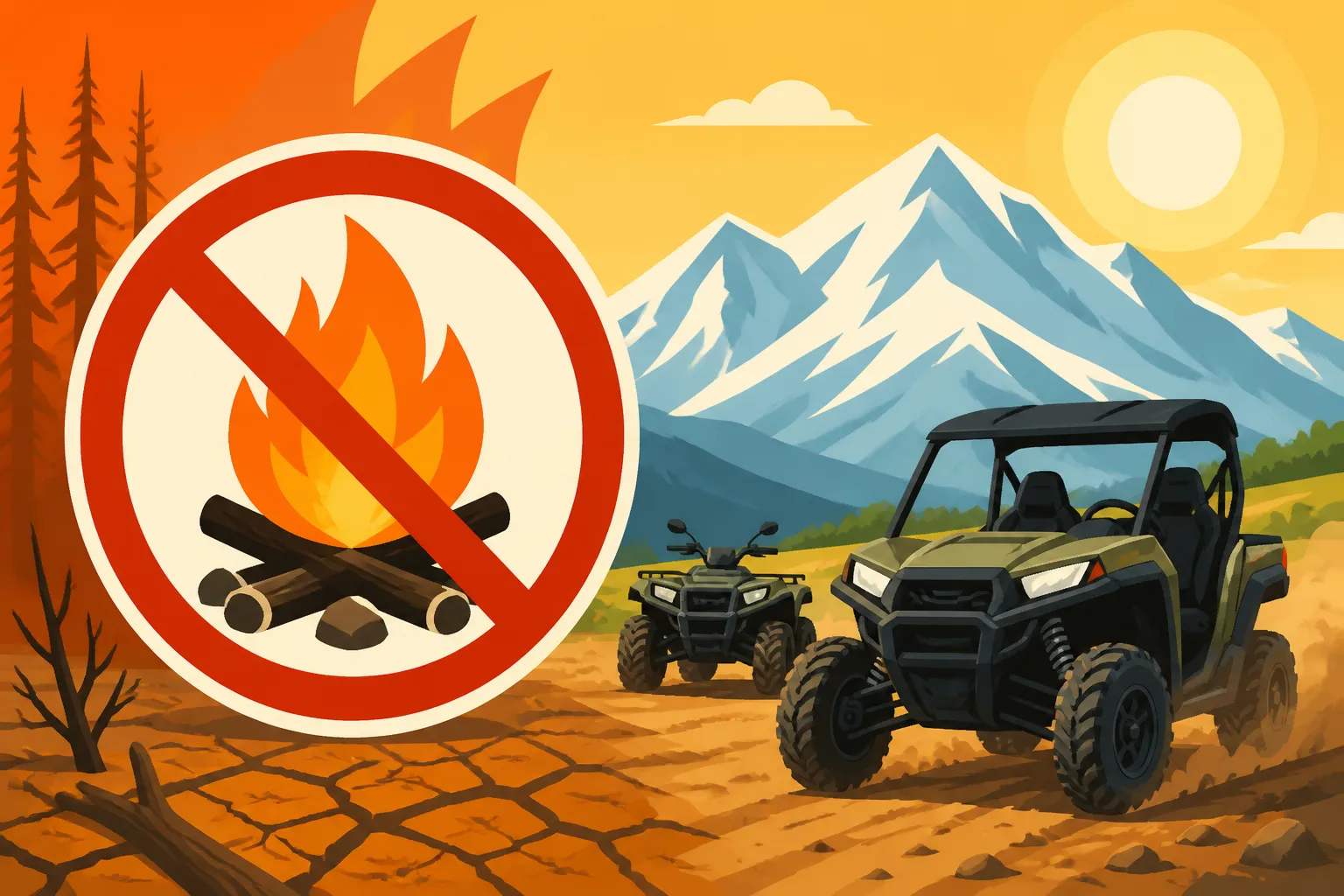
“Fire restriction” does not always mean the same thing. An order may limit campfires or other open flames without closing riding areas. A separate closure may restrict access to a trail, parcel, or larger area because of fire danger or active fire operations. Do not assume that permission to ride means every kind of fire or cooking activity is also allowed.
Restrictions can differ by land manager and location. A route may cross state land, private property, land managed by another agency, or a mix of jurisdictions. The statewide general permit for riding on eligible state land does not replace separate restrictions or grant access to land managed by someone else. For background on where that permit applies, see Alaska’s Statewide General Permit for ATV Use. For a route crossing different parcels, Alaska Land Ownership and Who to Ask and Alaska Land Status Maps can help you identify who to contact.
Depending on the place and the current order, restrictions may address:
- Campfires, charcoal grills, or other open flames
- Smoking or disposing of smoking materials
- Portable stoves and other cooking devices
- Activities or equipment considered likely to start a fire
- Access to a trail, recreation area, or other land
Those are examples, not a universal checklist. The exact terms matter. A restriction may allow some activities while prohibiting others, or it may apply only to a named area. Read the actual notice rather than relying on a social media post, a previous trip, or another rider’s interpretation.
Vehicle access and fire rules are related but distinct. If an area is open to riding, that does not automatically mean a campfire is permitted. If a burn restriction is in place, that does not by itself tell you whether a particular trail is open. Check for both fire notices and access closures before leaving.
Conditions can change during a trip. A notice that was accurate when you planned the ride may be out of date by the time you reach the trailhead. If you encounter a closure sign, barrier, or official instruction, do not ride around it. A marked closure may protect people, firefighters, wildlife, or ground that is especially vulnerable to damage. For more on responding to a closure, see Alaska Penalties for Riding a Closed Area.
How to check restrictions before and during the ride
Start with the authority responsible for the land you plan to use. Look for current fire notices, access restrictions, and closures from the relevant land manager or local fire authority. If your route crosses more than one jurisdiction, check each one. A general permit, trailhead pass, or local access permission is not a substitute for a current fire-status check.
Use a map to work out where the ride goes, but do not treat a map as proof that a route is open. Boundaries may be hard to see on the ground, and temporary restrictions may not appear on a standard trail map. If a route is unclear, contact the land manager and ask specifically about the planned trail, the date of travel, and any cooking or camping activities.
A useful check before departure is:
- Identify the land managers for the trail, staging area, and any planned overnight stop.
- Check current fire restrictions and vehicle closures for each area.
- Read the full wording, including the boundaries, activities covered, and any exceptions.
- Confirm whether the order applies to your machine, your planned route, and any cooking or camping gear.
- Save or note the official contact details and check again before riding if conditions are changing.
If the notice is ambiguous, ask before you go. Be precise: “Is this trail open to ATVs today?” is more useful than asking whether “the area” is open. If you plan to use a stove or camp, ask about that activity separately. Keep a record of the information and when you checked it, but understand that an earlier answer cannot override a later closure or order.
A phone may not have service at the trailhead or along the route. Check notices while you still have a reliable connection, and carry an offline map or other navigation information. If new information reaches you on the ride, pause somewhere safe to verify it. Do not continue into an uncertain area simply because turning around is inconvenient.
| Before the ride | What to confirm | Why it matters |
|---|---|---|
| Route | Which land managers control the trail and nearby ground | One ride may cross several jurisdictions |
| Fire status | Current restrictions on flames, cooking, smoking, or equipment | Restrictions are location-specific and can change |
| Vehicle access | Whether the trail or area is open to ATVs and UTVs | Fire orders and riding closures may be separate |
| Overnight plans | Whether camping and cooking are allowed at the stop | Permission to ride does not automatically cover camp activities |
| Changing conditions | How to check for updates during the trip | A closure may be issued after you leave |
When checking conditions, also consider the ground itself. Dry vegetation, tundra, and wetland areas can be sensitive to travel, and a fire restriction is not the only reason to stay on an authorized route. Alaska Tundra and Wetland Conditions offers related context on why surface conditions matter.
Reduce ignition risks from the machine and camp
No checklist can make a ride risk-free during a dry spell. The goal is to avoid preventable ignition sources, follow every applicable order, and leave early if conditions make the trip unsafe.
Check the machine before departure
Inspect the exhaust area, engine compartment, and underside for dry grass, leaves, mud, or other material that could collect near hot components. Clear away debris before riding and again after a route with tall vegetation. Check that the exhaust system is intact and that the machine is running properly. A damaged or modified system can create additional hazards and may also violate equipment rules.
Spark arresters are an important part of fire prevention on equipment where they are required. Confirm what applies to the machine and the land you plan to ride. Do not assume a stock part is present, working, or suitable just because the machine is commonly used off-road. The related pages Alaska Spark Arrester Requirements and Alaska Spark Arrester Checks explain what to verify.
Also check for loose parts or cargo that could drag, strike rocks, or contact hot components. Secure straps and gear. Keep the machine on the permitted route rather than cutting across dry vegetation to get around a puddle, rut, or blocked section. If your machine overheats, smells unusually hot, or develops an exhaust problem, stop in a safe place and investigate rather than continuing through dry brush.
Treat campfires and cooking equipment as separate decisions
Before bringing any flame-producing device, check the wording of the current restriction. Do not assume a small campfire is allowed because it is contained, or that a stove is allowed because it is portable. The order may distinguish among devices, fuels, or locations, and it may prohibit an activity that is usually permitted.
If the notice is unclear, choose a no-flame meal and skip the fire. If a cooking device is allowed, follow its instructions and the applicable rules, keep it away from dry vegetation, and never leave it unattended. Have a way to extinguish it, and make sure it is fully out before you leave. Do not use a device in a way the manufacturer does not recommend.
Dispose of smoking materials only where permitted and in a way that cannot ignite vegetation. Never flick a cigarette or match from a moving machine or vehicle. Avoid parking over dry grass where a hot exhaust could contact vegetation, and do not leave a running machine unattended near combustible material.
Carry useful safety equipment
A small fire extinguisher suitable for the machine can be useful, but it is not a substitute for obeying a closure or calling for help when a fire grows beyond immediate control. Secure it where the rider can reach it, protect it from damage, and check that it remains serviceable. If you are shopping for one, a marketplace such as Amazon may offer many choices; confirm the extinguisher’s intended use, size, rating, and mounting compatibility rather than selecting by price or appearance alone.
Carry a charged phone or other communication device appropriate to the route, while recognizing that service may be unavailable. Tell someone where you are going and when you expect to return. A fire can spread quickly in dry or windy conditions, so an early report and a clear location can matter. For trips beyond cell coverage, Choosing a Satellite Messenger for a Backcountry Ride may help you plan communication options.
What to do if you see smoke or a fire
If you see smoke, flames, or a new burn area, do not ride closer to investigate. Move away from the fire and smoke, keep other riders together, and avoid routes that could put you between the fire and an exit. Wind can change direction, and smoke can reduce visibility on trails.
Report the fire to the appropriate emergency or fire authority as soon as you can do so safely. Provide the clearest location you can: trail name or area, nearby landmarks, direction of travel, and what you can see. If you are uncertain whether the fire has already been reported, say so. Do not delay reporting while trying to take photos or determine the cause.
If a small fire is immediately accessible and you can act without putting yourself at risk, use the extinguisher only if you know how and have a safe way out. Leave if it does not go out promptly or begins spreading. Do not attempt to fight a wildfire on foot or with an ATV. Your machine is not firefighting equipment, and driving toward a fire can block responders or expose you to heat, smoke, and changing escape routes.
After reporting, follow instructions from responders or land managers. Do not cross a fire line, barrier, or closed route, even if it appears clear. If the area is under active management, firefighters may need the road or trail for access. Check for official updates before returning; the absence of visible smoke does not mean the area has reopened.
A dry summer can also make a route less suitable even without a formal closure. Strong wind, very dry vegetation, poor visibility, or a machine problem that leaves hot components near brush are good reasons to shorten or cancel a ride. Choosing a different location or postponing the trip is often the simplest way to reduce risk. Before setting out, revisit Alaska State Land Riding Explained for the access rules that apply to your route, then check current fire notices and closures directly.
Disclaimer
This article is for general informational purposes only and does not constitute professional advice. Laws, prices and regulations vary by location and change over time. Consult a qualified professional for guidance on your specific situation.