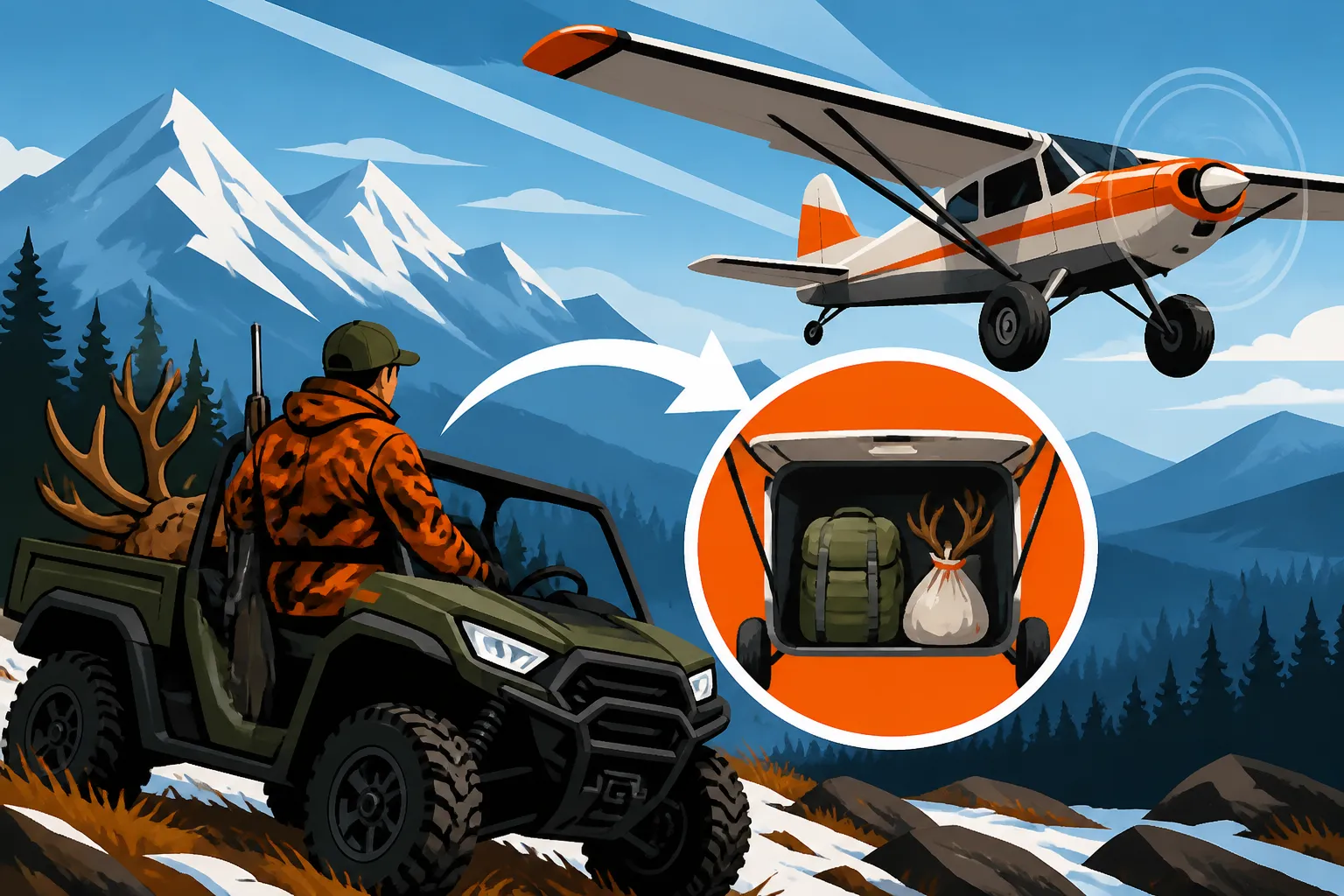
The Same-Day Airborne Rule for Alaska Hunters
Alaska’s same-day airborne rule can disrupt a hunt if you fly in and plan to take big game that day. It is separate from ATV and UTV access rules, but the two can overlap when you use an aircraft to reach a hunting area and a machine to travel on the ground. Knowing what the rule covers—and checking the regulations for your hunt—helps you plan a legal route and schedule.
What Alaska’s same-day airborne rule means
In broad terms, Alaska’s same-day airborne restriction limits taking big game on a day when you have been airborne in an aircraft. The rule is intended to prevent hunters from using aircraft to spot game and then hunt it soon afterward. It is not simply a rule about whether an airplane lands near the hunting area.
The important practical point is that the restriction can apply to the hunter, not just to a pilot who actively looks for animals. If you fly to a community, lodge, or staging area and intend to hunt big game that day, do not assume that the flight is irrelevant because it was for transportation rather than scouting. Check the current hunting regulations and any listed exceptions before making plans.
The rule is separate from rules governing aircraft use, access, and game transport. For example, it is not the same as a restriction on using an aircraft to locate game, nor is it an ATV rule. Review Alaska Hunting Regulations and Machines for the broader relationship between hunting and motorized access.
| Situation | What to consider |
|---|---|
| You fly in and plan to hunt big game the same day | The same-day airborne restriction may prevent you from hunting, unless a specific exception applies. |
| You take a regularly scheduled commercial flight | A specified exception may apply, but confirm the current regulation and its exact wording. |
| You fly in one day and hunt the next | The next-day hunt may avoid the same-day issue, but other hunting and access rules still apply. |
| You use an ATV or UTV after flying | Riding a ground vehicle does not, by itself, remove or override an aircraft-related restriction. |
| You fly after a hunt on the same day | Do not assume the flight is automatically acceptable; check how the current rule applies to your full itinerary. |
The table is a planning aid, not a substitute for the regulation. The wording, exceptions, species covered, and applicable area are what determine whether a particular trip is legal. If the plan depends on an exception, confirm it before booking a flight or starting the hunt.
The rule is about timing, not just distance
A common mistake is to focus only on how close a plane comes to the hunting area. The same-day restriction is generally framed around being airborne on the same day as hunting, rather than only around a flight over a particular parcel or a pilot’s direct involvement in spotting game. Do not build a plan around an assumption that a flight “far away” from the hunt cannot count.
The opposite assumption can also create problems: not every flight necessarily has the same treatment. Regulations may set out specific exceptions, including an exception for certain regularly scheduled commercial passenger flights. The exact conditions matter. A charter, private aircraft, air taxi, or other flight should not be treated as equivalent to a commercial flight without checking the applicable text.
If a flight is part of your route, identify the type of flight, the date you will be airborne, and the date you plan to hunt. Then check the regulation that applies to your species and hunt area. If the language is unclear, ask the appropriate wildlife office or a qualified local hunting professional before relying on an interpretation.
Do not confuse hunting with flying or traveling
The rule concerns hunting activity and aircraft use; it does not mean every person who boards a plane is permanently barred from hunting. The timing is central. A hunter may be able to schedule travel on one day and hunt on another, subject to the applicable rule and all other requirements.
Similarly, being on an ATV or UTV after a flight does not change the fact that the hunter was airborne. A ground machine may be a practical way to reach a trail or move through an area where motorized access is allowed, but it does not create an exception to an aircraft restriction. Plan the flight and hunting dates first, then plan the ground route.
How ATV and UTV use fits into a hunting plan
An ATV or UTV can help with access, but permission to hunt does not automatically mean permission to ride anywhere. Land ownership, land manager rules, local closures, seasonal conditions, and hunt-specific regulations can all limit where and how a machine may be used. A route that appears open on a map may cross land with different rules or require permission.
Start by separating three questions:
- May you hunt the area? Check the current hunting regulations for the species, hunt area, season, and any special conditions.
- May you travel there by ATV or UTV? Check the land manager’s motorized-use rules and confirm the route is open to your machine.
- May you use the machine to move people, equipment, or harvested game? Check the rules for the specific area and the applicable game-transport restrictions.
These questions are related, but one answer does not settle the others. A hunting license or permit is not a general authorization to ride across private, restricted, or closed land. For background on access, see Alaska Hunting Access by Machine and Hunting Regulations That Limit Machines.
The Alaska statewide general permit for ATV use is also not a universal pass for every parcel or land type. It applies only where its terms allow, and it does not replace permissions or restrictions set by other landowners and managers. Before relying on it for a hunt, check Alaska’s Statewide General Permit for ATV Use and confirm who manages the ground you intend to cross.
Plan the route and the harvest separately
A machine may be allowed on a route for access but restricted for transporting harvested game. Conversely, rules may permit a particular kind of game transport while limiting travel elsewhere. This is why a single question such as “Can I take my quad hunting?” is not enough to plan the trip.
Check the route from the staging point to the hunting area, including crossings, trails, and any land boundaries. Then look separately at whether the machine can carry a hunter, gear, or harvested meat in that area. For more on that distinction, read Alaska Game Transport by Machine and Transporting Meat by Machine.
Avoid assuming that an existing trail is open simply because it is visible or commonly used. Its status may depend on the managing agency, season, ground conditions, or a temporary closure. If the route crosses land owned or managed by someone else, verify permission with the appropriate party; Alaska Land Ownership and Who to Ask explains why confirming land status matters.
Keep the aircraft restriction in view throughout the itinerary
A mixed trip can have several stages: a flight to a remote community, a ground transfer, an ATV ride, and a hunt. Write down each stage and its date. That makes it easier to notice whether your hunting day coincides with being airborne and whether a claimed exception truly fits.
Do not treat an ATV ride as a reset between flying and hunting. A flight followed by a long ground journey may still raise the same-day issue if you hunt that day. Nor should you assume that leaving the aircraft behind, switching vehicles, or changing locations makes the timing restriction disappear.
If weather or a schedule change alters your flight date, reassess the hunt before proceeding. A delayed flight can turn a plan that was legal on paper into one that falls within the same-day restriction. The safest option is to preserve a full day between a non-exempt flight and a big-game hunt when your itinerary allows, while still checking the exact current regulation.
A practical pre-trip checklist
Use this checklist before committing to flights, rentals, or a hunt schedule:
- Identify the hunt. Confirm the species, hunt area, season dates, and any permit or harvest conditions in the current regulations.
- List every flight. Note when you will be airborne and whether each flight is scheduled commercial service, charter, private, or another type.
- Check the same-day rule and exceptions. Read the current regulation rather than relying on a general summary or another hunter’s interpretation.
- Set the hunt date around the flight. If your flight may count, consider scheduling the big-game hunt for a later day.
- Confirm ground access. Identify the land manager and verify that your planned ATV or UTV route is open and permitted.
- Check machine and harvest restrictions. Confirm whether the machine may be used for access, carrying equipment, and transporting game in that specific area.
- Recheck after itinerary changes. A moved flight, new route, or unexpected closure can change what is allowed.
Keep the regulations and any relevant permissions accessible during the trip. Carrying the right documents will not make an otherwise prohibited activity legal, but it can help you answer questions about your plans and avoid relying on memory in the field.
For a permit-and-access overview, Alaska Hunting Access by Machine is useful alongside the rules for your exact hunt and route. Treat general information as a starting point; hunt-specific regulations and land-manager directions control the details.
Disclaimer
This article is for general informational purposes only and does not constitute professional advice. Laws, prices and regulations vary by location and change over time. Consult a qualified professional for guidance on your specific situation.